BRICS Delhi Declaration Exposes US Faultlines; Can India Make the Bloc a Bridge?
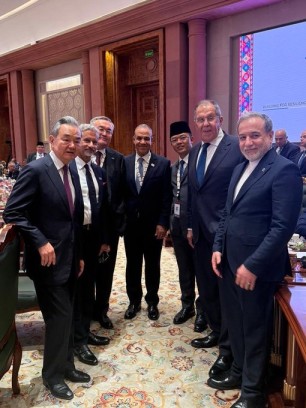
BRICS foreign ministers pose for an informal group photograph during the BRICS Foreign Ministers’ Meeting in New Delhi. (Image Jaishankar on X)
By NIRENDRA DEV
The New Delhi Declaration highlights areas of consensus on terrorism, diplomacy and global governance, while India’s ties with China, Russia, Iran and the West underline its bid to keep BRICS non-Western without making it anti-Western.
New Delhi, September 13, 2026 — India and China are nuclear-armed neighbours sharing a roughly 3,800-km-long, largely unmarked frontier. Yet the broader geopolitical picture is considerably more complicated than the tensions along the Himalayas.
Prime Minister Narendra Modi has adopted a pragmatic and cautious approach to the changing global order. That approach could potentially help position BRICS as a bridge between the West and the developing world, rather than as an explicitly anti-Western bloc.
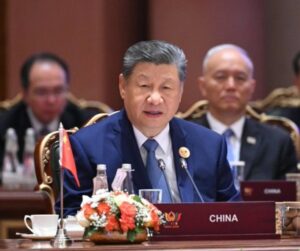
Chinese President Xi Jinping’s arrival for the BRICS Summit and his bilateral meeting with Modi are being viewed as important steps towards reconciliation following the deadly 2020 military clash.
Ties between the two Asian powers have shown signs of improvement, with flights and high-level contacts gradually being restored. China has said it is willing to work with India to properly manage differences and remain “good neighbours and friends”.
New Delhi, for its part, has maintained that peace and tranquillity in the border areas remain essential for the continued development of bilateral relations.
There are, however, substantial hurdles. Both countries continue to maintain significant military deployments in the Himalayas. India and China fought a brief but brutal border war in 1962, while relations deteriorated sharply again after the Galwan clash in 2020.
Ties began recovering towards the end of 2024 after Modi and Xi agreed to work towards ending the military stand-off in the western Himalayas.
BRICS declaration and a diplomatic balancing act
On Saturday, September 12, BRICS members managed to unanimously agree on the wording of the New Delhi Declaration, a significant diplomatic achievement given the divergent interests within the expanded grouping.
For India, the document contained several important elements.
The declaration condemned the Pahalgam terror attack, with China among the signatories. The reference was significant for New Delhi given Beijing’s longstanding strategic relationship with Pakistan.
The declaration also reiterated a commitment to resolving international disputes peacefully through “dialogue, consultation and diplomacy” and backed comprehensive reform of the United Nations, including the Security Council.
The document called for maximum restraint in the Middle East while avoiding direct language that would explicitly target BRICS members involved in regional conflicts.
That is perhaps the essence of the BRICS challenge.
Jiang Shixue of the China-based Council for BRICs Cooperation acknowledged that the 11 members “cannot speak with one voice on many issues”.
Hence, pragmatism becomes essential.
Dialogue and diplomacy, a formulation repeatedly emphasised by New Delhi, may provide the road forward.
Beijing and Delhi, however, have differing views about what BRICS should ultimately become.
China has sought to expand BRICS influence as a counterweight to the United States under Donald Trump, whose policies have included global tariff and trade confrontations and a retreat from several multilateral institutions.
India has taken a more cautious approach.
New Delhi sees BRICS as a potential bridge between the West and the developing world, rather than an instrument for constructing an alternative anti-American order.
Modi made that position clear when he said BRICS was “not against anyone”.
The larger Indian proposition appears to be that the emerging world order should be non-Western without necessarily becoming anti-Western.
That is a difficult diplomatic assignment.
RIC Bond: Modi’s Handshake with Putin, Xi Sends a Powerful BRICS Message
China remains the economic challenge
The political thaw cannot hide the economic contradictions.
China is India’s largest source of imports, with Indian purchases from China rising to about $132 billion in 2025-26. Indian exports to China remain considerably smaller, leaving a trade deficit of more than $100 billion.
Even after military tensions eased, businesses on both sides continue to face regulatory hurdles, visa delays and restrictions affecting the movement and sale of industrial equipment.
For India, therefore, the China relationship requires simultaneous management of security, trade and strategic competition.
That is precisely where BRICS becomes useful.
Russia, Iran and strategic autonomy
India’s relationship with Russia provides another dimension.
New Delhi has navigated the energy crisis linked to the Iran conflict while continuing to engage Moscow, one of its most important strategic partners.
At the same time, India has kept its channels open with Iran.
The Modi government has repeatedly maintained since the beginning of the Russia-Ukraine conflict that India stands for peace and dialogue while avoiding alignment with rival geopolitical camps.
That principle is now informing its stewardship of BRICS.
India’s External Affairs Minister S. Jaishankar’s engagement with Ukraine has also demonstrated that New Delhi does not intend to abandon its relationships with the West merely because it maintains close ties with Moscow.
Ukrainian President Volodymyr Zelenskyy has expressed gratitude for India’s commitment to ending the conflict.
This is the essence of strategic autonomy: engage competing powers without becoming dependent on any one of them.
How US Media Read the New Delhi BRICS Summit: India’s Balancing Act, and a Red Carpet for Tehran
The financial system is the next battleground
The larger geopolitical shift is also increasingly about finance.
The idea of the “weaponisation” of financial systems refers to the use of global financial infrastructure—including dominant currencies, payment systems and financial networks—as instruments of geopolitical pressure.
For countries heavily integrated into Western financial architecture, the possibility of sanctions and secondary sanctions has become a strategic concern.
This explains why the debate around BRICS is moving beyond summit declarations towards payment mechanisms, local currencies, financial institutions and economic resilience.
For India, however, the objective need not be to destroy the existing Western financial system.
It is to ensure that India has alternatives.
BRICS as a bridge, not a bloc
The New Delhi Declaration may ultimately prove significant not because it creates a new geopolitical alliance, but because it demonstrates that countries with sharply different interests can still find common ground.
India has simultaneously strengthened engagement with China and Russia while maintaining partnerships with the United States, European Union, Japan and other Western powers.
That gives New Delhi a unique position within BRICS.
The challenge is to ensure that the grouping remains non-Western but not anti-Western, while giving developing countries greater influence over global institutions, trade, finance and diplomacy.
If India succeeds, BRICS could become something more useful than an alternative to the West.
It could become a bridge between the West and the developing world.
That would be a far more consequential achievement than simply creating another geopolitical bloc.
Follow The Raisina Hills on WhatsApp, Instagram, YouTube, Facebook, and LinkedIn




About The Author