Quad Moves Beyond Security: $85 Million AI Push, Critical Minerals Deals and 2027 Business Forum
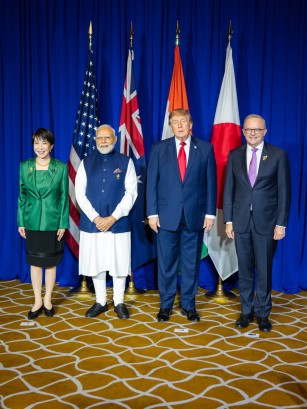
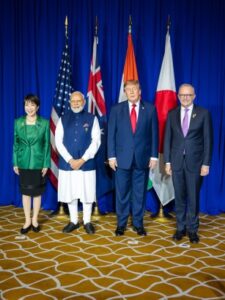
The Quad leaders met in Manila to discuss maritime security, critical minerals, trusted supply chains and emerging technologies. (Image Albanese on X)
By TRH World Desk
The United States, India, Japan and Australia are seeking to turn the Quad into a more practical platform for economic security, trusted technology and Indo-Pacific cooperation, with a new maritime patrol exercise and a business leaders’ forum planned.
New Delhi, November 17, 2026 — US President Donald Trump’s description of Prime Minister Narendra Modi as a “very tough man” added a lighter moment to the Quad leaders’ meeting in Manila on Tuesday. But the meeting’s more significant message was about the future of the four-nation partnership: securing critical mineral supplies, strengthening maritime security and expanding cooperation in artificial intelligence and advanced technologies.
The meeting brought together Trump, Modi, Japanese Prime Minister Sanae Takaichi and Australian Prime Minister Anthony Albanese. It marked the first in-person Quad leaders’ meeting since 2024 and took place against a backdrop of intensifying competition over technology, strategic resources and influence across the Indo-Pacific.
Speaking alongside the other leaders, Trump praised their personal relationships, describing the four countries as some of the world’s most important partnerships. Referring to Modi, he said: “He’s a very tough man, just in case.” He also suggested that Takaichi might be even tougher.
The exchange attracted attention, but the meeting’s substance lay in the announcements that followed.
From maritime security to critical minerals
Modi described the Quad as a “constructive and trusted partnership” for India. In a post on X after the meeting, he said the four countries remained committed to delivering trusted solutions for the Indo-Pacific, covering maritime security, trusted supply chains, emerging technologies and disaster response.
He added that the discussions had given fresh momentum to their shared vision of a free, open, peaceful and prosperous Indo-Pacific, with concrete goals for the next phase of cooperation.
Trump highlighted agreements on critical minerals and rare earths, presenting them as an effort to reduce dependence on dominant global suppliers. He said the United States, India, Japan and Australia had signed several deals to strengthen supply security and expand production.
The significance extends beyond access to raw materials. Rare earths and other critical minerals are essential to advanced manufacturing, electronics, electric vehicles, defence systems and clean-energy technologies. Countries that can secure reliable supplies and processing capacity will have an important advantage in the industries shaping the next phase of economic competition.
The Quad’s approach reflects a growing recognition that economic security and national security are increasingly connected. Supply-chain disruptions, export restrictions and concentrated production can become strategic vulnerabilities.
AI and the contest for technological security
Artificial intelligence emerged as another major area of cooperation. Trump announced a Quad initiative described as a Super Intelligence accelerator and said more than $85 million would be spent to expand access to trusted AI ecosystems across the Indo-Pacific.
The four countries also intend to identify potential chokepoints in semiconductor and AI-related supply chains before they disrupt production or access to essential technologies.
This is an important development because the contest over AI is no longer confined to software or research laboratories. It involves computing infrastructure, advanced chips, energy, data, investment and control over the technologies needed to develop and deploy increasingly capable systems.
For India, participation offers an opportunity to deepen its role in technology partnerships while strengthening domestic capabilities. However, the real test will be whether the initiative leads to access to technology, investment, research collaboration and a stronger position in global supply chains.
A maritime signal and a business push
Analyst Richard Rossow in a post on X highlighted two notable elements of the Quad leaders’ joint press release: a proposed naval exercise involving P-3 and P-8 maritime patrol aircraft, and a Quad Business Leaders Forum planned for early 2027.
The maritime exercise would add an operational dimension to the grouping’s security cooperation. Maritime patrol aircraft are important for surveillance, monitoring sea lanes and improving coordination among partner countries. In a region where shipping routes, territorial disputes and strategic competition intersect, stronger maritime awareness has direct economic and security implications.
The proposed business forum is equally significant. It could bring governments and private companies closer together on critical minerals, advanced manufacturing, technology and investment. The presence of a business platform would help the Quad move beyond diplomatic statements towards commercially viable projects.
The Indian Ministry of External Affairs has also reaffirmed India’s commitment to a constructive and reliable Quad, with Mumbai set to host the inaugural Quad Business Leaders Forum in 2027.
Australian Prime Minister Albanese described the four countries as deeply invested in the peace, stability and security of their region. He said the leaders had met at a critical and challenging time for the world, but that cooperation offered grounds for optimism.
The China question and India’s strategic calculation
Although the Quad presents itself as a partnership for a free and open Indo-Pacific, its growing emphasis on critical minerals, semiconductors and AI supply chains inevitably intersects with competition involving China. The effort to reduce dependence on concentrated sources of strategic materials is particularly important in this context.
Yet the Quad’s credibility will depend on whether it can offer practical alternatives rather than merely frame cooperation around geopolitical rivalry. The partnership must demonstrate that it can deliver reliable supplies, investment, technology access and regional public goods.
For India, this creates both an opportunity and a balancing exercise. New Delhi can benefit from cooperation with Washington, Tokyo and Canberra while retaining its emphasis on strategic autonomy. Its participation does not require it to turn the Quad into a formal military alliance or abandon engagement with other powers.
The summit also paid homage to the legacy of former Japanese Prime Minister Shinzo Abe, whose vision of a free and open Indo-Pacific helped shape the revival of the Quad. The leaders noted that 2026 marks nearly a decade since the grouping was revived and the tenth anniversary of Abe’s articulation of that vision in 2016.
The Manila meeting has therefore given the Quad a wider economic and technological agenda. But announcements and declarations are only the beginning. The proposed maritime exercise, the critical mineral arrangements, the AI accelerator and the 2027 business forum will determine whether the partnership can translate diplomatic convergence into measurable outcomes.
For India, the opportunity is to help shape that agenda while ensuring that the Indo-Pacific remains open, stable and economically connected. The real measure of the Quad will not be the warmth of the leaders’ exchanges, but the practical results their cooperation delivers.
Trump, Xi and Putin’s Power Triangle: Is India Losing Its Strategic Space?
Follow The Raisina Hills on WhatsApp, Instagram, YouTube, Facebook, and LinkedIn




About The Author