Ram Temple Donation Row: Yogi Adityanath’s Biggest Leadership Test
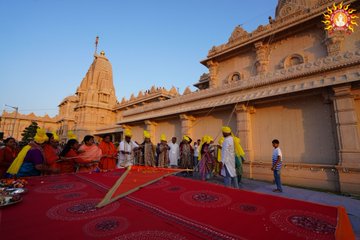
Ram Temple in Ayodhya (image Ram temple trust on X)
By SIDHARTH MISHRA
The allegations over Ram Mandir donations have shifted the debate from politics to governance, placing Uttar Pradesh Chief Minister Yogi Adityanath at the center of a battle to restore faith and institutional credibility.
New Delhi, July 15, 2026 — The Ram Janmabhoomi movement was never merely a political campaign. It was a civilisational assertion, a spiritual awakening and an emotional journey undertaken by millions of Hindus over several generations. For many, the construction of the Ram Mandir in Ayodhya was the culmination of a 500-year struggle. It represented not just the rebuilding of a temple but the restoration of historical memory and cultural pride.
Ironically, barely two years after the consecration of the temple, the movement finds itself facing one of its gravest internal challenges not from ideological opponents or judicial battles, but from allegations of financial irregularities involving devotees’ donations. If there is one leader upon whom history has placed the responsibility of restoring confidence, it is Uttar Pradesh Chief Minister Yogi Adityanath.
For Yogi, this is far more than an administrative crisis. It is both a political test and a spiritual obligation. His association with the Ram Janmabhoomi movement predates his entry into electoral politics. He inherited the ideological legacy of Mahant Avaidyanath, one of the foremost saints who kept the movement alive long before it became the centrepiece of national politics.
Unlike many political leaders who later identified themselves with the movement, Yogi emerged from within the religious tradition that nurtured it. Consequently, any stain on the institution built through that movement inevitably becomes a personal challenge for him.
The controversy has come at a particularly sensitive time. The Bharatiya Janata Party has consciously avoided owning the institutional functioning of the Ram Mandir Trust. Party leaders in Ayodhya have repeatedly maintained that the temple and its Trust function independently and do not include BJP representatives. Yet this constitutional distinction has limited political value.
In public perception, the Ram Mandir, the Ram Janmabhoomi movement and the BJP remain deeply interconnected. It was this movement that transformed the BJP from a marginal political force into the country’s dominant national party. For crores of devotees, separating the temple’s administration from the political movement is an artificial distinction. If faith in one weakens, confidence in the other is inevitably affected. This explains why BJP workers in Ayodhya, as a newspaper reported, despite maintaining public silence, repeatedly invoke only one assurance: “Yogi Ji dekh lenge.”
This confidence in Yagi Adityanath is itself revealing. Reports from Ayodhya suggest that party workers have consciously avoided defending anyone connected with the Trust. Instead, they have chosen to repose their faith entirely in Yogi Adityanath’s ability to uncover the truth and punish those responsible. The expectation is clear: accountability, not political damage control.
The voices emerging from the grassroots are equally significant. Veteran workers who participated in the Ram Janmabhoomi movement during the early 1990s speak nostalgically about carrying consecrated bricks from village to village and mobilising people for what they believed was a sacred national cause. Younger workers recall collecting donations door-to-door, when villagers would entrust them with contributions for Lord Ram’s temple without demanding receipts or guarantees.
That sentiment explains why the issue refuses to die despite the government’s prompt response. To his credit, Yogi Adityanath acted without delay. A Special Investigation Team was constituted, arrests followed and preliminary findings reportedly point towards serious lapses in financial management. Publicly, the Chief Minister appealed for patience, reminding people that those who had fought for centuries for the temple’s reconstruction deserved a few days to investigate allegations of wrongdoing.
Administrative responsiveness, however, is only the first step. The challenge before Yogi is no longer merely to investigate financial irregularities. His larger task is to restore moral legitimacy to an institution that symbolises the faith of millions. Investigations establish facts. Trust will be restored only through visible justice.
The stakes extend well beyond Ayodhya. The BJP is already conscious of the political symbolism surrounding the temple after losing the Ayodhya parliamentary constituency in the 2024 Lok Sabha elections. Party workers openly admit that the defeat left psychological scars. Now, allegations concerning temple donations threaten to create another layer of discomfort before Uttar Pradesh heads towards Assembly elections in 2027 and India prepares for the 2029 Lok Sabha polls.
Opposition parties, particularly the Samajwadi Party, have naturally seized upon the controversy. However, the challenge for the BJP does not come from political attacks. It comes from the silent disappointment of devotees who had regarded the temple as being above ordinary institutional failings.
Fortunately, for the BJP, there remains one important distinction. Public anger is not directed at either Prime Minister Narendra Modi or Chief Minister Yogi Adityanath. Even critics acknowledge the remarkable transformation of Ayodhya under the Uttar Pradesh government. The city today possesses excellent roads, public infrastructure, airports, riverfronts and pilgrim facilities that would have been unimaginable a decade ago.
The criticism is directed at the functioning of the Trust and the management systems within the temple. This gives Yogi Adityanath a rare opportunity.
Instead of treating the controversy as political damage requiring containment, he can transform it into a defining moment in institutional reform. Complete transparency regarding the SIT findings, prosecution of every guilty individual irrespective of status, mandatory independent financial audits, digitised donation management, periodic public disclosures and greater administrative oversight can establish standards unmatched by any major religious institution in the country.
The Ram Mandir should become synonymous not merely with architectural grandeur but with impeccable governance. There is also a deeper philosophical dimension. Lord Ram represents Maryada — the ideal of righteous conduct. The concept of Ram Rajya derives its moral authority not from prosperity alone but from justice, fairness and ethical governance. If the temple dedicated to Lord Ram fails to uphold those very principles in its own administration, it weakens the larger message that the Ram Janmabhoomi movement sought to convey.
History often assigns extraordinary responsibilities to individuals without offering them a choice. Yogi Adityanath did not seek this controversy. Yet destiny has placed upon him the responsibility of ensuring that the movement, which culminated in the construction of the Ram Mandir, is not remembered for allegations of financial impropriety but for its commitment to truth and accountability.
The temple’s magnificent spires have already become symbols of India’s civilisational resurgence. It now falls upon Yogi Adityanath to ensure that the values beneath those spires remain equally unblemished. For millions of devotees, restoring that trust may ultimately prove to be as important as building the temple itself.
(This is an opinion piece. Views expressed are the author’s own.)
Ram Temple Donation Row: A Crisis of Accountability That Has Outgrown a Theft Investigation
Follow The Raisina Hills on WhatsApp, Instagram, YouTube, Facebook, and LinkedIn




About The Author








There has been a demand that govt should not control Mandirs.. but…
This happening now shows, people responsible and managing mandirs, donations received, right utilisation, are not able to maintain transparency, control corruption. It may be happening everywhere.
It shows, people associated with Mandirs are not Enlightened, get trapped in greed, corruption easily…
Mandirs are meant to spread, wisdom, values, larger vision of life, transform, enlighten people.. it is not happening..
Just karm-kand is meaningless, taking us nowhere…
Most of us are just fighting with each other for every little thing, widespread injustice, mistrust, violence, frustrated, indiscipline, corruption, ignorance in a divided society because of decades of votebankpowerpolitics, non-secular religions, other isms still part of secular democracy.. Wonder, how we are still surviving.. democracy is supposed to be best system but it is created such a chaos, aberrations in society… Reflects on Quality of education and training…
People need quality holistic education, the country needs enlightened self actualised Leaders in hundreds of thousands… What are we doing about that…??