Imran Khan, Rajiv Gandhi and the Politics of Power: What He Said in 1996
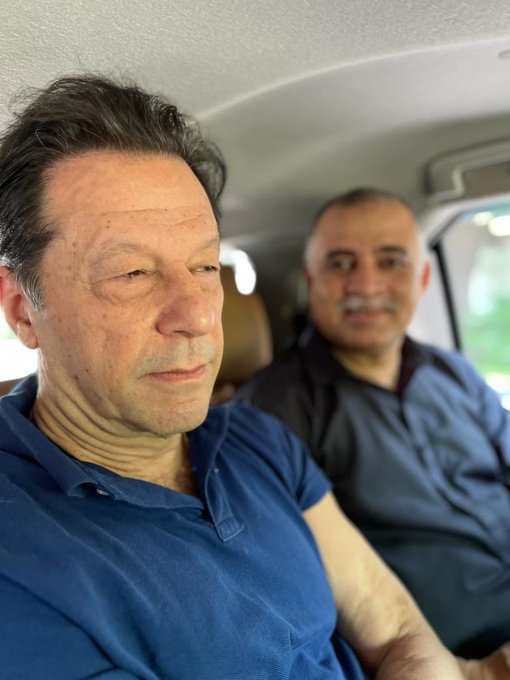
Photo credit Twitter @HamzaAzhrSalam
By NIRENDRA DEV
If history is any example, the tide will surely turn. What did Imran Khan say about Rajiv Gandhi’s ‘clean image’ in 1996?
New Delhi, August 27, 2026 — As Indian cricket fans, we hardly enjoyed Imran Khan’s performances as an all-rounder and captain. Yet, many years later, even some hardcore critics of Pakistan cricket may find themselves having sympathy for the cricket icon-turned-politician, a former prime minister who is now in jail.
In 1996, Imran Khan had just entered politics. At 44, he was embarking on a political career that would eventually take him to Pakistan’s highest elected office.
In an interview with India Today that year, Imran offered a striking assessment of politics: “Politics is considered a dirty business, so it’s not a place you go to get respect. It’s not a place for decent people, and we are in this quagmire because decent people have stayed out.”
Thirty years later, what Imran himself has made of those observations is a matter of history.
But one particular phrase from that 1996 interview stands out: “I know my limitations.”
Given where Imran Khan finds himself in 2026, the words carry an unmistakable irony.
Imran Khan’s early political philosophy
In 1996, India Today asked Imran whether he was willing to risk his reputation and credibility by entering politics.
His answer reflected the confidence of a man who believed he could remain outside politics and enjoy the privileges he had earned. “Personally, what is best for me is to stay out and enjoy myself… I mean, I have all the privileges without any office.”
But he immediately added that life could not be reduced to personal comfort. “We don’t come to this earth to only think about ourselves and our BMWs, our houses and our wives.”
Asked whether running a hospital qualified him to run a country, Imran replied that governance was fundamentally about management.
He said he knew his skills and, crucially, his limitations. His approach, he argued, would be to identify the best talent and put the right people in the right positions.
“The system is more important than an individual,” he said.
His criticism of former prime minister Benazir Bhutto was equally revealing. He argued that she had exceeded her limitations by appointing herself finance minister, something he said he would never do.
Three decades later, that assertion invites a difficult question: what happened to Imran Khan’s understanding of his own limitations?
From military ally to political prisoner
The transformation of Imran Khan’s political fortunes is central to understanding Pakistan’s turbulent political system.
The 2018 elections brought Imran to power amid controversy. At that stage, Pakistan’s powerful military establishment was broadly viewed as an ally of his political rise.
By the 2024 elections, that relationship had dramatically changed.
Despite a severe crackdown, millions voted for candidates backed by Imran’s Pakistan Tehreek-e-Insaf (PTI). The party, which was forced to field candidates as independents, claimed victory while alleging widespread manipulation of the electoral process.
Protests erupted after the elections.
Pakistan’s Supreme Court subsequently ruled that PTI was a political party and held that it was eligible for additional seats in the National Assembly in the post-election dispute.
Yet Imran remained out of power.
And eventually, he found himself in jail.
Iran’s Diplomatic Push Intensifies as Araghchi Works the Phones on Hormuz
Pakistan’s military and the democratic question
For much of Pakistan’s history, the military has exercised enormous influence over politics, with the country experiencing repeated periods of direct military rule.
The last military ruler, Pervez Musharraf, was forced to step down in 2008.
Yet the end of direct military rule did not necessarily mean the end of military influence over the political system.
Former Pakistani Senator Mustafa Nawaz Khokhar, writing in The Guardian, posed the larger question: “The larger question is why the military is allowed to choose who gets to run Pakistan.”
Khokhar argued that political leaders and parties have largely avoided confronting this fundamental issue, reducing politics to a competition for military approval.
The description is particularly relevant to Imran Khan’s journey.
A politician who once benefited from the military establishment’s support ultimately became one of its most prominent political adversaries.
Imran Khan on corruption and power
The 1996 interview also reveals how ambitious Imran’s original political project was.
Asked whether rooting out corruption was really as easy as he suggested, he argued that the power structure had to be challenged by surrounding oneself with clean people.
He said this was one reason he had refused to join existing political parties, arguing that they would have destroyed him politically.
Imran also spoke of strengthening the judiciary and decentralising the bureaucracy.
His political message was therefore not simply about becoming prime minister.
Indeed, when asked about the frenzied calls for him to become prime minister even before he had entered office, Imran reportedly dismissed the importance of the post itself.
He said a person could be a prime minister, a caretaker prime minister or a puppet prime minister. What mattered to him, he argued, were reforms rather than posts.
That distinction now looks particularly poignant.
What did Imran say about Rajiv Gandhi?
Perhaps the most revealing exchange in the 1996 interview came when the journalist Harinder Baweja brought up former Indian prime minister Rajiv Gandhi.
The question was essentially this: Rajiv Gandhi was “Mr Clean” too, but was overtaken by the system.
Imran’s answer was blunt. “That depends on how desperately you need that chair. You always have the option of walking away.”
He added: “I can’t talk about Rajiv but most people enjoy power without being responsible.”
The observation is striking because it was made by a young politician who had yet to experience the full weight of political power.
Three decades later, Imran Khan’s own political career raises precisely the question he posed about others: when does the pursuit of power become more important than the principles with which one entered politics?
The irony of Imran Khan’s political journey
The final irony is perhaps best captured by the assessment in The Guardian. “Now Khan is exactly where his opponents were a few years ago: in jail, waiting for the tide to turn.”
And if Pakistani political history teaches anything, political fortunes can indeed change dramatically.
Those who exercise power today may be out of power tomorrow. Those who are imprisoned can return to politics. Those who appear politically invincible can suddenly become irrelevant.
This has happened repeatedly in Pakistan.
Imran Khan, therefore, is not merely an individual prisoner caught in a political battle. His predicament is also a reflection of the deeper structural problem confronting Pakistan: who ultimately decides who governs the country — voters, political parties or the military establishment?
That question remains unresolved.
Imran Khan entered politics in 1996 promising to challenge a system he described as dirty and dominated by people who had allowed decent citizens to stay away.
He eventually became prime minister.
He also discovered that changing Pakistan’s system was far more difficult than changing its government.
And today, the man who once said “I know my limitations” is himself confronting perhaps the ultimate limitation of Pakistani politics: the power to determine who gets to govern.
Follow The Raisina Hills on WhatsApp, Instagram, YouTube, Facebook, and LinkedIn




About The Author