1984 Anti-Sikh Riots: Survivors Recall the Long Wait for Justice
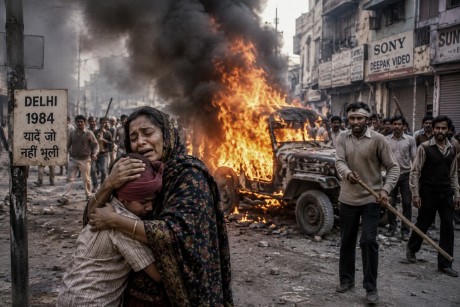
A representational image depicting the chaos and human suffering during the 1984 anti-Sikh riots in Delhi, when thousands of Sikh families were affected by days of violence, arson and displacement following the assassination of Prime Minister Indira Gandhi. (Representational image generated for illustrative purposes. Not an actual photograph from the 1984 riots.)
By BHAWNA MALIK
From Operation Blue Star to the anti-Sikh riots, survivors share stories of loss, courage and the enduring scars left by one of independent India’s darkest chapters.
Chandigarh, June 8, 2026 — Four decades after Operation Blue Star and the anti-Sikh riots, survivors continue to carry memories of loss, displacement and an unfinished search for justice.
June 1984 marked a turning point in independent India’s history when Operation Blue Star was launched inside the Golden Temple complex in Amritsar. The military action aimed to flush out militants but left deep wounds within the Sikh community. The damage to the Akal Takht, the highest seat of Sikh temporal authority, transformed a security operation into an emotional and religious trauma for millions of Sikhs across the world.
The Days That Changed Childhood Forever
Amarjeet Kaur was only 13 when violence engulfed Delhi. “I still remember the mob pounding on our door. Our neighbours risked their own safety to hide us. Our home was looted and later set on fire,” she recalls.
For days, her family moved from one house to another seeking refuge. “The cries of ‘Maaro, maaro, Sikh hain ye’ still echo in my ears. Forty years later, those memories have not faded,” she added.
Every June, Amarjeet begins a Sehaj Path that continues until November in memory of those who lost their lives in 1984.
Amid the violence, stories of courage also emerged. “If our neighbours had not sheltered us, we might not be alive today,” says Amarjeet.
Across Delhi, countless families were saved by neighbours who hid Sikh families in their homes, provided food and helped them escape violent mobs. These acts remain reminders that humanity often survives even in the darkest moments.
Behind Every Statistic Was a Family
According to estimates cited by the Nanavati Commission, 2,733 Sikhs were killed in Delhi between October 31 and November 5, 1984.
Yet numbers fail to capture the true scale of loss.
In Delhi’s Tilak Vihar, commonly known as the “Widows’ Colony,” generations have lived with the consequences of those few days. Women who lost their husbands became sole breadwinners. Children who witnessed killings grew up carrying emotional scars into adulthood.
“We lost not only family members but also our sense of security,” says a resident of Tilak Vihar, adding: “Life was divided into before 1984 and after 1984.”
For elderly survivor Sawarn Singh, the tragedy remains painfully vivid. “The mob dragged my young brother-in-law out. They pulled his hair and burnt him alive before our eyes. Some memories never leave you,” he says, adding: “My sister became a widow at 24.”
The passage of time has not diminished the pain. For many survivors, the struggle for justice became a second battle, stretching across decades.
The Long Shadow of 1984
Gurdeep Kaur, who lost four relatives during the violence, speaks of a wound that never fully healed. “The atrocities we endured in 1984 were no less grievous. We have spent decades waiting for justice and recognition of our suffering.”
For many Sikh families, Operation Blue Star and the riots that followed are not separate events but interconnected chapters of a shared tragedy that reshaped lives forever.
History is often recorded through political decisions, military operations and official reports. Yet its deepest impact is felt through ordinary people whose lives are altered forever. Four decades later, Operation Blue Star and the 1984 anti-Sikh riots remain more than historical events. They are living memories carried by survivors who continue to seek healing, remembrance and justice.
“The buildings were rebuilt and the streets became busy again, but for many of us, 1984 never really ended,” says Amarjeet Kaur. “We learned how fragile peace can be.”
Follow The Raisina Hills on WhatsApp, Instagram, YouTube, Facebook, and LinkedIn




About The Author







It’s a pity since 1984 , no one has squarely blamed the one and only culprit,Congress Party. People who were directly responsible for and the Gandhi family who purposely looked the other way. Every article barring very few have exonerated Congress including this article.