“The Age of Party Democracy Has Passed”: Why a Dead Political Scientist’s 2013 Warning Reads Like Today’s Headlines
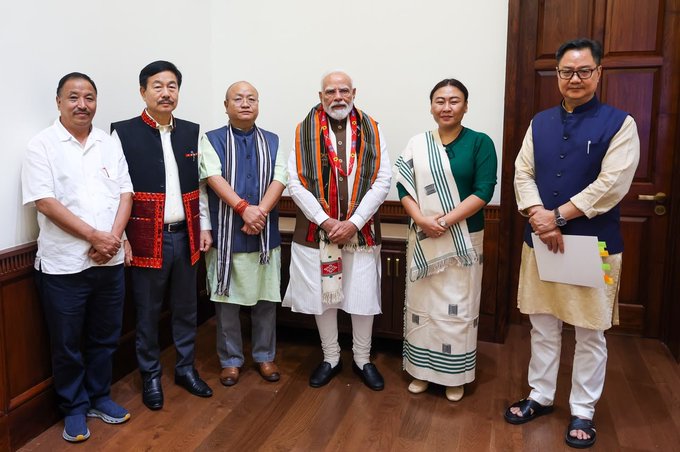
Prime Minister Narendra Modi in a a meeting with MPs from Arunachal Pradesh and Nagaland. (Image Modi on X)
By TRH Political Desk
Peter Mair predicted the hollowing-out of party democracy before Brexit, before Trump, before Modi’s third term. A decade on, from Washington to Kathmandu, the pattern he described is hard to miss.
New Delhi, July 30, 2026 — In 2013, two years after his death, Irish political scientist Peter Mair’s final book landed with a blunt opening line: “the age of party democracy has passed.” Ruling the Void: The Hollowing of Western Democracy argued that Europe’s major parties — once the connective tissue between citizens and the state — had become a self-referential professional class, retreating into government institutions rather than building genuine roots in society. Turnout was falling, party membership was shrinking, and the voters who stayed loyal were doing so with less and less enthusiasm.
Mair’s diagnosis went further than “people are tuning out.” He argued that as elected politicians hollowed out, power was migrating to bodies insulated from electoral accountability altogether — courts, independent regulators, central banks, and, in his sharpest example, the European Union itself. He summed up the resulting model of governance in a phrase that stuck: “judges plus NGOs equals democracy.” Mair wasn’t simply saying people were disengaging from politics — he was saying the entire architecture of representation was being quietly replaced.
Reviewers and political scientists have since debated pieces of that argument — whether party systems really “converged” the way Mair claimed, and whether internal party democracy declined as sharply as he suggested. But the core prediction — that voters would eventually revolt against a depoliticized, managerial style of governance — is the part of the book aging best.
The Personality Turn
If Mair’s void was defined by faceless technocracy, what’s filled it is the opposite: politics organized almost entirely around individual personalities rather than institutional party structures.
The United States offers the clearest case. Donald Trump’s hold over the Republican Party functions less like traditional party leadership and more like a personal movement that absorbed an existing party infrastructure. India’s BJP under Narendra Modi has, similarly, built its electoral machine heavily around Modi’s individual brand and image, more than around competing internal factions or collective party identity. Turkey’s Recep Tayyip Erdoğan has spent two decades consolidating executive power around his own persona, reshaping institutions to fit rather than the reverse.
Europe shows the same pattern from a different angle: personality-driven insurgent parties eating into establishment structures that have existed for generations. In Germany, the AfD — closely identified with figures like Alice Weidel — has pushed ahead of Chancellor Friedrich Merz’s CDU in national polling through much of 2026, with some surveys putting the gap at eight points or more, while the once-dominant SPD has slid to record lows. In France, Marine Le Pen’s National Rally has polled in the mid-30s for the 2027 presidential race even through a criminal conviction and court battle over her eligibility to run — a level of personal brand loyalty that has outlasted the legal process meant to sideline her, while President Emmanuel Macron’s centrist bloc and France’s traditional Socialist and Gaullist parties have been reduced to single-digit also-rans.
Britain may be the starkest illustration of institutional churn. Reform UK, built almost entirely around Nigel Farage, spent much of the past two years leading national polls ahead of both Labour and the Conservatives — a two-party duopoly that has governed Britain for a century. Labour’s Keir Starmer resigned the premiership in mid-2026, handing the job to Andy Burnham, while the Conservatives have been stuck in the high teens alongside a resurgent Green Party and Liberal Democrats. Reform’s own lead has since narrowed sharply amid a personal finance controversy around Farage — itself a reminder that personality-centered parties can unravel as quickly as they rise, since there’s no institutional ballast to fall back on when the individual stumbles.
When the Void Gets Filled Overnight
Two recent episodes outside the West show the same dynamic in a more compressed, explosive form.
In Bangladesh, Sheikh Hasina’s Awami League government — in power for the better part of two decades — collapsed within weeks in mid-2024 under a student-led uprising, with Hasina fleeing the country and an interim administration taking over. The speed of the collapse, after years of what looked like an entrenched, institutionally secure ruling party, is close to a textbook case of Mair’s “void”: a governing structure that had lost its connection to the society it claimed to represent, absent any warning from the formal channels — elections, opinion surveys, party competition — that are supposed to register that kind of discontent.
Nepal’s 2025–2026 upheaval pushed the pattern even further. A Gen Z-led protest movement — organized substantially over Discord — toppled Prime Minister KP Sharma Oli’s government within days in September 2025, replacing it with an interim administration under former Chief Justice Sushila Karki, herself chosen through an online poll rather than a party process. Six months later, national elections handed a landslide majority to the Rastriya Swatantra Party, a four-year-old outfit led by Balendra Shah — a rapper-turned-civil-engineer-turned-Kathmandu-mayor known simply as “Balen” — which won roughly two-thirds of parliamentary seats, all but wiping out Nepal’s two dominant establishment parties, the Nepali Congress and the Communist Party (UML). It is difficult to construct a cleaner real-world test of Mair’s thesis than an entirely new, personality-anchored party replacing a century-old party system inside a single electoral cycle.
The Case for Reading This Differently
None of this is uncontested as evidence for Mair specifically. Some political scientists argue what’s happening is less a “hollowing out” of democracy than a stress-tested reallocation of it — voters using elections, protest, and social media to punish non-performing incumbents just as forcefully as Mair’s thesis predicted they’d stop bothering to do. Others point out that personality-centered movements can also represent renewed, if volatile, political engagement rather than its absence — turnout in several of these contests, including Nepal’s, was high, not the declining participation Mair diagnosed in 1990s and 2000s Western Europe.
What does look consistent across Washington, New Delhi, Ankara, London, Berlin, Paris, Dhaka, and Kathmandu is the erosion of the thing Mair actually built his career studying: the political party as a durable, program-based institution mediating between citizens and the state. Whatever is replacing it — a movement, a individual brand, a Discord server — looks less like the void Mair described and more like something new occupying it. Whether that’s a healthier democracy or merely a faster-moving version of the same disconnection is the argument now being tested, live, on several continents at once.
Follow The Raisina Hills on WhatsApp, Instagram, YouTube, Facebook, and LinkedIn




About The Author