Maulana Azad Was the Original Gen Z Leader: Jairam Ramesh Recalls His Remarkable Legacy
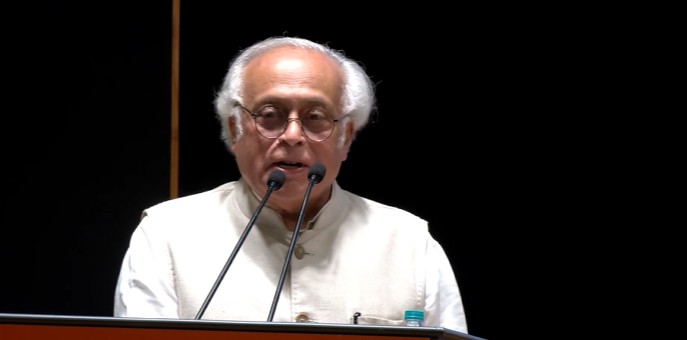
Jairam Ramesh says Maulana Azad was the first Gen Z leader, recalling his role in education, institution-building and secular nationalism. (Image video grab)
By TRH Political Desk
Congress MP says November 11 should be observed as Maulana Azad Jayanti, recalls his partnership with Jawaharlal Nehru, contribution to education and opposition to the idea of a nation based on religion.
New Delhi, November 15, 2026 — Congress MP Jairam Ramesh has called for November 11 to be observed not merely as National Education Day but also as the birth anniversary of Maulana Abul Kalam Azad, urging a renewed engagement with the freedom fighter’s writings, ideas and contribution to nation-building.
Speaking at a function commemorating Azad’s life and legacy, Ramesh said the country should mark his birth anniversary by seriously examining his articles, political thought and role in shaping independent India.
Ramesh highlighted what he described as the remarkable partnership between Azad and India’s first Prime Minister, Jawaharlal Nehru. Born a year apart, Azad in 1888 and Nehru in 1889, the two leaders shared a political vision rooted in secularism, nationalism and institution-building.
Recalling Azad’s early political prominence, Ramesh pointed out that he became Congress president in 1923, at the age of 35, making him one of the youngest leaders to occupy the position. He described Azad as a young political figure whose ideas and leadership were far ahead of his time. “In today’s terminology, Maulana Azad was truly a first Gen Z leader,” said Ramesh.
The Congress MP also drew attention to the years Azad spent in prison during the freedom struggle. He compared his imprisonment with that of other prominent national leaders, including Nehru, Mahatma Gandhi and Sardar Vallabhbhai Patel. According to Ramesh, Azad spent nearly a decade in jail across different periods of detention, underlining the personal sacrifices made by the leaders of the independence movement.
Ramesh also recalled Azad’s contribution as independent India’s first Education Minister, highlighting the foundations laid during his tenure for the country’s academic and cultural institutions.
He referred to the establishment and development of institutions such as the Indian Institutes of Technology, the University Grants Commission, the Sangeet Natak Akademi and the Lalit Kala Akademi. He specifically mentioned IIT Kharagpur, India’s first IIT, and the decision to establish IIT Bombay as part of the institutional framework that helped shape India’s higher education and cultural landscape.
A central theme of Ramesh’s remarks was Azad’s opposition to the idea that religion could serve as the basis for nationhood. He recalled Azad’s belief that a country could not be built around a single religious identity and referred to his warnings about the political consequences of partition.
Ramesh also invoked the subsequent separation of East Pakistan in 1971, which led to the creation of Bangladesh, in the context of Azad’s concerns about the idea of a nation founded on religion.
Azad, who served as Congress president during a crucial period of the freedom movement and later led the Education Ministry from 1947 to 1958, remains an important figure in India’s political and intellectual history.
Ramesh’s appeal to observe November 11 as both Azad’s birth anniversary and a day of reflection on his legacy comes amid continuing debates over the foundations of Indian nationalism, secularism and the role of education in nation-building.
His remarks underline the Congress party’s effort to bring renewed attention to Azad’s political philosophy and institutional legacy, particularly his belief in a plural, inclusive and secular India.
Follow The Raisina Hills on WhatsApp, Instagram, YouTube, Facebook, and LinkedIn




About The Author