Sonia Gandhi’s Italian Childhood: What ‘Bicycle Thieves’ Reveals About Her Journey to India
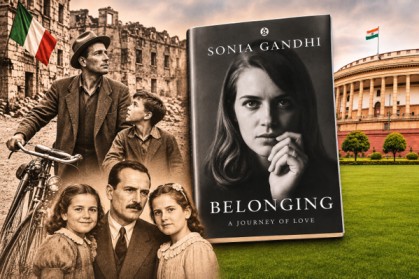
A cinematic, non-text historical composition juxtaposing post-war Italian streets with an old bicycle, evoking the atmosphere of Bicycle Thieves.
By SIDHARTH MISHRA
From post-war Italy and her father’s wartime memories to life in India’s most powerful political family, Sonia Gandhi’s memoir Belonging: A Journey of Love offers a deeply personal account of identity, displacement and resilience.
New Delhi, November 14, 2026 — Reading the opening chapters of Sonia Gandhi’s recently released memoir Belonging: A Journey of Love is an invitation to travel back to an Italy that is seldom remembered in the political narratives surrounding her. It is an Italy recovering from the devastation of the Second World War, where ordinary families struggled to rebuild their lives amid economic hardship, emotional scars and an uncertain future. The experience brings to mind Vittorio De Sica’s celebrated neorealist film Bicycle Thieves, set in the same historical landscape, where the struggle for survival becomes an intensely personal story of dignity, family and human vulnerability.
The connection is more than chronological. It offers an interesting way of understanding the emotional foundations of a woman whose eventual journey would take her thousands of kilometres away from her birthplace, into a country and a political family she could scarcely have imagined as a young girl.
De Sica’s 1948 masterpiece is a deceptively simple story. Antonio Ricci, an unemployed father in post-war Rome, finally finds work putting up advertising posters, only to discover that he needs a bicycle to earn his livelihood. His wife sacrifices the household’s precious linen to redeem the bicycle from the pawnshop. When it is stolen, Antonio’s desperate search through the streets of Rome becomes a struggle to preserve his family’s dignity. The bicycle is not merely a means of transportation; it represents hope, employment and the fragile possibility of a better tomorrow.
What makes the film enduring is its ability to capture the psychological consequences of deprivation. Poverty is not portrayed simply as an absence of money. It is an assault on self-respect, a source of helplessness and a constant reminder of how precariously ordinary lives are balanced.
Sonia Gandhi’s childhood, as recalled in Belonging, unfolds against this larger historical backdrop. Born Sonia Maino in 1946, she grew up in a modest Italian family, in a society still recovering from the consequences of war. Her father, Stefano Maino, had served in the Italian army and experienced the disastrous Russian campaign. The retreat, the privations of military life and the suffering he witnessed left a lasting impression upon him.
The emotional significance of her father’s wartime experience becomes particularly striking in the account of his encounters with two Russian children. According to Sonia’s recollections, Maino, then a young soldier, shared his meagre rations with two hungry Russian sisters and subsequently named his daughters Sonia and Anouchka after them. It is a poignant episode that gives the family story an extraordinary human dimension. The names of his children became a reminder of the humanity he had encountered amid the brutality of war.
Here, the world of Bicycle Thieves and the world of the Maino household seem to converge. Both evoke a generation of men who returned from war carrying memories of defeat, deprivation and disillusionment, yet were required to resume the ordinary responsibilities of life. The battlefield might have been left behind, but its psychological consequences travelled home with them.
For Stefano Maino, the challenge was no longer military survival but the upbringing of a young family. His sternness, anxieties and insistence on discipline can perhaps be read against the background of a man who had experienced circumstances in which control over one’s destiny was painfully limited. The war had taught him the vulnerability of human existence; the post-war years demanded that he construct a stable life out of its uncertainties.
This is where the childhood narrative acquires a significance beyond biography. A young Sonia grew up observing a father whose experiences had made him cautious, traditional and deeply concerned about the future of his family. The values of modesty, loyalty, obedience and respect that she recalls in her Italian upbringing were not merely inherited social conventions. They were also part of a family’s attempt to establish emotional security in a world that had once been violently unsettled.
Such an upbringing may have helped prepare her for the extraordinary displacement that awaited her. When Sonia Maino left Italy for Cambridge, she was stepping beyond the familiar boundaries of a small-town existence. Her relationship with Rajiv Gandhi eventually brought her to India, where she entered an environment radically different from the one in which she had grown up. The language, customs, food, social expectations and sheer scale of the country presented challenges that were not simply those of a young bride adjusting to a new household. They were challenges of belonging.
Her father’s reservations about the marriage and his anxiety about her settling in a distant country acquire an added poignancy when viewed in this context. A man shaped by war and insecurity could hardly have been indifferent to the prospect of his daughter leaving the protective familiarity of home. His insistence that she should retain the freedom to return if she found India unwelcoming was, in its own way, an expression of paternal affection and apprehension.
Yet Sonia chose to remain. The transition from a small Italian town to the household of India’s most powerful political family was not an uncomplicated passage. She had to negotiate a new identity without entirely abandoning the one she had inherited. In the years that followed, the private world she had sought to preserve would repeatedly be disrupted by political upheaval and personal tragedy.
It would be tempting to suggest that the hardships of post-war Italy directly prepared Sonia Gandhi for the turbulence of Indian politics. Such a conclusion would be too simplistic. Childhood experiences do not necessarily determine the course of an individual’s life, nor does adversity automatically produce resilience.
But they can leave behind a vocabulary of emotions through which later experiences are understood. Perhaps the more compelling insight is that Sonia Gandhi’s journey began not in the corridors of power in New Delhi, but in an ordinary Italian family attempting to recover its equilibrium after an extraordinary historical catastrophe. The experiences of her father, the anxieties of a post-war household and the values of a modest upbringing may have given her an emotional vocabulary for endurance, adjustment and loyalty.
In Bicycle Thieves, Antonio Ricci ends his desperate search without recovering the bicycle. Walking away with his young son, he remains trapped in the uncertainty of poverty. Yet the final image also suggests that human relationships survive even when material hopes collapse.
Sonia Gandhi’s life would unfold very differently. She would cross continents, become part of a remarkable political dynasty and eventually assume responsibilities she could never have anticipated in her youth. But the story of that transformation becomes more intelligible when one pauses at its beginning.
The Italy of Bicycle Thieves was not merely a geographical setting or a historical backdrop. It was a world in which ordinary people learnt to live with uncertainty, preserve dignity and carry the burdens of the past into an uncertain future.
Perhaps that is the most revealing way of approaching Belonging: as the story of a woman whose extraordinary public journey began in the intimate, unremarkable world of an ordinary family, where the lessons of survival were learnt long before the demands of political leadership arrived.
And in that sense, the distance between post-war Italy and contemporary India is not as immense as geography might suggest. Both journeys begin with the same fundamental human question: how does one find a home, preserve one’s identity and continue to live with dignity when circumstances demand that life be remade?
How WhatsApp, YouTube and X Are Changing Indian Politics Beyond Election Day
Follow The Raisina Hills on WhatsApp, Instagram, YouTube, Facebook, and LinkedIn




About The Author