Sonia Gandhi’s ‘Belonging’ Reopens Congress’s Nationalism Debate, Puts BJP on the Defensive
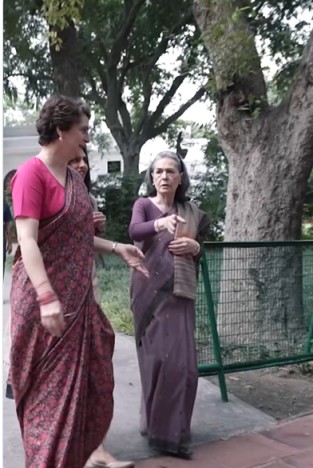
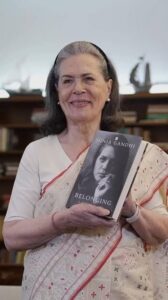
Sonia Gandhi’s memoir has reopened debate over the Gandhi family’s political legacy and the Congress’s place in India’s nationalism narrative. (Image video grab)
By TRH Op-Ed Desk
Political analyst Manish Anand argues that the former Congress president’s memoir seeks to revive the party’s emotional connection with voters by revisiting the sacrifices, personal losses and political legacy of the Gandhi family.
New Delhi, November 11, 2026 — Sonia Gandhi’s memoir, Belonging: A Journey of Love, has reopened a political debate that goes beyond the personal story of the Nehru-Gandhi family. By revisiting the assassinations of Indira Gandhi and Rajiv Gandhi, Sonia’s decision to decline the prime minister’s post in 2004 and her own journey from Italy to Indian public life, the book has brought questions of nationalism, sacrifice and political identity back into the Congress-BJP contest.
In a political analysis for The Raisina Hills, Manish Anand argues that the memoir could help the Congress challenge one of the BJP’s most persistent political narratives: the portrayal of the Congress and the Gandhi family as insufficiently connected to Indian nationalism.
“Does Sonia Gandhi’s book give the Congress a new lease of life?” Anand asks, framing the question around the political impact of the memoir rather than its literary merits.
Published on November 10, Belonging: A Journey of Love is a 544-page account of Sonia Gandhi’s personal experiences and decades in India. It revisits family tragedies, major political events and the circumstances that drew her into public life. \
The 2004 decision and the politics of sacrifice
Anand identifies Sonia Gandhi’s decision not to become prime minister after the Congress-led United Progressive Alliance won the 2004 general election as an important part of her political legacy.
Instead of taking the top post, she proposed Manmohan Singh for the position. The decision helped establish an image of personal sacrifice around her leadership, Anand argues, and allowed the Congress to retain political authority while Singh headed the government.
The UPA subsequently won a second term in 2009, defeating the BJP-led opposition under L.K. Advani. For Anand, this period demonstrated that Sonia Gandhi’s political influence did not depend on occupying the prime minister’s office.
He argues that the memoir brings this political memory back into public discussion, at a time when the Congress is attempting to rebuild its political identity and reconnect with voters.
Indira and Rajiv Gandhi: Bringing personal loss into political memory
The book’s treatment of the assassinations of Indira Gandhi in 1984 and Rajiv Gandhi in 1991 forms another central part of Anand’s argument.
He says the memoir reminds readers of the personal losses suffered by the Gandhi family and places those tragedies within the broader history of modern India. The deaths of two former prime ministers remain defining events in the country’s political history.
Sonia Gandhi also revisits the withdrawal of Rajiv Gandhi’s Special Protection Group security cover by the V.P. Singh government before his assassination. Her account questions the decision and argues that the continuation of the protection could have made a difference. This is her assessment of a deeply contested security episode.
According to Anand, recalling these events challenges the political image of the Gandhi family as an insulated political elite, an image he associates with criticism from Prime Minister Narendra Modi and the BJP.
He argues that the memoir seeks to place the family’s personal sacrifices and public service at the centre of the debate over nationalism.
Can the memoir restore Congress’s emotional connection?
Anand’s larger argument concerns the importance of emotional connection in Indian politics. He points to the political appeal once enjoyed by Indira Gandhi and Rajiv Gandhi, and argues that the Congress has struggled to recreate that connection with a new generation of voters.
He acknowledges Rahul Gandhi’s efforts, including the Bharat Jodo Yatra and his interventions on a range of political issues, but contends that the party has yet to fully recover the emotional bond associated with earlier generations of its leadership.
In his assessment, Sonia Gandhi’s memoir could help address that gap by presenting the family’s history through personal experiences of love, loss, duty and belonging.
Her account of making India her home also brings her identity and relationship with the country into focus. Anand argues that this narrative challenges repeated political criticism of her foreign origins and reinforces the message that her political and personal life became deeply intertwined with India.
The BJP, however, has disputed the memoir’s account of several historical episodes. Its criticism includes Sonia Gandhi’s treatment of the Emergency and the 1984 anti-Sikh violence. The party has accused the book of glossing over historical wrongs, while Congress leaders have rejected the criticism. The response illustrates how the memoir has become part of an ongoing political contest over competing interpretations of India’s history.
Whether the book translates into a lasting political revival for the Congress remains an open question. A memoir can influence public debate, but rebuilding political support requires sustained organisation, leadership and engagement with voters.
For Anand, however, Belonging has reopened an important argument: the Congress cannot be dismissed from debates on nationalism and sacrifice without confronting the history of the family that has shaped much of its modern political journey.
Follow The Raisina Hills on WhatsApp, Instagram, YouTube, Facebook, and LinkedIn




About The Author