How WhatsApp, YouTube and X Are Changing Indian Politics Beyond Election Day
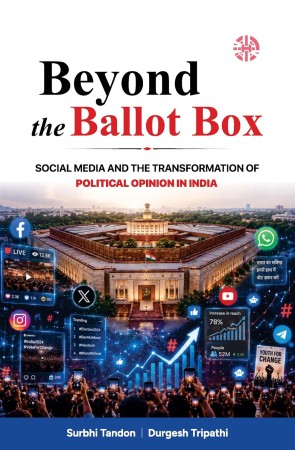
Beyond the Ballot Box by Surbhi Tandon and Durgesh Tripathi (image: Book cover)
By SIDHARTH MISHRA
Surbhi Tandon and Durgesh Tripathi’s new book examines how social media, data-driven campaigns and digital propaganda are reshaping voter behaviour and political discourse in India.
New Delhi, September 4, 2026 — In the world’s largest democracy, the traditional arena of political campaigning, marked by massive physical rallies, paper flyers, local street plays and door-to-door canvas drives, has been permanently augmented, if not largely surpassed, by digital infrastructure.
In the book, Beyond the Ballot Box: Social Media and the Transformation of Political Opinion in India, authors Dr Surbhi Tandon and Prof (Dr) Durgesh Tripathi deliver an incisive, timely examination of how online platforms have fundamentally reconfigured public discourse, voter behavior and campaign strategies across India. Published by HP Hamilton, UK, this work provides a comprehensive analysis of the intersection between digital communication technologies and democratic processes in a nation boasting hundreds of millions of internet users.
The volume moves methodically beyond simplistic narratives that view social media as either a purely democratic equalizer or a purely destructive engine of polarization. Instead, Tandon and Tripathi unpack the nuanced, multi-layered reality of India’s digital public sphere.
The book explores how social networks like WhatsApp, X (formerly Twitter), Facebook, and YouTube have democratized content creation while simultaneously enabling hyper-targeted political propaganda. The authors detail the transition from macro-level national broadcasts to micro-targeted messaging, showing how political parties leverage data analytics and localized communication cells to tailor messages down to the booth level.
A key strength of the text is its focus on the dual nature of social media engagement. While Digital platforms have lowered the bar for entry, allowing historical margins, regional actors, youth movements, and civic activists to bypass legacy media gatekeepers and shape national conversations directly, the authors analyze how platform algorithms reward sensationalism and emotional resonance, fostering echo chambers where confirmation bias thrives, misinformation spreads rapidly, and political discourse becomes increasingly tribal.
Book Review: ‘Fear and Fury’ Connects 1984 Shooting to Trump
Traditionally, political opinion formation peaked during active election cycles. Tandon and Tripathi demonstrate how social media has engineered a state of perpetual campaigning. Political opinion is no longer merely expressed “at the ballot box” once every five years; it is continuously performative, negotiated daily through trending hashtags, viral memes, short-form video content, and online political commentary.
Tandon and Tripathi bring significant academic pedigree in media studies and political communication to this volume. Their framework effectively synthesizes sociological and media theories such as Agenda-Setting Theory, Public Sphere Theory and Network Society Frameworks, and applies them directly to the unique cultural and political context of contemporary India.
The book excels in grounded contextualization. It pays close attention to vernacular internet culture, highlighting how regional language content drives much of India’s social media consumption and political opinion formation outside metro hubs. By investigating multi-lingual digital ecosystems, the authors ensure the text avoids urban-centric biases that often plague technology studies in the Global South.
While Beyond the Ballot Box presents a rich overview, certain areas leave room for further inquiry like Platform Volatility and Policy. Given the rapid shifts in platform governance, content moderation rules, and generative AI tools (such as deepfakes and automated bot networks), static academic analysis risks being outpaced by technological evolution. A deeper dive into synthetic media’s emerging role in voter manipulation would add further weight. Another area to look at is Regulatory Challenges. The text touches upon data privacy and electoral regulations but a more expansive critique of legislative attempts, or failure, to regulate political advertising and online hate speech in India would benefit policy researchers.
Beyond the Ballot Box: Social Media and the Transformation of Political Opinion in India stands out as a vital contribution to contemporary political sociology and media studies. Surbhi Tandon and Durgesh Tripathi have produced a well-structured, rigorous and accessible text that captures the profound paradigm shift in how Indian citizens consume political information and articulate civic identity.
It serves as an essential reference for academics, political strategists, journalists and students seeking to understand how digital networks continue to redefine the mechanics of Indian democracy in the 21st century.
(The author is a senior journalist and media educator)
Book Title: Beyond the Ballot Box: Social Media and the Transformation of Political Opinion in India
Authors: Surbhi Tandon and Durgesh Tripathi
Publisher: HP Hamilton, UK (ISBN: 978-1913936549)
Amazon Link: https://www.amazon.in/Beyond-Ballot-Box-Transformation-Political/dp/1913936546
Premanand Maharaj: Why His Message of Religious Harmony Is Resonating in the Digital Age
Follow The Raisina Hills on WhatsApp, Instagram, YouTube, Facebook, and LinkedIn




About The Author