Premanand Maharaj: Why His Message of Religious Harmony Is Resonating in the Digital Age
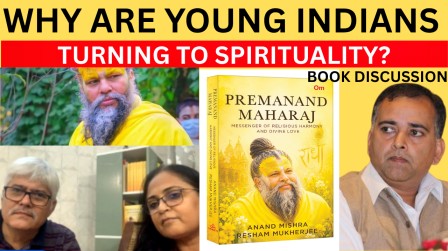
From Kashi to Vrindavan: The Spiritual Journey of Premanand Maharaj (Image TRH)
By TRH News Desk
A discussion with authors Anand Mishra and Resham Mukherjee explores Premanand Maharaj’s journey from Kashi to Vrindavan, his appeal among young professionals and his message of religious harmony, truth and universal love.
NEW DELHI: In an age of social-media outrage, religious polarisation and an increasingly materialistic definition of success, the growing appeal of Premanand Maharaj presents an intriguing question: why are thousands of young people, professionals and people from different religious communities turning towards a spiritual figure whose message is rooted in devotion, self-discipline and universal love?
That question lies at the heart of Premanand Maharaj: Messenger of Religious Harmony and Divine Love, written by journalists Anand Mishra and Resham Mukherjee.
In a discussion with the authors, Manish Anand explored the journey of Premanand Maharaj, his years of austerity in Kashi and Vrindavan, his transition from Shaivism to Vaishnavism, his appeal among young Indians and, significantly, the manner in which his message has travelled across the digital landscape.
The conversation also examined a larger phenomenon: the search for spiritual meaning in a post-COVID world.
From Kashi to Vrindavan: A Journey of Transformation
One of the most striking aspects of Premanand Maharaj’s story is his spiritual journey from Kashi to Vrindavan.
The discussion highlighted how Premanand Maharaj spent years in Kashi, beginning his spiritual journey with a deep devotion to Lord Shiva. His life was marked by extreme austerity and renunciation.
According to the account discussed by the authors, a decisive transformation occurred when he encountered the devotional traditions associated with Chaitanya Mahaprabhu. Initially reluctant to move away from his Shaivite path, he eventually witnessed the performance of Chaitanya’s Leela and was deeply moved by it.
That experience changed the direction of his spiritual journey.
He subsequently developed a strong desire to travel to Vrindavan, eventually making his way there.
For the authors, this transition is more than a biographical detail. It represents the meeting of two major streams of Indian spiritual thought—Shaivism and Vaishnavism.
The discussion suggested that Premanand Maharaj’s appeal lies partly in this ability to bring different traditions together rather than presenting them as competing systems.
As Anand Mishra observed during the discussion, Premanand Maharaj’s spiritual journey can be seen as a movement across different philosophical traditions, ultimately carrying a message of unity.
The discussion referred to his engagement with traditions ranging from Advaita Vedanta and Dvaita Vedanta to Vishishtadvaita and Bhakti.
The underlying message, as articulated in the conversation, is that differences between spiritual traditions need not become barriers to the larger human search for truth.
Vrindavan Beyond a Tourist Destination
The book also places Premanand Maharaj within the larger spiritual history of Vrindavan.
For millions of visitors, Vrindavan is primarily a pilgrimage destination. But the authors’ account attempts to recover the deeper historical and philosophical significance of the town.
The discussion noted Vrindavan’s association with Krishna and Radha, its connection with Chaitanya Mahaprabhu and its long history as a meeting place for saints, spiritual seekers and religious organisations.
Kashi and Vrindavan therefore emerge in the book not merely as geographical locations but as two important centres of Indian spiritual civilisation.
Kashi represents a profound Shaivite tradition, while Vrindavan is closely associated with Krishna bhakti and the devotional traditions surrounding Radha and Krishna.
Premanand Maharaj’s own journey between these two worlds gives the narrative an additional dimension.
Why Are Young Professionals Giving Up Conventional Success?
Perhaps one of the most revealing themes in the discussion was the profile of Premanand Maharaj’s followers.
Resham Mukherjee spoke about young people, particularly those in the 25-35 age bracket, who had apparently been pursuing conventional definitions of success—careers, salaries, urban lifestyles and material comfort—but chose to leave those paths and spend time in Vrindavan.
The authors’ research involved tracing the individual stories of disciples and examining their journeys towards renunciation.
Some had professional backgrounds and promising careers. Yet material success did not necessarily answer their search for meaning.
This challenges a familiar assumption about India’s younger generation: that it is driven exclusively by money, technology, career advancement and consumerism.
The discussion suggested a more complicated reality.
For some young Indians, prosperity can coexist with a profound sense of dissatisfaction or spiritual emptiness.
The search is not necessarily for an escape from modern life. Instead, it may be a search for meaning within it.
“Visit Vrindavan” Versus “Live Vrindavan”
A particularly interesting idea discussed during the conversation was Premanand Maharaj’s distinction between visiting Vrindavan and actually living in Vrindavan.
Millions visit the city for temple darshan, particularly on weekends and during religious occasions. But the spiritual significance of Vrindavan, according to the discussion, lies in immersing oneself in an environment where saints, scholars and spiritual seekers have historically pursued questions concerning the meaning of life.
Anand Mishra connected this phenomenon to a broader crisis of modern existence.
Modern society may have brought unprecedented connectivity, but it has not necessarily eliminated loneliness.
The paradox is striking: people can be surrounded by thousands of others and yet experience profound isolation.
For those seeking an alternative to a purely material understanding of success, spiritual centres such as Vrindavan can provide a different framework for understanding happiness, purpose and inner peace.
A Different Kind of Religious Influencer
The authors also draw a distinction between Premanand Maharaj and the wider phenomenon of spiritual influencers, katha vachaks and self-styled gurus who have flourished in the digital era.
Mukherjee pointed to Premanand Maharaj’s criticism of blind belief and orthodoxy as one of the characteristics that distinguishes him.
The discussion also highlighted a notable feature of his interaction with seekers: according to the authors, when someone approaches him looking for a guru, he does not necessarily position himself as the answer.
Instead, he encourages the seeker to find the right spiritual guide.
That approach, the authors argue, forms part of what makes his message different.
The distinction becomes especially relevant in an era in which spiritual messaging can sometimes be packaged as instant solutions to personal problems.
Premanand Maharaj’s discourse, as described in the discussion, is less about promising quick miracles and more about discipline, devotion, truth and self-realisation.
Religion Without Hatred
Perhaps the strongest theme emerging from the book and the conversation is religious harmony.
The authors emphasised Premanand Maharaj’s appeal beyond a single community and discussed his following among people from different religious backgrounds, including Sikhs and Muslims.
The larger argument is that religious faith does not necessarily have to produce hostility towards those who follow another tradition.
Instead, spirituality can become a language of universal love.
This is particularly significant in a time when religious identity is frequently discussed through the prism of political conflict.
The discussion argued that Premanand Maharaj’s message is not centred on attacking another community or establishing the superiority of one faith over another.
Rather, it focuses on devotion, spiritual discipline and the search for truth.
That makes the book relevant not only as a biography but also as an exploration of India’s plural spiritual traditions.
Why Premanand Maharaj Matters in the Digital Age
Premanand Maharaj’s rise also demonstrates an unexpected relationship between technology and spirituality.
The digital world is often criticised for shortening attention spans and encouraging superficial engagement. Yet YouTube, Instagram and other social platforms have simultaneously allowed spiritual teachers to reach audiences far beyond their physical locations.
Anand Mishra acknowledged the role played by social media in his own research for the book.
Premanand Maharaj’s daily interactions and discourses are now accessible to audiences who may never have travelled to Vrindavan.
The discussion noted that his audience cuts across generations—from teenagers and young adults to middle-aged and elderly followers.
Professionals, including doctors, lawyers, professors and members of the armed forces, were among the categories mentioned in the conversation.
This suggests that spiritual curiosity cannot simply be reduced to a lack of formal education or economic opportunity.
The Post-COVID Search for Meaning
The authors also connected the renewed interest in spirituality with the experience of the COVID-19 pandemic.
The pandemic confronted millions with mortality in an unusually direct way. Families experienced loss, uncertainty and isolation. For many, the experience raised questions that ordinary professional and material life could not easily answer.
Mukherjee argued that this encounter with mortality may have encouraged people to look inward.
Spirituality, in this interpretation, becomes a means of developing inner strength and accepting the impermanence of life.
The post-COVID period has therefore produced not merely an economic or social recovery but also, for some people, a search for meaning.
Religion as a Way of Life, Not Escape
The discussion also challenged the idea that becoming spiritual requires abandoning one’s profession, family or responsibilities.
The message emerging from the conversation was almost the opposite.
A person can continue working, maintain family responsibilities and participate fully in professional life while pursuing spiritual development.
The essential question is not whether someone has withdrawn from society but whether that person’s inner life is becoming more peaceful, disciplined and compassionate.
Universal love was repeatedly emphasised as a central measure.
The discussion invoked the broader spiritual principle that religious progress should be reflected in a reduction of inner stress and an increase in love for others.
Why This Book Is Timely
Premanand Maharaj: Messenger of Religious Harmony and Divine Love arrives at an interesting moment.
India’s spiritual landscape is simultaneously traditional and digital. Ancient pilgrimage centres coexist with YouTube channels, Instagram clips and viral spiritual discourses.
Premanand Maharaj sits at this intersection.
His story begins with austerity in Kashi and continues through the devotional culture of Vrindavan, but his message now reaches audiences through smartphones and social-media platforms.
That journey—from ancient ghats to digital screens—is perhaps one of the most fascinating dimensions of the story.
The book’s larger proposition is that spirituality need not be understood through the narrow lens of sectarian identity.
It can instead be understood through the search for truth, inner peace and universal love.
For readers interested in Indian spirituality, the history of Kashi and Vrindavan, the changing aspirations of India’s youth or the intersection of religion and digital media, the book offers a window into a phenomenon that is much larger than one individual saint.
At its core is a simple but powerful question: in an increasingly connected world, what are people still searching for within themselves?
The answer, as the discussion around Premanand Maharaj suggests, may be meaning, peace and a sense of connection with something larger than material success.
(The full YouTube discussion is shared above.)
Follow The Raisina Hills on WhatsApp, Instagram, YouTube, Facebook, and LinkedIn




About The Author