Chirag Paswan Takes Aim at Jitan Ram Manjhi Over Dalit Quota Classification
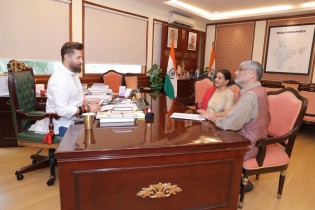
Union Minister Chirag Paswan with a former FCI official in New Delhi. (Office of Paswan on X)
By AMIT KUMAR
Union Minister Chirag Paswan opposed sub-classification and creamy-layer criteria for SC/ST reservation, arguing that Dalit quota is rooted in social discrimination and that internal divisions could weaken the fight for social justice.
Patna, August 29, 2026 — Union Minister and Lok Janshakti Party (Ram Vilas) chief Chirag Paswan has stepped up his opposition to the classification of Scheduled Caste quotas, taking a direct swipe at Union Minister Jitan Ram Manjhi and arguing that dividing the Dalit community could weaken the broader fight for social justice.
Speaking on the continuing debate over reservation, Paswan said the constitutional basis of reservation for Scheduled Castes and Scheduled Tribes was rooted in social discrimination rather than economic deprivation. He questioned the demand for introducing economic criteria, including the creamy-layer concept, into SC/ST reservation.
Paswan’s remarks came while responding to questions about the position taken by leaders supporting sub-classification within the Scheduled Caste quota. He was speaking to reporters in Patna on Saturday.
Taking direct aim at Manjhi, Paswan asked whether those demanding the application of the creamy-layer concept to SC/ST reservation were themselves prepared to give up the benefits of reservation.
“If creamy layer is to be applied, then you also come under it,” Paswan said, referring to Manjhi and his son.
He argued that the debate should not become an exercise in dividing the Dalit community.
Paswan said the question was not merely about reservation benefits but about whether social discrimination had actually disappeared from Indian society.
He cited examples of discrimination against Dalits, including restrictions on temple entry, participation in wedding processions and other social practices, to argue that the social basis for reservation remained relevant.
‘Reservation is based on social discrimination’
Paswan strongly rejected the argument that SC/ST reservation should be examined primarily through an economic lens.
He said that if the constitutional basis of reservation was to be changed, the matter should be debated openly in Parliament.
His argument was that reservation for Scheduled Castes and Scheduled Tribes was created in response to historical and continuing social discrimination and could not simply be converted into an economic-benefit scheme.
The LJP (Ram Vilas) chief also questioned the political parties that now highlight incidents of caste discrimination, pointing out that Congress governments ruled India for several decades after Independence.
Paswan said the persistence of discrimination showed that merely blaming one another would not solve the problem.
Reservation Policy Has Become “Dynastic,” Says Political Analyst, Calling for Overdue Review
‘Don’t divide Dalit society’
The most significant part of Paswan’s remarks was his opposition to dividing Scheduled Castes into separate categories for reservation benefits.
He argued that Dalit unity remained a source of political and social strength, particularly for economically weaker sections that continue to face discrimination in rural India.
Referring to Bihar, Paswan said the Scheduled Caste community comprises 22 castes and argued that their collective strength would be weakened if the community were divided into Dalit and Mahadalit or further sub-categories.
He recalled opposition to earlier attempts at creating such divisions in Bihar.
According to Paswan, the beneficiaries of social justice could ultimately suffer if political competition over reservation results in fragmentation within the community.
‘Will discrimination disappear with economic progress?’
Paswan’s central argument was that economic advancement does not necessarily eliminate caste-based discrimination.
He referred to instances in which even people holding senior constitutional or public positions have faced alleged social discrimination.
He cited former President Ram Nath Kovind as an example and referred to an incident involving Manjhi himself to argue that economic or political status alone cannot guarantee immunity from caste discrimination.
His argument was that if people from Dalit communities continue to face discrimination despite attaining positions of power, the justification for reservation cannot be reduced simply to income.
The wider Dalit quota debate
The controversy over SC reservation has gained political significance amid the debate over sub-classification and the distribution of reservation benefits among different Scheduled Caste communities.
Supporters of sub-classification argue that some communities within the SC category remain disproportionately disadvantaged and that reservation benefits should reach the most marginalised groups.
Opponents, however, warn that internal classification could fragment Scheduled Caste communities and dilute their collective political bargaining power.
Paswan has positioned himself firmly on the latter side.
His latest remarks indicate that the issue could become an important point of debate within the National Democratic Alliance (NDA), particularly as different allies represent distinct social constituencies.
A political challenge within the NDA
Paswan’s direct criticism of Manjhi is significant because both leaders are part of the NDA but represent different strands of Bihar’s Dalit politics.
Manjhi has advocated greater attention to the most disadvantaged sections within the Scheduled Caste category, while Paswan has repeatedly stressed the importance of maintaining unity within the broader Dalit community.
The disagreement therefore goes beyond an individual political exchange. It reflects a larger debate over the future architecture of affirmative action: whether reservation should remain a unified constitutional category or whether its benefits should be redistributed through greater internal classification.
For Paswan, the answer appears clear.
His message is that social justice should not become another mechanism for dividing the communities that reservation was intended to empower.
Follow The Raisina Hills on WhatsApp, Instagram, YouTube, Facebook, and LinkedIn




About The Author