MMDR Amendment: Why Odisha Fears Losing Control of Its ₹53,000-Crore Mining Revenue
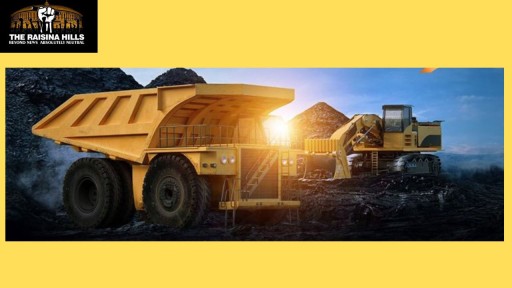
Coal mining in India! (Image Coal India)
By SAHASRANSHU DASH
The MMDR Amendment promises mineral-producing states investment, value addition and industrialisation in exchange for greater central control over mineral taxation. But from the perspective of public economics, the bargain is far less straightforward than it first appears.
Sheffield, the United Kingdom, August 29, 2026 — The debate surrounding the MMDR (Mines and Minerals (Development and Regulation)) Amendment Act has largely been framed as a contest between economic efficiency and state fiscal autonomy. The Union government argues that India’s mining sector is burdened by an increasingly fragmented system of state levies that raises costs, discourages investment and undermines the competitiveness of Indian minerals at a time when the country is seeking to become a major manufacturing and critical-minerals power.
Critics, including the BJD, which governed Odisha for 24 years under former Chief Minister Naveen Patnaik, as well as mineral-producing states more broadly, have argued that greater central control over mineral levies weakens the fiscal autonomy of states. The BJP-led Union government and state governments (including the Mohan Majhi government in Odisha), by contrast, present the amendment as a measure that will expand rather than curtail the role of states in mining. Both sides have a legitimate argument.
The amendment leaves Odisha’s core mining revenues intact, including royalties, auction premiums, DMF (DMF: a fund from mining firms for affected local communities) receipts and other statutory income. The Union government can therefore argue that revenue-sharing remains unchanged, while excessive or unpredictable state levies that deter investment in capital-intensive mining have been removed.
The harder question is why eliminating one distortionary tax should require states to surrender a valuable future fiscal instrument. The amendment transfers fiscal authority immediately, while its promised benefits depend on uncertain investment, industrialisation and future revenues. This asymmetry between certain costs and speculative gains makes the amendment problematic from a public economics perspective.
Moreover, the constitutional stakes remain significant: Justice B.V. Nagarathna’s dissent in the 2024 SAIL judgment argued that Parliament’s power to impose limitations on state taxation of mineral rights under Entry 50, List II gives the MMDR framework unusually broad reach. Odisha’s own Orissa Rural Infrastructure and Socio-Economic Development (ORISED) Act, 2004 shows that this power is not abstract: the state had sought to capture mineral rents through a dedicated levy to finance rural infrastructure and socio-economic development.
Natural-resource rents, fiscal option value and Odisha’s public finances
The weakness of the current debate is that it treats mineral taxation as though it were simply another form of business taxation. Minerals generate location-specific economic rents that can often be taxed with limited efficiency costs. The real question is how those rents should be shared. By shifting bargaining power to the Union, the amendment weakens producing states like Odisha despite their bearing most extraction costs.
Here precision matters. Clearly, Odisha is not fiscally distressed. The Comptroller and Auditor General’s (CAG) latest audited figures for 2024-25 show a revenue surplus of ₹22,651 crore, a fiscal deficit of 2.81% of GSDP, and outstanding liabilities of only 15.48% of GSDP, among the lowest debt burdens of any major Indian state.
The CAG itself describes the state’s overall position as stable and its debt as manageable. But the same report also hints at the other half of the story: revenue receipts grew by only 2.43% in 2024-25, despite nominal GSDP growth of 11.4%. Own-revenue buoyancy fell to just 0.02. Non-tax revenue actually declined, from ₹53,011 crore to ₹51,221 crore.
Revenue expenditure absorbed 87.69% of revenue receipts, leaving a thinning margin. The CAG explicitly warns that weak revenue mobilisation, combined with repayment pressures, could constrain future development and capital expenditure.
Odisha, in other words, has substantial fiscal space but diminishing fiscal buoyancy, a distinction that sharpens, rather than weakens, the argument. Fiscal space is an asset built over time; the question is whether policy should now narrow the very revenue instruments that sustain it.
Modern public finance treats fiscal sustainability not as a snapshot of today’s debt-to-GSDP ratio but as a government’s continuing ability to generate healthy future budget balances as conditions change. How the stock of debt moves depends on the gap between the interest rate the state pays and the rate at which its economy grows, offset by whatever primary surplus it manages to run. What matters for Odisha is not merely whether that arithmetic can be kept under control, but how much say the state retains over the revenue side of it in future.
Two states may share identical debt ratios yet differ in fiscal resilience if one controls more revenue instruments. Odisha’s low debt is therefore not grounds for complacency but an asset (built partly through prudent use of mineral rents) worth protecting.
Odisha’s dependence on mineral revenue
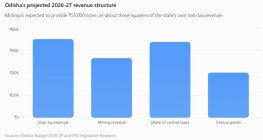
The scale of that dependence is extraordinary, and the state’s own 2026-27 budget makes it visible. Of Odisha’s total projected revenue for the year, own tax revenue and the state’s share of central taxes each form the largest blocks, with central grants providing a smaller supplementary stream.
Sitting alongside these is mining revenue at roughly ₹53,000 crore, a single stream that, on its own, comes close to matching what the state raises through its entire own tax base, and comfortably exceeds what it receives in central grants. Within Odisha’s own non-tax revenue specifically, mining accounts for nearly three-quarters of the total.
This is not a peripheral revenue line, but one of the foundations of the state’s fiscal model, sitting on a par with, rather than beneath, the state’s more conventional and diversified revenue sources.
The amendment does not strip Odisha of this ₹53,000 crore today. What it does is far more consequential over the medium term: it substantially narrows the state’s freedom to design, modify or introduce new mineral-related levies in future. That is a loss of fiscal option value. Fiscal flexibility matters because future governments face unpredictable economic, technological and environmental conditions. By narrowing Odisha’s fiscal instruments, the amendment reduces its capacity to adapt.
Disaster risk raises the value of that lost option further
Odisha’s exposure to this problem is unusually acute because its expenditure risk is highly asymmetric. Cyclones and floods can generate large, unplanned expenditure within weeks, a reality the state continues to face in 2026: the Centre approved an additional ₹500 crore advance from the central share of the State Disaster Response Fund (SDRF) during the August 2026 floods.
Formal disaster-financing mechanisms, the State Disaster Response Fund (SDRF) and the State Disaster Mitigation Fund (SDMF), exist precisely to absorb such shocks. Own-source fiscal capacity remains crucial because disaster spending is uncertain, urgent, lumpy and difficult to postpone. Strong revenues and low debt allow states to absorb such shocks without immediately cutting spending or borrowing.
Mineral revenues therefore provide insurance value, depending not only on their average level but on their behaviour during crises. If mineral revenues weaken while disaster spending rises, pressures compound, making fiscal flexibility especially valuable. Narrowing Odisha’s future fiscal instruments reduces its capacity to manage such correlated shocks.
Why industrialisation cannot automatically compensate for weaker fiscal autonomy
The Union government’s principal response is that Odisha should judge the amendment not by the taxes it loses but by the economic activity it gains. The proposed chain from lower mineral taxation to greater investment, extraction, processing, manufacturing, productivity and state revenue is theoretically plausible and consistent with development economics. The difficulty is that every link requires empirical validation, particularly the final one, because economic growth does not automatically translate into state fiscal capacity.
An aluminium smelter, steel plant or critical-mineral facility may substantially increase Odisha’s output without proportionately increasing state revenues. The resulting surplus may instead accrue as corporate profits, wages, supplier incomes, consumer surplus or Union tax receipts. The relevant comparison is therefore not today’s mining taxes against tomorrow’s GDP, but whether future state revenues generated by this chain, discounted to present value, exceed the fiscal discretion Odisha is surrendering. There is no convincing basis for assuming that they will.
The same caution applies to claims of inevitable value-chain upgrading. Critical Mineral Processing Parks and National Critical Mineral Mission support may encourage processing, but moving from ore to metal is different from developing specialised components, advanced engineering, research-intensive manufacturing and technological innovation. These depend on skills, institutions and industrial networks that mining policy cannot guarantee. Freight infrastructure presents a similar uncertainty. Proposed rail links and freight corridors could reduce transport costs, but their construction, timing and eventual impact remain uncertain.
Even if they materialise, better logistics cannot determine who captures the resulting surplus. Value addition and infrastructure therefore cannot substitute for fiscal autonomy unless a credible mechanism links these uncertain gains to higher state revenue.
Federalism, moral hazard and the economics of intergenerational justice
The implications extend beyond Odisha, exposing a structural tension in Indian fiscal federalism. States bear much of the expenditure on health, education, infrastructure, environmental management, disaster response and social development, while the Union controls most broad and elastic tax bases. The MMDR Amendment shifts further fiscal authority towards the Centre even as local extraction costs, including infrastructure, environmental management, rehabilitation, water and disaster preparedness, remain concentrated in producing states.
This creates a potential moral-hazard problem. If the Union controls mining policy while states absorb associated costs, national policy may prioritise cheaper industrial inputs, strategic mineral security, lower import dependence and manufacturing competitiveness without fully internalising local costs. The amendment therefore risks shifting fiscal and environmental risks from the Union to producing states.
There is also an intergenerational dimension. Minerals are exhaustible natural capital, so their rents should finance durable public assets such as infrastructure, education, health and technological capacity. Odisha’s low debt and substantial public investment suggest mineral revenues have contributed to this process. Yet those rents are also needed to finance diversification that can reduce dependence on mining. Curtailing them before that transition is complete weakens the fiscal foundation of structural transformation.
Even if existing state levies are distortionary, eliminating fiscal discretion is not the only solution. National gains could instead be shared through predictable formula-based transfers, a strengthened DMF, disaster-resilience transfers, environmental compensation or a negotiated state share of incremental mineral rents. Without such mechanisms, the amendment exchanges certain fiscal autonomy for uncertain development gains while shifting more risk towards producing states.
(This is an opinion piece. Views expressed are the author’s own.)
Sijimali Protests Show Why Tribal Consent Cannot Be Reduced to Paperwork
Follow The Raisina Hills on WhatsApp, Instagram, YouTube, Facebook, and LinkedIn




About The Author