Nobel Prize in Economics 2026: How Robert Hall and Michael Woodford Changed Economic Policy
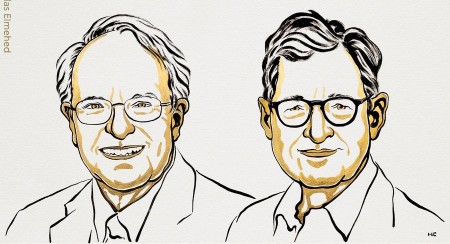
Robert E. Hall and Michael Woodford are recognised for research underpinning modern economic stabilisation models used to guide monetary policy, inflation control and economic growth. (Image Nobel Prize on X)
By PRADEEP KUMAR PANDA
Robert E. Hall and Michael Woodford are recognised for research underpinning modern economic stabilisation models used to guide monetary policy, inflation control and economic growth.
Bhubaneswar, October 13, 2026 — The Royal Swedish Academy of Sciences on Monday awarded the 2026 Sveriges Riksbank Prize in Economic Sciences in Memory of Alfred Nobel to Robert E. Hall of Stanford University and Michael Woodford of Columbia University “for microeconomic foundations of macroeconomic stabilisation.” The pair will share the 12 million Swedish kronor prize equally for research that rebuilt the intellectual scaffolding of modern stabilisation policy after the failures of traditional Keynesian models in the 1970s.
Their work provided the theoretical basis for the New Keynesian models now routinely employed by central banks and finance ministries worldwide. These models enable policymakers to analyse how interest-rate adjustments, fiscal interventions and expectations management can dampen the amplitude of business cycles—smoothing peaks of overheating and troughs of recession—while remaining robust to changes in policy regime.
The Failure of Traditional Keynesian Relationships
Stabilisation policy has roots in John Maynard Keynes’s response to the Great Depression. The core idea remains powerful: aggregate demand does not automatically equal potential output. When demand falls short, unemployment rises and growth slows; when it exceeds capacity, inflation accelerates. Governments and central banks can therefore lean against the wind—cutting rates or raising deficits in downturns, and doing the reverse in booms.
By the postwar decades, this intuition had been operationalised through empirical relationships among macroeconomic aggregates: the Phillips curve linking inflation and unemployment, and consumption functions tying spending tightly to current disposable income. Policymakers treated these statistical regularities as approximately stable and linear, allowing them to calculate the size of the required stimulus or restraint.
The oil-price shocks of the 1970s shattered that confidence. Economies simultaneously experienced high inflation and high unemployment—stagflation—while the previously reliable links between income and consumption, and between slack and inflation, proved unstable. Attempts to stimulate demand often fed inflation without restoring employment. The experience lent force to the Lucas critique: reduced-form correlations among aggregates are not structural. When agents optimise and form expectations, a change in the policy rule alters the very relationships policymakers had been exploiting.
A new framework was required—one that retained Keynes’s recognition of market imperfections and the potential value of stabilisation, yet rested on microeconomic foundations. Decisions of millions of households and firms, rather than assumed constant aggregate correlations, had to generate the observed dynamics. Those agents needed to be forward-looking, reacting to anticipated policy as well as current conditions. Hall and Woodford supplied the decisive building blocks.
Hall’s Consumption Insight
Private consumption constitutes the largest component of aggregate demand in most economies. Understanding its determinants is therefore essential for any stabilisation analysis. Permanent-income and life-cycle theories had long suggested that households smooth consumption over time, basing spending on expected lifetime resources rather than current income alone. Testing and quantifying that idea, however, faced an observational problem: expectations are not directly measured.
In a 1978 paper, Hall inverted the research strategy. If households are rational and forward-looking, current consumption already incorporates all available information about future income and other relevant variables. Changes in consumption should therefore occur only when genuinely new information arrives—and, by definition, new information is unpredictable. Consequently, changes in aggregate consumption should themselves be unpredictable; consumption should follow an approximate random walk (or martingale).
Empirical tests largely confirmed the prediction. Variables that earlier researchers had hoped would forecast consumption growth proved of limited use once current consumption was controlled for. The result was not merely negative; it supplied a natural benchmark. Deviations from pure unpredictability could be interpreted as evidence of liquidity constraints or rule-of-thumb behaviour. In subsequent work with Frederic Mishkin (1982), using household-level panel data, Hall estimated that roughly four-fifths of consumers behaved in a manner consistent with forward-looking optimisation, while the remainder lived “hand-to-mouth,” consuming current income. The proportions vary across countries and over time, but they are measurable and economically consequential: the share of constrained households governs the short-run multiplier of temporary tax cuts or transfers.
Hall’s contribution thus resolved a central identification problem and demonstrated that rigorous, optimising microfoundations could be taken seriously in aggregate data. It shifted the research agenda from searching for better forecasting equations toward estimating the incidence of credit constraints and the elasticity of intertemporal substitution—the sensitivity of consumption growth to the real interest rate. Subsequent empirical work has found that elasticity to be modest, implying that interest-rate changes operate more through other channels than through pure intertemporal substitution in consumption.
Woodford’s Synthesis: The New Keynesian Prototype
Michael Woodford assembled the elements into a coherent, usable macroeconomic laboratory. Drawing on Hall’s consumption theory, earlier work on staggered price setting (Taylor, Calvo, Rotemberg), and monopolistic competition, Woodford developed and synthesised the three-equation New Keynesian model that remains the prototype for quantitative policy analysis.
The first equation is an intertemporal Euler equation for consumption (or, more generally, aggregate demand). Current demand depends on expected future demand and on the gap between the policy interest rate and the natural (or Wicksellian) rate of interest—the rate that would equilibrate saving and investment at flexible prices. Central banks therefore influence real activity by setting the short-term nominal rate relative to this natural rate, rather than by controlling the money stock. This formulation matched the practical evolution of monetary policy toward interest-rate targeting and provided a rigorous foundation for it.
The second equation is a New Keynesian Phillips curve. Firms face costs of adjusting prices and therefore set prices infrequently or only partially. When they do reset, they are forward-looking: the optimal reset price depends on expected future marginal costs and competitors’ prices. Inflation today is consequently a function of expected future inflation and of the current output gap—the difference between actual output and the flexible-price (natural) level of output. The output gap measures demand pressure and replaces earlier, less structural measures of slack.
The third equation is a description of monetary policy—often a simple interest-rate rule of the Taylor type, or the optimal policy derived from a welfare criterion. Because private agents are forward-looking, the entire path of expected future policy rates matters. Credibility and clear communication therefore become central policy instruments. A central bank that can commit to a systematic rule, or credibly signal its reaction function, can shape expectations and thereby influence current inflation and activity at lower cost in terms of interest-rate volatility.
Woodford’s 2003 monograph, Interest and Prices, provided the definitive exposition and extended the framework to optimal policy design under alternative constraints. The model is microfounded, so its parameters are, in principle, invariant to the policy rule—addressing the Lucas critique. It can be estimated or calibrated and used for counterfactual policy experiments. It also readily accommodates fiscal policy: temporary government spending or tax changes affect the output gap and, through the Phillips curve, inflation, with multipliers that depend on the monetary response and on the share of constrained households.
Practical Consequences for Stabilisation
The resulting framework has proven durable across successive shocks. During the Global Financial Crisis and the subsequent zero-lower-bound episode, the model clarified the power of forward guidance—promises about the future path of rates—and of balance-sheet policies that operate through risk premia or liquidity. In the face of energy-price shocks, it distinguishes between cost-push disturbances (which may warrant accommodating some inflation to limit output losses) and demand disturbances (which call for tighter policy). The same apparatus is used to evaluate the interaction of fiscal expansions with monetary policy: when rates are at the effective lower bound, the fiscal multiplier is larger; when the central bank is free to offset demand pressure, the multiplier is smaller.
Because the models are built from optimising behaviour, they also generate welfare criteria. Stabilisation is valuable not merely because volatility is unpleasant, but because sticky prices and monopolistic competition create inefficiencies that fluctuate with the cycle. Optimal policy seeks to minimise a weighted average of inflation variance and the variance of the welfare-relevant output gap.
Hall’s and Woodford’s contributions did not invent every ingredient of the modern synthesis. They built on earlier work by Lucas, Friedman, Modigliani, Taylor, Calvo, Rotemberg and many others. Yet Hall’s consumption characterisation removed a critical obstacle to embedding rational, forward-looking households in aggregate models, while Woodford’s systematic development of the New Keynesian apparatus turned those microfoundations into an operational toolkit for monetary and fiscal authorities.
The result is a paradigm in which stabilisation policy rests on firmer theoretical ground. Peaks and troughs cannot be eliminated—fundamentals still fluctuate—but well-timed and well-communicated interventions can reduce their amplitude. In an era of repeated large shocks, from pandemics to energy disruptions, that capacity remains indispensable. The 2026 prize recognises the intellectual architecture that makes such policy possible.
Indian scientists make strides in quantum entanglement that won Nobel Prize in Physics
Follow The Raisina Hills on WhatsApp, Instagram, YouTube, Facebook, and LinkedIn




About The Author