Modi Blames Corporate India, But His Own Economic Policies May Be Holding Back Investment
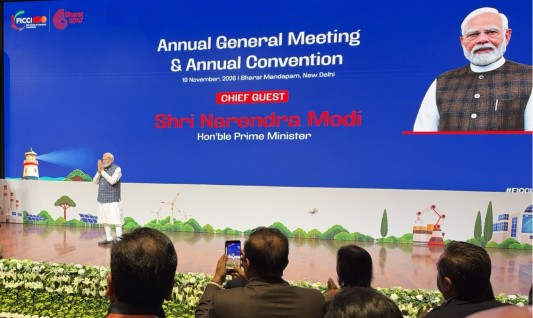
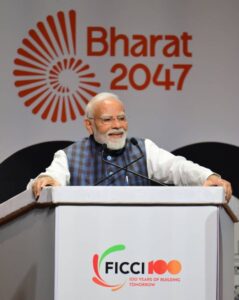
PM Narendra Modi has questioned India Inc. over job creation, salary growth and investment despite corporate tax concessions. (Image FICCI on X)
By TRH Op-Ed Desk
Manish Anand argues that corporate India’s reluctance to invest, create jobs and raise wages cannot be separated from the government’s shift towards populist welfare spending and its failure to strengthen consumer demand.
New Delhi, November 21, 2026 — Prime Minister Narendra Modi has questioned corporate India for failing to create jobs, increase employee salaries and expand investment despite lower corporate taxes. But the reasons behind weak private-sector investment may also lie in the government’s own economic policy choices, argues political analyst Manish Anand in a monologue for The Raisina Hills.
Modi recently expressed disappointment with India Inc., pointing out that corporate tax cuts had not translated into higher wages, employment or investment. Anand said the criticism was justified, as economists have argued for years that tax relief was expected to encourage businesses to expand capacity, invest in research and development and create jobs.
However, Anand said the government must also examine why companies have remained cautious. The disruption caused by Covid-19, followed by a shift in economic policymaking towards welfare schemes and electoral spending, has affected the broader investment environment.
He argued that the Centre’s increasing reliance on free ration schemes, cash transfers and other welfare measures has diverted resources that could otherwise have gone towards infrastructure, public education, healthcare, research and capacity building.
Anand pointed to the political shift around welfare spending since 2022, arguing that the BJP, which had earlier criticised the politics of freebies, increasingly embraced similar schemes to win elections. State governments subsequently followed the same approach, weakening the broader focus on long-term economic development.
According to Anand, weak household incomes, particularly in rural India, have constrained consumption. When consumers lack purchasing power, businesses have little incentive to expand production capacity or make fresh investments.
He argued that corporate investment cannot be viewed in isolation from government policy, public infrastructure, demand and economic direction.
Anand also questioned India’s growing dependence on Chinese goods, arguing that inadequate investment in innovation, research and development and quality infrastructure has weakened domestic competitiveness.
He said Modi’s complaints against corporate India should also be directed at his own government and BJP-ruled states.
The central question, Anand argued, is whether India’s resources will be used primarily to win elections through welfare promises or to build long-term economic capacity, improve public services and create better opportunities for the country’s youth.
Key takeaways
Modi’s corporate complaint: Corporate tax reductions have not translated into sufficient job creation, salary growth or fresh investment.
Investment expectations remain unmet: Tax concessions were expected to boost capacity expansion, innovation and employment.
Demand is the missing link: Weak household purchasing power can discourage companies from expanding production.
Freebies versus productive spending: Welfare and electoral spending have increasingly competed with long-term investment in infrastructure, healthcare, education and R&D.
Private investment follows economic signals: Businesses respond to demand, policy direction and the overall economic environment.
Government accountability: Corporate India cannot be held solely responsible for weak investment without examining the government’s economic priorities.
India’s Growth Story Faces a Household Reality: Inflation, Debt and Shrinking Savings
Follow The Raisina Hills on WhatsApp, Instagram, YouTube, Facebook, and LinkedIn




About The Author