RIC Revival: Can Russia, India and China Shape a Multipolar World Without Becoming a Bloc?
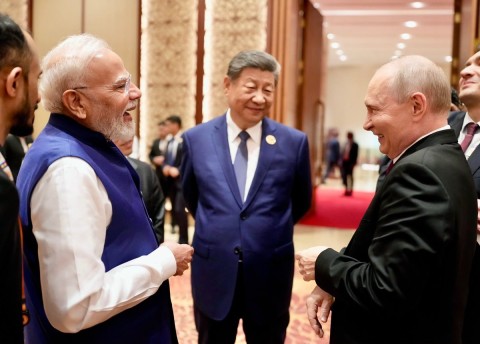
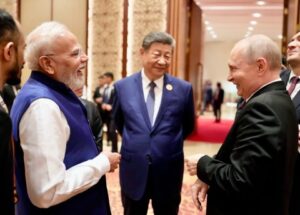
Prime Minister Narendra Modi with Chinese President Xi Jinping and Russian President Vladimir Putin during the BRICS Summit 2026 in New Delhi. (Image Modi on X)
By TRH World Desk
Moscow sees a possible expansion of the great-power conversation from three countries to four, with India emerging as a decisive player. But the RIC framework remains constrained by mistrust, geopolitical rivalries and India’s independent foreign policy.
New Delhi, November 20, 2026 — The latest debate over a changing global order has revived an important diplomatic question: can Russia, India and China once again become a meaningful trilateral force in international affairs, or has geopolitical competition made the RIC framework too difficult to revive?
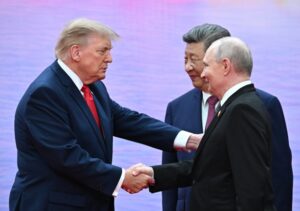
In a column titled A Three-Way Summit, published on November 18, Russian International Affairs Council President Dmitriy Trenin examines the significance of a high-profile meeting involving Russia, China and the United States. His argument goes beyond the immediate diplomatic spectacle, suggesting that the emerging international order is increasingly shaped by a small number of major powers and that India could eventually become an indispensable fourth player in this equation.
Trenin argues that the meeting should not be mistaken for a new Yalta or a blueprint for a tripolar world. The more important development, according to his assessment, is the movement towards multipolarity and the recognition that major powers are increasingly shaping geopolitical, military and economic realities.
His reference to India as a potential member of an expanded great-power grouping is particularly significant. India is not merely an emerging economy seeking a seat at the table. It is a major civilisation-state, a nuclear power, a consequential voice of the Global South and a country increasingly unwilling to let its foreign policy be defined by competing power centres.
RIC: An old diplomatic idea with renewed relevance
The Russia-India-China framework, commonly known as RIC, emerged as a diplomatic platform for engagement among three influential Eurasian powers. The foreign ministers’ dialogue began in 2002, while the first informal leaders’ summit took place in 2006. The framework was envisioned as a forum for discussing international developments, multipolarity, regional stability and cooperation on common challenges.
The three countries have historically shared an interest in reforming global institutions, strengthening the voice of developing countries and preventing international politics from becoming dominated by a single power centre.
However, RIC was never a military alliance or a unified strategic bloc. Its potential rested on dialogue and the ability of three countries with different political systems, interests and ambitions to maintain communication.
The last RIC foreign ministers’ meeting took place in November 2021. While the formal trilateral dialogue has remained dormant, the academic and Track-II channels have continued to provide a platform for exchanges. The 20th RIC Academic Conference held in Beijing on November 18–19, 2025, demonstrated that trilateral engagement has not entirely disappeared.
India’s position makes the equation complicated
India’s participation in any renewed RIC initiative would be driven by strategic interests rather than a desire to join a geopolitical camp. New Delhi maintains close defence and energy ties with Moscow, while its relationship with Beijing remains complicated by border tensions, strategic mistrust and competition across Asia.
At the same time, India has strengthened engagement with the United States, Europe, Japan and Australia through economic, defence, technology and Indo-Pacific cooperation.
This multi-alignment is not necessarily a contradiction. India’s foreign policy has increasingly sought to preserve flexibility, maintain partnerships across competing blocs and secure its own interests in a changing international environment.
RIC could provide India another platform for engaging China directly and Russia diplomatically, but it cannot replace bilateral negotiations or resolve the fundamental differences between New Delhi and Beijing.
From RIC to a wider multipolar conversation
Russia’s interest in strengthening non-Western platforms has grown amid its confrontation with the West. China, meanwhile, seeks a greater role in global governance and international economic institutions. India has its own ambition: to influence the emerging order without becoming subordinate to either Washington, Moscow or Beijing.
The RIC framework could therefore become relevant not as an anti-Western alliance, but as a mechanism for dialogue among powers that do not necessarily share the same worldview.
The challenge is to turn diplomatic meetings into tangible cooperation on trade, energy security, connectivity, terrorism, climate change, financial systems and institutional reform.
The idea of an expanded great-power conversation, as suggested by Trenin, may be aspirational. India is unlikely to accept any framework that diminishes its strategic autonomy or places it in a predetermined alignment.
The future of RIC will depend not on declarations about multipolarity, but on whether Russia, India and China can find enough common ground to sustain cooperation despite their disagreements. In a world where rivalries are intensifying, the ability to keep channels open may itself become a strategic achievement.
Xi Jinping’s Shenzhen Vision: China Pitches Asia-Pacific Integration Amid Global Fragmentation
Follow The Raisina Hills on WhatsApp, Instagram, YouTube, Facebook, and LinkedIn




About The Author