Putin in Shenzhen: The Diplomatic Optics Expose Russia’s Unequal Partnership With China
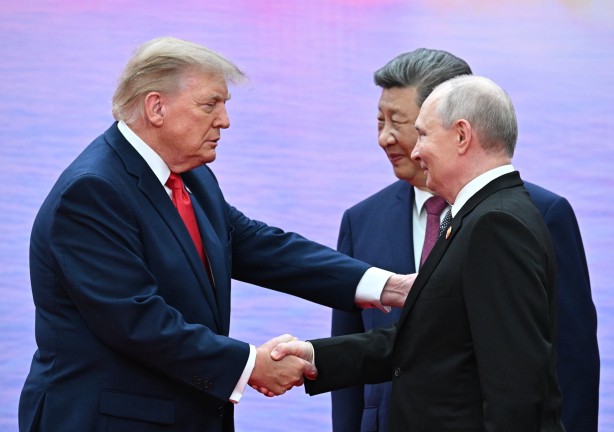
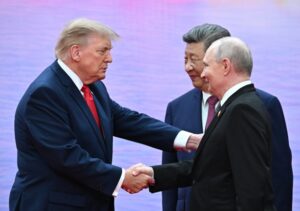
The three leaders meet ahead of their scheduled trilateral talks in Shenzhen. (Image Russian embassy in US)
By TRH World Desk
Xi Jinping’s personal welcome for Donald Trump, contrasted with Vladimir Putin’s reception by a senior Chinese official, has sharpened questions about Moscow’s standing in Beijing. The first-ever Trump-Xi-Putin meeting may offer historic imagery, but it does not make the three powers equal partners.
New Delhi, November 19, 2026 — Vladimir Putin arrived in Shenzhen seeking something more than another diplomatic engagement: recognition that Russia remains a central player in global power politics. But the opening choreography of the APEC summit has exposed an uncomfortable reality for the Kremlin. In the triangular relationship involving China, Russia and the United States, Beijing appears to hold the strongest hand.
Chinese President Xi Jinping personally welcomed US President Donald Trump at Shenzhen airport on November 18, breaking with established protocol in a gesture reciprocating Trump’s September reception of him in Washington. Putin, who arrived earlier, was welcomed by Cai Qi, a member of China’s Politburo Standing Committee and one of Xi’s closest associates. Cai is a senior figure, making the reception far from insignificant, but the contrast with Xi’s personal welcome for Trump was unmistakable.
The symbolism continued around the leaders’ first public encounter. Videos and photographs from the APEC welcome event showed Trump and Xi interacting before Putin joined them. Their subsequent group positioning became a subject of intense online scrutiny.
Political scientist Branislav Slantchev of the University of California, San Diego, argued on X that Beijing was signalling where its most important diplomatic relationship lay. He described the idea of a “new Yalta” as unrealistic, suggesting that Putin’s presence was more useful to Moscow’s image than evidence of an equal trilateral partnership.
Former diplomat Pavel Slunkin offered a protocol-based interpretation of the positioning, arguing that Putin’s place in the photograph would not have been especially prestigious even if he had stood on Trump’s right. Such readings are interpretations of diplomatic symbolism, not proof of a deliberate Chinese insult.
The deeper imbalance, however, is not photographic. It is structural.
Velina Tchakarova has described the China-Russia relationship as a “DragonBear”: strategic coordination between two powers, but not an alliance of equals. Russia supplies energy, commodities and geopolitical cooperation, while China has gained increasing economic and technological leverage over Moscow.
A 2026 assessment by the US-China Economic and Security Review Commission similarly describes Russia as increasingly dependent on China for trade, energy, finance and defence-related supply chains. Beijing, meanwhile, retains greater freedom to manage its relationship with Moscow without accepting binding alliance obligations.
The leaders’ agendas also diverge. Trump wants to discuss nuclear arms control, Iran and broader strategic stability. Xi’s priorities include trade, technology and China’s relationship with Washington. Putin is seeking diplomatic attention for the Ukraine war and a demonstration that Russia cannot be isolated.
US officials have cautioned against expecting an immediate agreement on nuclear arms reduction, while China has resisted joining arms-control negotiations on the same terms as Washington and Moscow.
For Moscow, the danger is not merely being placed away from the centre of a photograph. It is becoming increasingly indispensable to China’s strategy while finding its own room for independent strategic manoeuvre shrinking.
Quad Moves Beyond Security: $85 Million AI Push, Critical Minerals Deals and 2027 Business Forum
Follow The Raisina Hills on WhatsApp, Instagram, YouTube, Facebook, and LinkedIn




About The Author