Trump, Xi and Putin’s Power Triangle: Is India Losing Its Strategic Space?
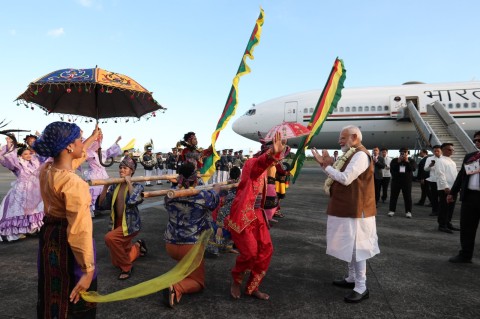
The anticipated engagement between three major powers raises questions about India's position in the emerging world order. (Image Modi on X)
By TRH Op-Ed Desk
As Manila hosts key Asian diplomatic engagements and the meeting of Quad leaders, the geopolitical spotlight is shifting to Shenzhen, where Donald Trump, Xi Jinping and Vladimir Putin are set to meet. Manish Anand argues that India’s influence is facing a test as great-power politics increasingly sidelines multilateral institutions.
New Delhi, November 16, 2026 — This week could prove to be one of the most consequential periods in global diplomacy, with Manila and Shenzhen emerging as two important centres of geopolitical activity. While Asian leaders gather in Manila for regional engagements and a meeting of Quad leaders, the world’s attention is also turning towards a trilateral meeting between US President Donald Trump, Chinese President Xi Jinping and Russian President Vladimir Putin in Shenzhen.
The convergence of these diplomatic developments raises a critical question: where does India stand as the global balance of power undergoes another transformation?
In a geopolitical analysis for The Raisina Hills, Manish Anand, a geopolitics analyst, describes the week as one of diplomatic turbulence, arguing that the real centre of global power politics may not be Manila but Shenzhen, where three major powers could attempt to shape the international agenda according to their respective interests.
Quad’s relevance faces a serious test
Prime Minister Narendra Modi has arrived in Manila for the regional diplomatic engagements, which include a meeting of Quad leaders from India, the United States, Japan and Australia.
However, Anand questions the significance of the proposed meeting, particularly because of the limited time allocated to it. The gathering is reportedly scheduled for just 55 minutes, raising doubts about whether substantive discussions can take place.
He also points to the uncertainty surrounding the status of the meeting as a formal Quad summit. India currently holds the Quad chairmanship, and Anand argues that the leadership meeting should ideally have taken place in India.
The Quad, established as a strategic grouping focused on the Indo-Pacific, has sought to strengthen economic cooperation, maritime security and regional stability. China has traditionally viewed the grouping with suspicion, regarding it as an effort to contain its growing influence.
Yet, despite the importance of the Indo-Pacific, the Quad’s leadership-level engagement has remained limited.
Anand argues that the absence of a leaders’ summit for nearly two years has weakened the grouping’s political momentum. Although US Secretary of State Marco Rubio has maintained that the Quad remains active, pointing to repeated foreign ministers’ meetings, Anand questions whether ministerial engagement can compensate for the absence of sustained leadership-level interaction.
He believes the Quad risks entering a state of diplomatic stagnation if its leaders cannot demonstrate greater commitment.
Shenzhen and the three-power equation
For Anand, the more consequential diplomatic development is the anticipated meeting between Trump, Xi and Putin in Shenzhen.
Each leader is expected to approach the engagement with a different strategic priority. Putin is interested in the future of European security architecture, Xi wants the Asia-Pacific economic agenda to remain central, while Trump is expected to emphasise nuclear arms control.
These competing priorities illustrate the changing nature of international diplomacy, where major powers increasingly seek direct negotiations to advance their national interests.
Anand argues that the growing importance of bilateral and trilateral power arrangements is reducing the influence of multilateral institutions such as ASEAN and other international groupings.
He describes the emerging geopolitical environment as one dominated by power projection, strategic bargaining and competition among major powers, with smaller countries and multilateral institutions struggling to retain their influence.
India-US relations lose momentum
The changing diplomatic equation also raises questions about India’s relationship with Washington.
Anand believes India is no longer occupying the central position it once enjoyed in Trump’s geopolitical calculations. Despite the strategic, defence and economic cooperation developed during previous years, the relationship has lost some of its earlier warmth during Trump’s second presidency.
Trade negotiations, economic restrictions, immigration-related concerns and American pressure affecting India’s regional interests have contributed to the growing uncertainty.
The proposed meeting between Modi and Trump in Manila is therefore attracting considerable attention. There are expectations that the two leaders could discuss the proposed bilateral trade agreement, particularly the first phase of negotiations.
However, Anand cautions against expecting a major breakthrough from a brief diplomatic encounter. With limited time available for the meeting of the Quad leaders, the scope for an extended bilateral discussion may also be constrained.
India must reassess its geopolitical position
The larger concern, according to Anand, is that global diplomacy is increasingly being shaped by three major powers pursuing their own strategic agendas.
India’s growing international influence, once reinforced by its prominent position in the Quad and its partnerships with Washington and other Indo-Pacific powers, now faces a more complicated geopolitical environment.
The coming diplomatic engagements may therefore reveal more about the changing priorities of Washington, Beijing and Moscow than about the future of the Quad itself.
For India, the challenge is to preserve strategic autonomy, maintain its Indo-Pacific partnerships and ensure that it does not become a peripheral player in negotiations shaping the international order.
The most important geopolitical signals may emerge not from Manila, but from Shenzhen. As Trump, Xi and Putin navigate their competing ambitions, the future direction of global power politics could become clearer.
The question India must confront is whether it can continue shaping the emerging world order or whether the great powers will increasingly determine its direction without New Delhi at the negotiating table.
Follow The Raisina Hills on WhatsApp, Instagram, YouTube, Facebook, and LinkedIn




About The Author