The Quad Gathers in New Delhi: A Grouping Finding Its Footing
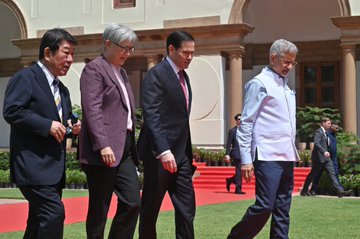
Indian External Affairs Minister S. Jaishankar with Quad foreign ministers at Hyderabad House in New Delhi (Image MEA India)
By TRH World Desk
The Quad’s New Delhi meeting unveiled maritime surveillance cooperation, critical minerals coordination and its first Pacific infrastructure project.
News Commentary | May 26, 2026 — The 11th Quad Foreign Ministers’ Meeting, convened at Hyderabad House in New Delhi on Tuesday, was neither the summit of crisis nor the summit of comfort. It was something more consequential: a grouping of four maritime democracies quietly but deliberately converting diplomatic ambition into operational architecture.
With External Affairs Minister S. Jaishankar in the chair, flanked by US Secretary of State Marco Rubio, Australian Foreign Minister Penny Wong, and Japanese Foreign Minister Toshimitsu Motegi, the meeting delivered three concrete deliverables — maritime surveillance, critical minerals, and a port in Fiji — against a backdrop of a turbulent Indo-Pacific, India-Pakistan tensions, and a Trump administration that has sometimes played an unsettling partner.
The Four Voices at the Table
Jaishankar (India): The host minister set the terms of the conversation with characteristic precision. Describing the Quad nations as “maritime democracies, pluralistic societies and market economies,” Jaishankar called for a collective responsibility toward ensuring a “free and open Indo-Pacific,” declaring that the region “must remain a driver for global growth and stability.”
He specifically called for “trusted and transparent” partnerships — pointed language in a geopolitical environment where China’s Belt and Road has faced questions of opacity. On counterterrorism, Jaishankar was direct: there must be “zero tolerance for terrorism” and nations subject to terrorist attacks “have the right to defend themselves” — remarks that carried the unmistakable weight of India’s Operation Sindoor and the April 2025 Pahalgam attack still fresh in New Delhi’s memory.
On his X account after the meeting, Jaishankar confirmed Quad agreement on the Indo-Pacific Maritime Surveillance Initiative and the creation of a Common Operating Picture in the maritime domain — effectively, a shared real-time intelligence picture of sea lanes.
Marco Rubio (USA): The Secretary of State arrived in New Delhi having completed a broader bilateral visit from May 23-26, and his Quad messaging was tailored to show American seriousness. Rubio’s stated objective was to transform the Quad “from a forum into a force” — a phrase that captured Washington’s desire to inject “bureaucratic agility and logistical teeth” into the grouping.
He acknowledged that “the areas in which Quad has been working together became more relevant because of recent events around the world” — a nod to supply chain disruptions, China’s critical mineral leverage, and the Indo-Pacific’s growing strategic salience.
On India-US friction over tariffs and the Trump administration’s early re-hyphenation of India and Pakistan post-Pahalgam, Rubio sought to reassure, arguing that trade imbalances were addressed from a “global perspective” rather than as a specific targeting of India.
His blunt insistence that terrorism “anywhere, including Pakistan, must go” — delivered in the days leading to the Quad meeting — was widely noted in New Delhi as a recalibration.
Time for India to Lead? Trump’s Drift Reopens the Quad Question
Penny Wong (Australia): Australia’s Foreign Minister brought the voice of the Pacific neighbourhood to the table. Wong called for making the Quad “as strong and as effective as possible,” adding that Canberra was “determined to continue the momentum of the Quad” in the pursuit of “a peaceful, stable, prosperous Indo-Pacific.”
Her emphasis on momentum was notable: the Quad had lost a gear in 2025 after a proposed leaders’ summit failed to materialise, and Australia was keen to demonstrate institutional continuity regardless of turbulence in Washington.
The Fiji port project — the grouping’s first-ever joint infrastructure pilot — bore Canberra’s fingerprints, given Australia’s sustained focus on Pacific infrastructure as a counter to Chinese presence in the islands.
Toshimitsu Motegi (Japan): The Japanese Foreign Minister offered perhaps the most structurally confident statement of the day, saying the Quad sent an “unshakable message” about advancing practical cooperation to realise a free and open Indo-Pacific “amid structural changes in the international order.”
For Tokyo, Quad is existential — Japan has watched China’s military modernisation, its assertiveness in the East China Sea, and North Korea’s missile programme accelerate simultaneously. Motegi’s language of “structural changes” signalled Japan’s view that this is not a cyclical crisis but a systemic transformation of the Asian security order that requires durable coalitions.
What Was Decided: Three Deliverables That Matter
Indo-Pacific Maritime Surveillance Collaboration (IPMSC): The most operationally significant announcement, the IPMSC will for the first time integrate Quad member maritime surveillance assets into a shared real-time awareness system, initially focused on the Indian Ocean Region.
It augments the earlier Indo-Pacific Partnership for Maritime Domain Awareness (IPMDA) by enabling real-time information sharing — effectively making the four navies informationally interoperable in a region where China’s grey-zone activities and Pakistan’s naval presence have deepened anxieties.
Quad Critical Minerals Initiative Framework: In language that alluded to China’s domination of global critical mineral supply chains without naming Beijing, the joint statement expressed being “deeply concerned” about the “abrupt constriction and future reliability of key supply chains.”
The new framework will coordinate investment in mining, processing, and recycling — a direct response to China’s export restrictions on rare earths and processed minerals. India’s membership of the Pax Silica and the FORGE initiative — mentioned by Jaishankar in the run-up — amplifies this ambition.
Fiji Port Infrastructure Pilot & Energy Security Initiative: The Quad Initiative on Indo-Pacific Energy Security targets regional energy resilience, while the Fiji port project marks a qualitative leap: the Quad is no longer just a talk shop but is beginning to physically build in the Pacific — on China’s doorstep.
The Quad Counterterrorism Tabletop Exercise scheduled for Australia in June, focused on state-sponsored terrorism and drone threats, further underlined operational intent.
What It Means for the Indo-Pacific
The New Delhi meeting arrives at an inflection point. The Quad had its most difficult year in 2025 — a leaders’ summit postponed, India-US tariff friction, and Washington’s perceived re-hyphenation of India and Pakistan after the Pahalgam attack left New Delhi quietly but visibly irritated. That the grouping has recovered institutional momentum — hosting its 11th Foreign Ministers’ Meeting, launching three concrete initiatives, and talking about a leaders’ summit later this year — is itself a statement.
For the Indo-Pacific, several implications stand out.
Maritime security is being institutionalised, not just discussed. The IPMSC is a genuine operational development. If implemented, a common maritime operating picture covering the Indian Ocean Region gives smaller regional states — from Sri Lanka to the Maldives to Seychelles — a Quad-backed awareness architecture that is an alternative to dependence on Chinese intelligence and port infrastructure.
Critical minerals competition has entered a new phase. The Quad’s decision to coordinate supply chains for critical minerals reflects a recognition that economic security is inseparable from physical security. China’s dominant position in rare earth processing is a strategic lever — the Quad framework, if it attracts investment from partner mining economies in Africa, Australia, and South America, could materially reduce that leverage over the next decade.
The Quad is beginning to build, not just talk. The Fiji port pilot is symbolically and practically important. China has spent fifteen years constructing ports, roads, and fibre across the Pacific. The Quad’s first joint infrastructure project in the Pacific marks a belated but real entry into the competition for physical presence.
Jaishankar’s articulation of the Quad as reflective of “a multi-polar order” — not an Indo-Pacific NATO and not a bloc against a single country — remains India’s framing, and it continues to shape the Quad’s character.
The grouping still carries unresolved tensions: the shadow of a postponed summit, the recent India-US trade dispute, and Rubio’s dual-track of Quad camaraderie alongside US engagement with Pakistan’s military. But as Jaishankar has said on record, the Quad is “here to stay, here to grow, and here to contribute.” Tuesday’s meeting in New Delhi offered evidence for all three.
‘Quad not Beatles band, but a lighthouse’; China must toe rules-based order
Follow The Raisina Hills on WhatsApp, Instagram, YouTube, Facebook, and LinkedIn




About The Author