From Hyderabad’s Biryani to UP’s Pulao: Owaisi’s Political Pitch Faces a Reality Check
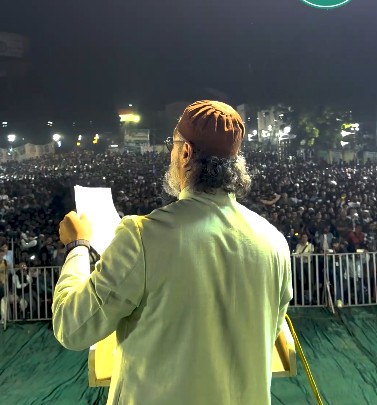
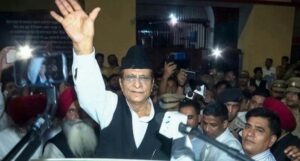
Asaduddin Owaisi's independent Muslim political mobilisation faces the electoral realities of Uttar Pradesh, where Azam Khan and the Samajwadi Party represent a different political approach. (Image video grab)
By MANISH ANAND
As Asaduddin Owaisi seeks to build an independent Muslim political constituency in Uttar Pradesh, Azam Khan’s emphasis on regional culture, tactical voting and the Samajwadi Party’s broader electoral coalition highlights the limits of identity-driven mobilisation.
New Delhi, November 20, 2026 — Muslim politicians in India took keen interest in the Mid-Term poll win of Abdul Al-Sayed, with some of them asking supporters for finding their own “Abdul.” All India Majlis-e-Ittehadul Muslimeen (AIMIM) leader Asaduddin Owaisi was blunt in his exultations, telling supporters in Uttar Pradesh that “Abdul will not help other win elections, but fight own political battles.”
Owaisi’s outfit, also called Majlis, is fast emerging as an electoral mercenary, felling parties which earlier banked on Muslim votes to win elections. His victims have been Nationalist Congress Party and the Congress in Maharashtra, Rashtriya Janata Dal in Bihar, Bahujan Samaj Party (BSP) in Uttar Pradesh, and the Aam Aadmi Party in Delhi.
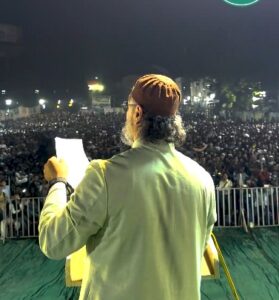
Sporting a skullcap and a small tuft of beard under the lower lip, Owaisi has marketed himself effectively as a Muslim leader. He speaks in a tearing hurry, packing lamentations and grievances, to rouse the youth. The Muslim youth, already nursing anguish for political marginalisation of the community, rallies behind Owaisi.
Uttar Pradesh with over 25 crore population is not far behind the US, which has a 34-crore people’s count. If the US voters are split on colours, affordability and slogans, the people in UP are divided on food, clothes and history.
On his release from the Dasna jail in Ghaziabad, Samajwadi Party’s Azam Khan challenged Owaisi with a reality check: “In UP, the people like pulao and mutton. Here, mutton biryani is favoured. The people here don’t like Hyderabadi biryani.”
Khan also checked on Owaisi’s branding. “One doesn’t become a Maulvi by wearing a skull cap. One also doesn’t become a Mufti by sporting beard.” That was a direct hit on Owaisi. “He’s a barrister, not a Maulvi,” said Khan.
Khan is a socialist by political orientation, while being SP’s Muslim face. Unlike Owaisi’s fiery speeches, Khan speaks in measured voice with gravity as the undertone. Observers say he’s a master of wordplay.
Unlike Owaisi, Khan doesn’t believe in exclusive Muslim politics. He’s clean shaven. He sports black canonical cap, which was made famous by former Prime Minister VP Singh. For Khan, tactical voting by Muslims remains the best case for political empowerment of the community.
In UP, Muslim outlook is shaped with imprints of Deoband, Aligarh Muslim University, and the cultural heritage of Lucknow. Regionally within UP, the outlook acquires shades of diversity.
In western UP, Deoband imprints may be more intense with moderation provided by the AMU. In Lucknow and adjoining areas, Tehzeeb sets apart educated from uneducated.
Food carries intense flavours of diversity. Galouti kebab gives Lucknow a distinctive identity, as the mutton balls made for melting in mouth with softness have made to Delhi’s delicacies.
If Owaisi is slotted with Hyderabadi biryani, he may find comforts in western UP where Moradabadi biryani commands premium. Biryani of Hyderabad and Moradabad also shows shared blending of spices.
But his bid to steer away Muslims from the mainstream political parties may prove daunting, for Moradabadi biryani isn’t popular beyond a few cities of western UP. The region’s politics is dictated by three dominating electoral groups: Jat, Jatav, and Muslims. But they work only in combinations, as alone they prove ineffective.
Rashtriya Lok Dal, a party identified with Jats, is now forgotten in the saffron tent of the Bharatiya Janata Party (BJP). Bahujan Samaj Party, identified with Jatav, is fighting for relevance after its social engineering imploded with the rise of the BJP. A prominent Muslim leader, who held positions of national importance in mainstream parties, tried finding sponsors to launch a Muslim-only outfit for months in the run up to the UP Assembly elections but failed.
SP’s Akhilesh Yadav would prefer Azam Khan not speak of mutton and chicken as poll pot stirs in UP where Chief Minister Yogi Adityanath-led dispensation faces accusations of forcing vegetarianism during Sawan month and even on Tuesdays. Akhilesh has embraced soft Hindutva, speaking of Krishna and visiting temples. He is also slated to visit the Ram Temple in Ayodhya next month. Azam Khan may soon be told that the SP’s key poll plank is to deny Adityanath any scope to whip polarisation.
FAQs:
Q1. What is Asaduddin Owaisi’s political strategy in Uttar Pradesh?
Owaisi’s strategy is to expand AIMIM’s electoral presence by encouraging Muslims to pursue independent political representation rather than relying exclusively on mainstream parties.
Q2. Why is Azam Khan politically important in Uttar Pradesh?
Azam Khan has been a prominent Muslim leader in the Samajwadi Party, with influence rooted in regional politics, political experience and his longstanding association with the party.
Q3. How could AIMIM affect Samajwadi Party electoral prospects?
AIMIM’s expansion could potentially split votes in constituencies where Muslim voters are decisive, affecting the electoral calculations of the SP and other opposition parties. The outcome would depend on local candidates, alliances and constituency-level voting patterns.
Q4. What is the Jat-Jatav-Muslim electoral equation in western Uttar Pradesh?
It is a political combination involving three influential voter groups. Their electoral impact depends on coalition-building, local leadership, political alliances and constituency-specific issues.
Q5. Why is tactical voting important in Uttar Pradesh?
Tactical voting occurs when voters prioritise defeating a particular candidate or party by supporting the strongest alternative, rather than necessarily choosing their first preference. It can significantly influence closely contested constituencies.
Azam Khan’s Return Poses a Political Dilemma for Akhilesh Yadav Ahead of UP Polls
Follow The Raisina Hills on WhatsApp, Instagram, YouTube, Facebook, and LinkedIn




About The Author