India’s Growth Story Faces a Household Reality: Inflation, Debt and Shrinking Savings
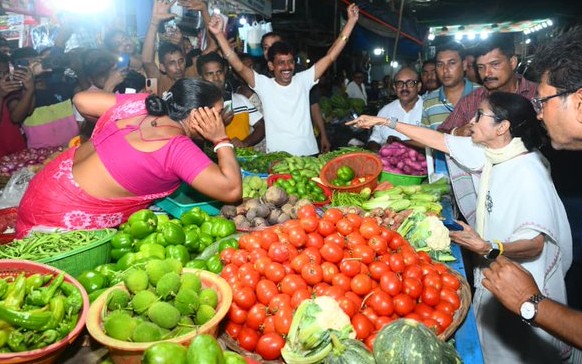
West Bengal CM Mamata Banerjee at a vegetable shop in Kolkata on Sunday evening. (Image AITMC on X)
By Prof. S.S. SOMRA
India’s economy continues to expand rapidly, but rising food prices, mounting household debt and declining net financial savings are putting pressure on families, raising questions about the inclusiveness and sustainability of economic growth.
Jaipur, November 20, 2026 — While India’s economy maintains a strong position among the world’s major emerging economies—boasting a growth rate of over 7 percent—rising inflation is eroding the purchasing power and household savings of the common citizen. Amidst the glittering figures of economic growth, the rising cost of running a household, the increasing prices of essential commodities, and shrinking savings raise a critical question: are the actual benefits of this growth reaching all sections of society?
The fact that people may not appear visibly distressed does not mean they are unaffected by inflation. It is possible that individuals have curtailed their desires, compromised on their savings, and integrated this economic pressure into their daily lives. Their hardship is not reflected on their faces, but rather in their declining bank balances, growing debt, and unfulfilled aspirations.
Data released by the Ministry of Statistics and Programme Implementation (MoSPI) on November 12 indicates that retail inflation reached 6.09 percent in October 2024, while food inflation was recorded at 8.94 percent. This situation is particularly concerning as retail inflation has breached the Reserve Bank of India’s upper tolerance limit of 6 percent.
According to data released by the Ministry of Commerce and Industry (MoCI) on November 16, India’s wholesale inflation rose to 12.29 percent in October—the highest level recorded under the revised series—up from 11.39 percent in September. The pressure of inflation is not limited to mere economic indicators; it is directly impacting the standard of living of low- and middle-income households.
For families with already limited incomes, rising food prices mean having to cut back on essential expenditures such as education and healthcare. According to recent reports (2024–2026) from the Reserve Bank of India (RBI) and the Ministry of Statistics and Programme Implementation (MoSPI), household debt in India has surpassed 45.5% of the GDP—a rate of growth that significantly outpaces the growth of savings.
Net financial savings, which stood at 7.0% of GDP in 2024–25, have slipped to approximately 6.2% in 2025–26 due to rising debt—a figure below the historical average of 7.9%. The RBI’s Financial Stability Report (June 2026) indicates that the debt burden on Indian households is steadily increasing; current data shows that for every ₹100 of financial assets (savings) held by Indian households, the debt burden has risen to ₹32—up from ₹27 four years earlier (in June 2022).
Household debt climbed from 41.3% of GDP in March 2025 to 45.5% by September 2025, reaching approximately 45.9% by March 2026. Over the past year, household debt has grown by 15.7%, while financial assets have increased by only 8.0%. Non-residential retail credit—essentially consumption-based debt—now accounts for 58.4% of total household debt. Furthermore, the current inflationary trend highlights the structural weaknesses within India’s agricultural system.
The reliance on imports for pulses and edible oils indicates that, despite a vast agricultural sector and significant domestic demand, India has yet to achieve self-sufficiency in several essential food items. The heightened inflationary pressure in rural areas is a particular cause for concern. The incomes of agricultural laborers, small-scale farmers, and workers in the unorganized sector are often precarious; such households frequently lack adequate savings or access to credit.
Consequently, even a minor inflationary shock can have long-term repercussions on their nutrition, education, and health. It is, therefore, essential to strengthen the Public Distribution System (PDS), provide targeted financial assistance to vulnerable families, and expand employment opportunities. Social security must be integrated into a broader strategy for economic stability.
The current inflationary situation presents India with a challenge that extends beyond mere price control; it serves as a litmus test for agricultural self-sufficiency, energy security, fiscal discipline, and inclusive growth.
The monetary policy of the Reserve Bank of India (RBI) plays a pivotal role in curbing inflation. By raising interest rates, the RBI can manage the demand for credit and excess liquidity in the market. However, if rising food prices are primarily driven by production shortfalls or supply-side bottlenecks, increasing interest rates alone cannot offer a permanent solution.
Furthermore, potential hikes in interest rates could make housing, vehicle, and personal loans more expensive, which risks dampening consumer spending and private investment. The challenge for the RBI, therefore, lies in anchoring inflationary expectations without unnecessarily undermining the momentum of economic growth.
The idea that policy adaptation is more critical than economic forecasting—a concept highlighted in the context of the 2026 Nobel Prize in Economics—draws attention to a vital aspect of economic policymaking. Economic theories associated with the work of Robert E. Hall and Michael Woodford help us understand how the expectations held by households and firms shape their economic decisions.
Economic forecasting is essential for budget formulation, investment, employment, and monetary policy; however, the future does not always unfold in line with such projections. Global energy crises, wars, climate change, supply chain disruptions, and shifts in consumer behavior can render any economic forecast irrelevant.
Therefore, the hallmark of good governance lies not merely in making accurate forecasts, but also in adapting policies in a timely manner as circumstances change. India must develop an economic framework that ensures price stability and social security alongside rapid economic growth.
FAQs:
Q1. Why is inflation a concern despite India’s strong economic growth?
Strong GDP growth does not automatically improve household living standards. If food, fuel, housing and essential costs rise faster than household income, purchasing power and savings can decline despite an expanding economy.
Q2. How does rising household debt affect India’s economy?
Increasing household borrowing can support consumption in the short term, but excessive debt may reduce future spending flexibility, increase repayment burdens and weaken household financial resilience.
Q3. Why are household savings declining in India?
Higher living costs, greater consumption expenditure, increased borrowing and financial commitments can leave families with less money to save. The effect is especially pronounced among households whose incomes are not keeping pace with inflation.
Q4. Can RBI interest rate hikes control food inflation?
Interest rate increases can influence demand, credit and inflation expectations. However, food inflation caused by supply disruptions, weather conditions, agricultural shortages or import dependence may require supply-side interventions in addition to monetary policy.
Q5. Why is food inflation particularly damaging to low-income families?
Lower-income households spend a larger proportion of their income on food and other essentials. Price increases can force them to reduce spending on nutrition, healthcare, education and other necessities.
Q6. What measures can help India manage inflation and household financial stress?
Policy measures include strengthening food supply chains, agricultural productivity, targeted social assistance, employment generation, food distribution, financial stability and effective inflation management.
Modi Questions India Inc: Did Corporate Tax Cuts Deliver Higher Salaries, Jobs and Investment?
Follow The Raisina Hills on WhatsApp, Instagram, YouTube, Facebook, and LinkedIn




About The Author