Nobel Economics 2026: Why Inflation Control Must Go Beyond Interest Rates
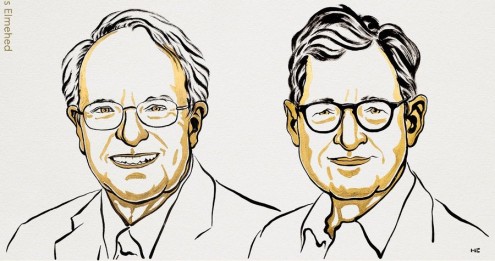
Balancing inflation control, investment and employment is central to sustainable economic growth. (Image The Nobel Prize)
By Prof. S.S. SOMRA
Prof. S.S. Somra examines how demand, supply, fiscal policy and monetary credibility must work together to deliver price stability, employment and inclusive growth in India.
Jaipur, October 25, 2026 — Robert E. Hall and Michael Woodford have been awarded the 2026 Nobel Prize in Economics. Both economists have developed new, highly precise models designed to shield the economy from the shocks of recession and inflation.
Until now, governments and central banks worldwide viewed the economy in aggregate terms, formulating policies based on broad indicators such as overall inflation or total output.
Robert Hall and Michael Woodford have fundamentally transformed this conventional perspective. They demonstrated that a nation’s entire economy is, in fact, the cumulative result of countless small, daily decisions made by millions of ordinary households and businesses.
Consequently, without a nuanced understanding of the limitations of monetary policy, the necessity for fiscal coordination, and the ongoing relevance of Keynesian economics, it is impossible to achieve a lasting solution to inflation or reach the goal of inclusive growth.
The discourse surrounding inflation, unemployment, and economic development extends beyond mere statistics and abstract models; at its core lies a critical question: who benefits from economic policies, and who bears the cost?
The ongoing debate between Keynesian economics and modern mainstream economics brings this fundamental issue to the fore. On one hand, emphasis is placed on demand, private investment, and government spending as the primary drivers of growth; on the other, the focus shifts toward price stability, inflation expectations, and the credibility of the central bank.
In reality, the stability of any economy requires a careful balance between these two perspectives.
The central argument put forth by Keynes and Michał Kalecki was that, in a capitalist economy, a deficiency in demand can have a long-lasting, detrimental impact on both production and employment.
If the private sector is hesitant to invest, relying solely on interest rate cuts is often insufficient to stimulate economic activity. Businesses will only invest when they perceive sufficient demand for their products and a clear prospect for future profitability.
In such a situation, public investment, the expansion of infrastructure, and effective fiscal policy can support economic growth.
Conversely, the traditional supply-side perspective emphasizes that, in the long run, production capacity, labor productivity, and market efficiency form the foundation of growth.
However, understanding an economy solely through the lens of either demand or supply is insufficient. Expanding production capacity is essential, but it requires both investment and market demand.
Similarly, while boosting demand can be beneficial, if the supply of essential goods—such as food, energy, or transport—is limited, an increase in demand may simply drive up prices.
Therefore, the objective of an effective economic policy should be to strike a balance between demand and supply—one that fosters growth while keeping inflation under control.
Since the impact of inflation is not uniform across all segments of society, measures to control it should be evaluated not merely by looking at average price indices, but also by considering their distributional consequences.
It is also important to recognize that price stability and social justice are not mutually exclusive goals. Stable prices benefit workers, pensioners, and households with limited incomes.
However, if the measures adopted to achieve stability end up reducing employment opportunities, exerting downward pressure on real wages, or undermining productive investment, the social cost becomes significant.
Consequently, economic policy must clearly identify the source of inflation, the most effective means of controlling it, and which segments of society will bear the burden of such measures.
This debate holds particular significance for a developing nation like India. Here, factors such as food prices, the monsoon, agricultural productivity, energy imports, exchange rates, and shifts in global markets all influence inflation.
For companies that have borrowed in foreign currency, a depreciation of the domestic currency can increase the cost of debt repayment. In such a context, relying solely on interest rates to maintain economic stability is not enough.
It is also essential to strengthen agricultural supply chains, enhance storage and transport facilities, encourage competition, accelerate productive investment, and implement targeted fiscal measures when necessary.
Ultimately, economic theories should not be evaluated solely on the basis of their mathematical elegance or predictive capacity. Their true utility lies in how well they grasp the complexities of the economy and the extent to which they improve the lives of citizens.
The Keynesian perspective highlights the role of demand and employment, while modern monetary economics emphasizes the importance of expectations, credibility, and price stability. It would be more pragmatic to integrate the lessons from both.
Therefore, the real challenge for economic policy is not merely to keep inflation within a target range, but to foster a form of stability that also bolsters investment, production, employment, and social welfare.
Stability should be assessed based on how resilient it makes the economy and how broadly its benefits are distributed across society. After all, economic stability is not an end in itself; rather, it is a means to achieve a better life, secure employment, and inclusive growth.
Nobel Prize in Economics 2026: How Robert Hall and Michael Woodford Changed Economic Policy
Follow The Raisina Hills on WhatsApp, Instagram, YouTube, Facebook, and LinkedIn




About The Author