The Entrepreneur Within: Jitendra Singh Rajput’s Book Redefines What It Means to Be an Entrepreneur
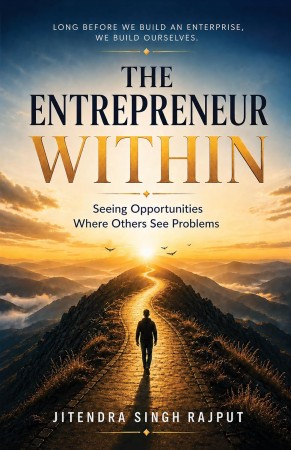
The Entrepreneur Within: Why Entrepreneurial Thinking Goes Beyond Starting a Business (Image Book Cover)
By SIDHARTH MISHRA
In his book published by Penman Books, Jitendra Singh Rajput argues that entrepreneurship begins with mindset, problem-solving and self-mastery rather than business plans or financial gains alone.
New Delhi, October 13, 2026 — The Entrepreneur Within, written by Jitendra Singh Rajput and published by Penman Books, offers a fresh, introspective perspective on entrepreneurship. Rather than treating business creation as merely a series of external operational steps—such as drafting business plans, raising venture capital, or legal incorporation—Rajput posits that true enterprise is primarily an internal state of mind. The book asserts that long before a business entity is registered in the physical world, an entrepreneurial consciousness must first be cultivated within the individual.
Rajput argues that traditional business literature often focuses excessively on mechanics while neglecting the psychological and philosophical foundation required to sustain initiative. The Entrepreneur Within bridges this gap, establishing entrepreneurship as an accessible, universal framework for problem-solving, personal growth, and continuous innovation.
At the heart of Rajput’s philosophy is a cognitive shift in how individuals perceive daily obstacles. Most people view inefficiencies, market gaps, and administrative bottlenecks as frustrating hindrances. In contrast, The Entrepreneur Within guides readers to recognize that every problem represents an unfulfilled need—and consequently, a potential entrepreneurial venture. By training the mind to look past immediate discomfort and analyze underlying systemic flaws, individuals can transform routine challenges into actionable opportunities for value creation.
A recurring premise in the book is the distinction between pursuing financial profit versus pursuing value creation. Rajput warns against entering business driven solely by short-term monetary gains, which often leads to unsustainable business models and rapid burnout. Instead, the narrative emphasizes that sustainable wealth is merely a byproduct of solving meaningful real-world problems. When the primary objective centers on enhancing user experience, improving efficiency, or elevating quality of life, economic rewards follow naturally as a result of that impact.
Building a business or executing an ambitious project inherently involves risk, uncertainty, and frequent setbacks. Rajput dedicates significant attention to the psychological fortitude required to navigate these realities. Self-mastery—encompassing emotional regulation, disciplined execution, and mental adaptability—is presented as the non-negotiable core of any successful founder or leader. The author emphasizes that an individual’s ability to remain composed under pressure and pivot strategically when initial hypotheses fail is far more crucial than possessing a flawless initial plan.
One of the book’s most practical strengths is its broad, inclusive application of entrepreneurial principles. Rajput stresses that one does not need to leave employment or launch an independent startup to think and act like an entrepreneur. The concept of intrapreneurship—applying an entrepreneurial lens within an existing corporate, non-profit, or institutional ecosystem—is championed throughout the text. Employees who embody “the entrepreneur within” take ownership of their roles, proactively identify organizational friction, streamline workflows, and drive internal innovation, making them invaluable assets to any organization.
While the book places high emphasis on mindset, Rajput grounds these psychological principles in pragmatic action. Entrepreneurship is distinguished from idle daydreaming through the discipline of strategic execution. The text outlines frameworks for calculating and mitigating risk, conducting rapid real-world testing, and iterating based on direct feedback. Ideation without execution, according to Rajput, remains mere speculation; true internal entrepreneurship mandates taking calculated, courageous steps into action.
The Entrepreneur Within functions as both a motivational guide and a strategic manual for a diverse audience, including students, corporate professionals, community organizers, and aspiring founders. In an increasingly dynamic global economy characterized by rapid technological shifts and career disruptions, Rajput’s message is timely: reliance on fixed career paths is giving way to a need for self-directed adaptability.
By shifting the definition of entrepreneurship from a specific job title to a flexible mental architecture, Jitendra Singh Rajput empowers readers to take ownership of their capabilities, see opportunity amidst disruption, and systematically build solutions that create lasting impact.
(The author is a senior journalist and media educator)
Book Title: The Entrepreneur Within
Author: Jitendra Singh Rajput
Publisher: Penman Books (ISBN: 978-9361940262)
Book Review: Anthony Scaramucci’s ‘All the Wrong Moves’ Is Part Mea Culpa, Part History Lesson
Follow The Raisina Hills on WhatsApp, Instagram, YouTube, Facebook, and LinkedIn




About The Author