Book Review: Anthony Scaramucci’s ‘All the Wrong Moves’ Is Part Mea Culpa, Part History Lesson
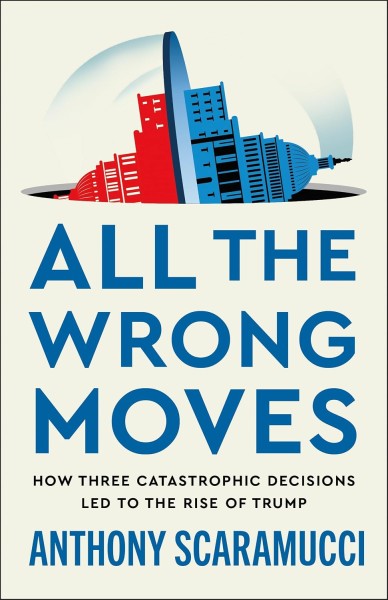
Anthony Scaramucci’s new book blames three bipartisan decisions — NAFTA-era China trade, the Iraq War, and the 2008 bailout — for Trump’s rise. (Image book cover)
By TRH Book Desk
The financier who lasted just 11 days as Trump’s communications director has written a book blaming three decades of bipartisan bad decisions for Trump’s rise.
New Delhi, September 29, 2026 — “All the Wrong Moves: How Three Catastrophic Decisions Led to the Rise of Trump,” published by St. Martin’s Press on September 22, is Anthony Scaramucci’s attempt to explain the Trump era not as an aberration but as the accumulated consequence of decisions made by both political parties over thirty years.
Kirkus Reviews’ capsule assessment of the book was terse but not unkind: “Smart and with just the right amount of vitriol.”
The Three Decisions
Scaramucci’s central argument, according to publisher materials from Macmillan, identifies three specific bipartisan turning points as the root causes of today’s political anger: Bill Clinton’s trade normalization with China, which “opened U.S. markets while abandoning American workers”; George W. Bush’s decision to wage war “while cutting taxes, exploding the deficit”; and Barack Obama’s Wall Street bank bailout, which “saved Wall Street but left millions of ordinary families behind.”
Each decision, per the publisher’s framing, “deepened inequality, corroded trust, and stoked the anger that empowered Donald Trump’s rise.”
Kirkus’s review situated the author precisely: “The onetime GOP operative traces the missteps that got us where we are. There are wrong moves aplenty in Scaramucci’s account, both personal and societal.”
Where the Book Is Strongest, According to Critics
A review syndicated across AOL and NewsBreak — assessing the book with a headline framing it as “confessions of an ex-Trumper” — was unambiguous about which section of the book actually works: “The most interesting chapter in Anthony Scaramucci’s All the Wrong Moves is the one where the hedge funder turned podcaster goes to work for Donald Trump.”
That review recounted Scaramucci’s brief, infamous stint as White House communications director in the summer of 2017 — a job the review notes he “doesn’t know how to do,” taken partly, in the author’s own telling, out of what the review calls “Potomac fever,” a condition the book describes afflicting Wall Street financiers who arrive in Washington convinced they’re “full of power and judgmental insight … about to fix everything.”
The tenure lasted just 11 days — not long enough, the review notes dryly, “to be truly tainted by Trump’s first term, though it is enough time for Scaramucci to miss the birth of his son.”
The review characterized the book’s self-examination as “a mea culpa soup, with the author full of regrets for his hubris, his impulsivity, his ‘pride, egotism and asinine stupidity.’”
A more sympathetic review from the blog History Nerds United reached a similar conclusion about the book’s emotional core, if from a warmer angle: “What kept me reading is Scaramucci’s willingness to issue an early and loud mea culpa. He was smug, he was arrogant, and he got into something he didn’t understand.” That reviewer also credited the book’s structural even-handedness, noting Scaramucci places blame for the three foundational decisions across “about 20 years ago or more,” with the express point that “the left and right are on the hook” together.
Where Critics Pushed Back
The AOL-syndicated review was considerably less forgiving of the book’s broader historical analysis, arguing Scaramucci’s account leaves out inconvenient context that would complicate his own tidy thesis. The review noted it was “peculiar for Scaramucci to tell the entire history of his nation’s economy with only the most fleeting mention of Ronald Reagan’s union-busting,” and argued he “similarly tells the story of the war in Iraq as a cashflow snafu without considering whether anti-imperialists and pacifists might have a point, sometimes,” while covering the 2008 bailouts “with only the swiftest nod towards the Occupy movement which, again, was broadly correct in its analysis.”
The review’s larger critique was about timing and intellectual humility: it described the book as documenting “a man who thought he knew it all, slowly surrendering to more sophisticated analyses when it is too late now anyway,” pointing to how the world Scaramucci is diagnosing has already moved on — “China no longer looks to the US for its place in global markets,” American wars are “no longer waged with long-term strategic aims,” and “Wall Street no longer calls the shots, techbros do.”
Book Review: ‘When America Roared’ Makes a Sweeping Case for the 1980s as Our Origin Story
Follow The Raisina Hills on WhatsApp, Instagram, YouTube, Facebook, and LinkedIn




About The Author