Why Xi Jinping Is Purging His Own Trusted Generals and Communist Party Leaders
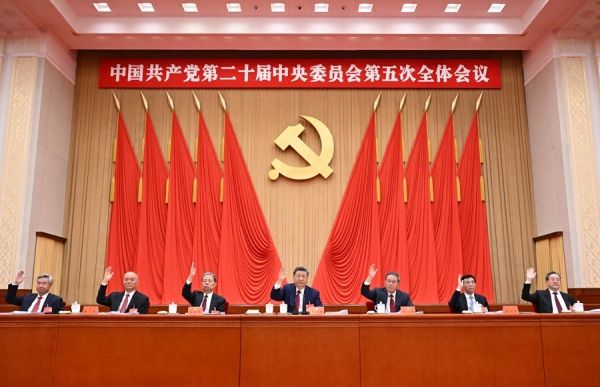
Xi Jinping Purges His Own Loyalists: Fear, Military Control and the Battle for China’s Future (Image MFA China on X)
By TRH World Desk
A Brookings discussion argues that Xi’s sweeping purge of Communist Party and military leaders is rooted in his obsession with political loyalty, party discipline and control over succession ahead of the 2027 Party Congress.
New Delhi, November 13, 2026 — Chinese President Xi Jinping’s purge of senior Communist Party and military leaders has entered an extraordinary phase: even his own trusted appointees are no longer beyond scrutiny. A new discussion hosted by the Brookings Institution suggests that the campaign is about more than corruption. At its core lies Xi’s determination to enforce absolute political loyalty and ensure that the Communist Party remains under his ideological control.
In its November 10 podcast, The Beijing Brief, Brookings experts Jonathan A. Czin and Ryan Hass spoke with China historian Joseph Torigian about the unprecedented scale of the purges, their historical parallels and what they could mean for China’s political future.
The discussion follows the Chinese Communist Party’s Fifth Plenum in late October, which confirmed the removal of several dozen Central Committee members. Since Xi began his third term in 2022, the purge has reached the highest levels of the party and the People’s Liberation Army (PLA).
The most striking development is the dismantling of the Central Military Commission (CMC), China’s supreme military command structure. According to the Brookings discussion, the body has been reduced to Xi and General Zhang Shengmin, who oversaw investigations into his fellow military leaders.
Three Politburo members have also been purged in the past year, underscoring that political proximity to Xi offers no permanent protection.
Loyalty above professional competence
Torigian’s central argument is that Xi views party discipline as an existential question. For the Chinese leader, the survival of the Communist Party depends on cadres placing the party’s mission above personal interests.
Explaining Xi’s approach, Torigian says that mistakes are not necessarily treated as administrative failures. They can be interpreted as evidence of defective political consciousness or insufficient commitment to the party’s cause.
This creates an environment in which officials must demonstrate ideological conformity rather than simply deliver results. Even long-standing loyalists can fall if Xi loses confidence in them.
The historian also highlights a significant difference between Mao Zedong’s era and Xi’s current campaign. Under Mao, some purged officials were eventually rehabilitated. Under Xi, there has been little comparable rehabilitation, leaving officials with virtually no assurance of a return after falling out of favour.
The consequence is a political culture of fear in which survival within the party hierarchy becomes an overriding concern.
The PLA is particularly important because Xi’s concern extends beyond financial corruption. According to Torigian, loyalty determines whether the military will obey the leadership during an internal power struggle, political unrest or a possible war with the United States.
This raises questions about military effectiveness. Repeated removals of senior commanders can disrupt institutional continuity, weaken confidence and divert attention from operational preparedness.
The implications extend to the Taiwan Strait. Torigian cautions that the purges could affect military readiness, although Xi may consider the short-term disruption necessary to secure a politically dependable military.
The 2027 succession question
Perhaps the most consequential part of the discussion concerns what happens after Xi.
The 2027 Party Congress is expected to mark the beginning of another five-year term. Yet Xi has not clearly identified a successor. Torigian suggests that Xi himself may not have decided whether to designate an heir or remain in power indefinitely.
The historian draws comparisons with the succession struggles following Stalin and Mao, warning that transitions in highly personalised authoritarian systems can become battles over influence, political survival and control of the security apparatus.
The central paradox is that Xi’s effort to eliminate uncertainty through tighter personal control may create greater uncertainty about China’s future leadership.
A party in which even the most powerful officials fear dismissal may demonstrate the leader’s authority. But whether such a system can sustain institutional competence, military effectiveness and an orderly succession remains an open question.
China’s internal power struggle is not merely a domestic political story. It has consequences for regional security, Taiwan, US-China relations and the stability of the global balance of power.
Xi Jinping’s Fifth Plenum: Is China’s Communist Party Meeting Becoming a Purge Summit?
Follow The Raisina Hills on WhatsApp, Instagram, YouTube, Facebook, and LinkedIn




About The Author