Kotia Dual Voting Exposes Gaps in SIR as Odisha-Andhra Border Dispute Deepens
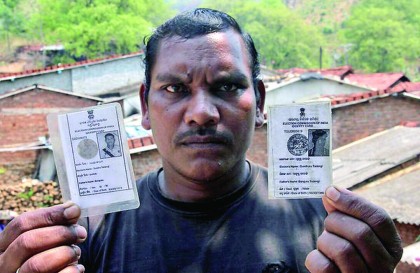
Voting by residents of disputed Kotia villages in Andhra Pradesh has raised questions about electoral roll duplication and the effectiveness of SIR. (Image PK Panda)
By PRADEEP KUMAR PANDA
Hundreds of residents from Odisha’s disputed Kotia villages reportedly voted in Andhra Pradesh’s local elections, reviving questions about duplicate voter registration, the Election Commission’s SIR exercise and the unresolved interstate boundary dispute.
Bhubaneswar, November 11, 2026 — In the remote, forested hills of Koraput district in Odisha, a quiet tribal region has once again become the flashpoint of a decades-old interstate dispute — and, more significantly, a stark illustration of the shortcomings in India’s ongoing Special Intensive Revision (SIR) of electoral rolls.
When residents of the disputed Kotia cluster of villages crossed into Andhra Pradesh in early November 2026 to cast votes in the neighbouring state’s Mandal Parishad Territorial Constituency (MPTC) and Zilla Parishad Territorial Constituency (ZPTC) elections, opposition parties, particularly the Biju Janata Dal (BJD), seized upon the episode as damning evidence that the much-publicised SIR process had failed in one of its core objectives: ensuring that no citizen remains enrolled in more than one place.
The incident has revived questions not only about the long-pending territorial claim over Kotia but also about the integrity of electoral rolls in border areas and the effectiveness of the Election Commission’s intensive clean-up exercise across the country.
A Border Dispute Rooted in History
Kotia gram panchayat comprises 28 villages with a population of roughly 5,000, predominantly Kondh Adivasis who depend on farming and forest produce. Of these, 21 villages have been claimed by both Odisha and Andhra Pradesh for nearly seven decades. Odisha maintains that the area has been under its administrative control since the formation of the state in 1936 as part of the old Jeypore Estate and later Pottangi tehsil in Koraput. Andhra Pradesh asserts that the villages fall under Salur mandal in what is now Parvathipuram Manyam district, citing historical surveys and revenue practices from the pre-Independence Madras Presidency.
The dispute surfaced sharply in 1955 when Andhra officials attempted to collect land revenue. Both states conducted elections in the area in subsequent years. Odisha approached the Supreme Court in 1968. In 2006, the apex court disposed of the original suit, observing that it lacked jurisdiction under the proviso to Article 131 to decide inter-state boundary disputes, and directed both states to maintain the status quo until the matter was resolved by the appropriate constitutional authority — Parliament. That status quo has been repeatedly tested. Andhra Pradesh held rural polls in parts of Kotia in 2021, prompting contempt petitions from Odisha. The pattern repeated in 2026 when the Andhra Pradesh State Election Commission notified elections for MPTC and ZPTC seats covering the disputed villages.
Odisha responded by deploying 15–16 platoons of police, setting up barricades and check-posts, imposing prohibitory orders under Section 163 of the Bharatiya Nagarik Suraksha Sanhita, and filing a fresh contempt petition in the Supreme Court. Despite these measures, hundreds of residents managed to trek several kilometres through forest routes or slip across the border to vote at booths shifted by Andhra authorities to their side of the boundary. Andhra Pradesh officials reported that about 1,150 of the 2,899 registered voters in the Kotia area exercised their franchise — a turnout of around 40 per cent. Odisha’s Koraput Collector put the figure closer to 10 per cent. Either way, the fact of dual participation was undeniable.
The Reality of Dual Enrolment
What makes Kotia unique — and problematic for electoral integrity — is that most residents hold voter identity cards, ration cards and Aadhaar cards issued by both states. They receive welfare benefits from both administrations. Old-age pensions, rice distribution and other schemes offered by Andhra Pradesh are often more lucrative, providing a practical incentive for people to maintain dual status and participate in elections on both sides. In earlier general elections, some villagers have voted in both Odisha and Andhra Pradesh. The SIR exercise, conducted in both states in recent phases, was expected to identify and eliminate such overlapping enrolments. It did not.
BJD deputy leader in the Odisha Assembly and former minister Prasanna Acharya articulated the opposition’s charge with clarity: “How can a citizen vote in two places? People whose names are enrolled in the Odisha voter list have also got themselves registered in the Andhra Pradesh voter list. Hundreds of residents of Kotia reportedly voted in Andhra Pradesh despite the SIR exercise being conducted in both states.
Had the SIR been conducted properly, these people would not have been able to vote in two places.”
He described the episode as proof that the opposition’s allegations against SIR were “100 per cent correct” and that the process required a thorough review, as demanded by BJD president Naveen Patnaik.
What SIR Was Meant to Achieve
The Special Intensive Revision is an intensive, house-to-house enumeration ordered by the Election Commission under Section 21 of the Representation of the People Act, 1950, and Article 324 of the Constitution. Unlike the annual Special Summary Revision (SSR), which largely updates the existing roll, SIR involves distributing fresh enumeration forms to every existing elector.
Booth Level Officers visit households, forms are filled and returned, a draft roll is published, claims and objections are invited, and a final roll is prepared. The stated objective is clear: no eligible citizen should be left out, and no ineligible person — including the dead, the shifted, and duplicates — should remain on the rolls.
SIR has been rolled out in phases across the country since 2025. It has involved mapping electors to earlier intensive revisions (often from the early 2000s) and, in some cases, requiring documentation where linkages could not be established.
The exercise has resulted in the deletion of large numbers of names. Critics have pointed to mass exclusions of genuine voters, software mapping errors, procedural lapses that generated multiple EPICs for the same person in some states, and incomplete deletion of migrants. Reports from various states have highlighted remaining duplicates even after the intensive process. Kotia has now provided a vivid, real-time demonstration that cross-state dual enrolment survived the clean-up.
Political Reactions and Demands
In Odisha, the BJD has framed the Kotia episode as both an electoral failure and a failure of the state government to protect territorial integrity. The party has long argued that successive governments have not pursued the dispute with sufficient urgency.
It has demanded an immediate review of SIR in Odisha and Andhra Pradesh with special focus on border regions, identification and deletion of all dual enrolments, public disclosure of the number of such cases detected during SIR, legal action against those holding multiple voter IDs in violation of the law, and a permanent resolution of the Kotia dispute so that dual administration ends.
The Congress has echoed similar concerns. The ruling BJP government in Odisha has maintained that it prevented Andhra Pradesh from setting up polling booths on Odisha soil and has pursued legal remedies. Revenue Minister Suresh Pujari has stressed that Kotia is an integral part of Odisha and that the state is taking both administrative and legal steps. Yet the fact that voters could still participate in Andhra’s elections has left the government on the defensive.
Broader Implications
The Kotia incident is not merely a local curiosity. It raises fundamental questions about the principle of “one person, one vote.” If the same citizen can remain on the electoral rolls of two states and exercise the franchise in both, the purity of the rolls is compromised. Border regions across India, where populations move fluidly and administrative claims overlap, are particularly vulnerable. SIR was designed precisely to address such anomalies through intensive verification. Its inability to do so in a high-profile disputed pocket undermines public confidence in the exercise.
At the same time, the human reality in Kotia cannot be ignored. For the tribal residents, dual enrolment is a survival strategy in a region where development has historically lagged and welfare benefits from both states provide a safety net. Any corrective action must be careful not to abruptly deprive genuine residents of entitlements while cleaning the rolls.
The Election Commission now faces pressure to examine the Kotia case specifically, strengthen cross-state data sharing for de-duplication, and ensure that future revisions close the gaps that allowed dual voting to persist. Odisha and Andhra Pradesh must also move beyond periodic confrontations and work towards a lasting settlement of the territorial claim, whether through political negotiation or parliamentary intervention as envisaged by the Supreme Court.
Until then, the hills of Kotia will continue to symbolise both an unresolved border dispute and a cautionary tale about the limits of even the most intensive electoral roll revision. The principle of one person, one vote remains non-negotiable. The events of November 2026 have shown that, in this corner of India, it is still not fully realised.
(This is an opinion piece. Views expressed are the author’s own.)
Voter Roll Controversy: Courts Question ECI’s Form 6 Push as Form 8 Dispute Deepens
Follow The Raisina Hills on WhatsApp, Instagram, YouTube, Facebook, and LinkedIn




About The Author