INDIA Bloc Puts CEC Gyanesh Kumar in the Dock: ‘Public Impeachment’ Turns SIR Into Winter Session Battle
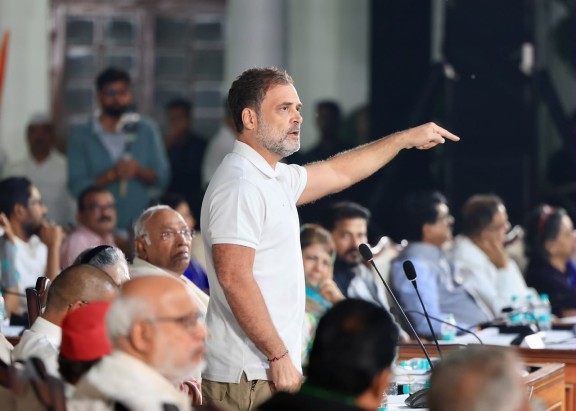
LoP Rahul Gandhi at public impeachment of CEC Gyanesh Kumar said that the removal of top poll official is inevitable (Image Congress)
By TRH Op-Ed Desk
Opposition parties use a symbolic public hearing to challenge the Election Commission’s Special Intensive Revision, raising questions over voter deletions, RTI disclosures, Form 6 and the decision-making process. Manish Anand argues that the controversy could shape the credibility debate around elections in six states next year.
New Delhi, October 31, 2026 — The opposition INDIA bloc has taken its confrontation with Chief Election Commissioner Gyanesh Kumar beyond Parliament, holding a symbolic public impeachment proceeding in New Delhi on Saturday and turning the controversial Special Intensive Revision (SIR) of electoral rolls into a major political issue ahead of the winter session.
The exercise, held at Congress president Mallikarjun Kharge’s residence, brought together opposition MPs, political representatives, public activists and people claiming to have been affected by voter deletions. Former Lok Sabha Speaker Meira Kumar presided over the proceedings. The event was part of the opposition’s continuing campaign alleging electoral irregularities and demanding Kumar’s removal.
In his political analysis for The Raisina Hills, Manish Anand, a political analyst, described the exercise as an unusual attempt by the opposition to take the technical details of SIR directly to the public.
“The opposition has dissected and post-mortemed the Special Intensive Revision before the country, putting several questions about the Election Commission’s functioning in the public domain,” Anand said.
One of the central issues was the decision-making process behind the nationwide revision. RTI activist Anjali Bhardwaj reportedly sought documents relating to the approval of SIR by the three-member Election Commission. According to Anand, the responses to her applications failed to provide the file notings and documentary trail she was seeking.
The issue has become particularly contentious following reports that Election Commissioners Sukhbir Singh Sandhu and Vivek Joshi had raised questions during internal deliberations.
The Election Commission, however, has rejected allegations of unilateral decision-making. In an affidavit before the Supreme Court, it maintained that all three SIR orders were approved unanimously by the Chief Election Commissioner and the two Election Commissioners. The Commission has also defended the legality of its procedures and denied changing the statutory Form 6.
The opposition has questioned whether the documentary record adequately explains the decision and its implementation.
Anand also drew attention to the historical contrast between the approach of India’s first Chief Election Commissioner, Sukumar Sen, and the present controversy. Sen’s first general election was organised in conditions where documentary identification was limited, but the guiding challenge was to bring eligible citizens into the electoral process.
The opposition argues that the present exercise has placed an excessive documentation burden on voters and risked excluding eligible electors.
Voter deletions and the human dimension
The public proceedings also brought forward people whose names were reportedly removed from electoral rolls, including individuals who said they had been incorrectly classified as deceased.
The opposition cited the scale of deletions under SIR, with approximately 13 crore names removed across the exercise’s various phases. In West Bengal, TMC MP Mahua Moitra reportedly argued that 71% of deleted voters were Muslims and 51% were women. These figures and the allegations of discriminatory impact require examination against the Election Commission’s underlying data.
Anand said the appearance of people who had allegedly been marked dead, despite being alive and present at the hearing, gave the controversy a human dimension that technical discussions about electoral rolls often lack.
Another disputed issue concerns so-called logical discrepancies. The opposition has alleged that differences in the recorded ages of parents and children, spelling variations and errors arising from the translation of names into English resulted in legitimate voters being flagged or deleted.
Form 6, used for the inclusion of eligible voters, has also become a contentious subject, with the opposition questioning whether the revised procedures created additional hurdles for registration.
Supreme Court scrutiny and the next electoral test
The dispute is already before the Supreme Court. The Election Commission has filed its response defending the SIR process, while petitions challenging aspects of the exercise remain under judicial consideration.
For the opposition, the immediate political challenge is the forthcoming electoral calendar. Uttar Pradesh, Uttarakhand, Goa, Punjab, Manipur and Himachal Pradesh are among the states facing Assembly elections in 2027, while Gujarat is due later in the year.
The central question is whether elections will be conducted using electoral rolls whose preparation remains under judicial and political scrutiny, and whether any voters wrongly excluded can be restored in time.
Anand argued that the controversy could have consequences beyond the next round of elections.
“Trust in the electoral process is essential. If the process is not transparent and free from errors, even the mandate emerging from an election will remain under a question mark,” he said.
The INDIA bloc’s public impeachment has no legal power to remove the Chief Election Commissioner. Actual removal requires the constitutional parliamentary process applicable to a Supreme Court judge. But politically, the opposition has used the exercise to put the Election Commission’s credibility at the centre of its campaign.
With the Supreme Court proceedings continuing and the winter session approaching, the SIR dispute is unlikely to remain a technical argument about voter registration. It is becoming a wider contest over institutional accountability, electoral transparency and public confidence in India’s democratic process.
Supreme Court Questions Bengal SIR Category as Delhi Audit Flags Wrong Voter Deletions
Follow The Raisina Hills on WhatsApp, Instagram, YouTube, Facebook, and LinkedIn




About The Author