Book Review: ‘Future Starts With Us’ by Gordon Brown Is Well-Intentioned, Data-Rich — and a Slog to Read
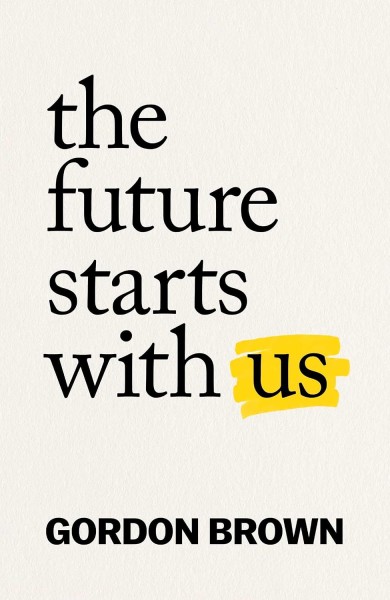
Cover of The Future Starts With Us by Gordon Brown (Image Amazon UK)
By S. JHA
The former UK prime minister’s new book draws on original polling of nearly 100,000 people across 45 countries to argue that civic renewal, not summit diplomacy, is what will save the fraying global order. Reviewers largely agree with the diagnosis — they’re less sold on the prose delivering it.
Mumbai, September 6, 2026 — Gordon Brown’s The Future Starts With Us, published by Simon & Schuster, arrives as the former UK prime minister and chancellor’s attempt to explain why global instability and civic decline are happening simultaneously — and to offer what its publisher calls “a practical and hopeful roadmap” for reversing both at once.
According to the publisher’s own description, Brown draws on “decades of experience at the heart of politics,” combined with new research and original polling of nearly 100,000 people across 45 countries, to argue that global instability and the erosion of civic life are directly connected — and that both are driving millions of people worldwide toward populist nationalist parties in search of solutions.
The book’s central claim, per its publisher, is that “the future will not be decided by the declarations of presidents or prime ministers or at conferences or summits, but by citizens becoming actively engaged in their communities and by what we choose to do together.”
A review published on BritBrief frames the book more specifically as “a comprehensive strategy for countering the rise of populism,” built on Brown’s argument that the populist wave “is not an inevitable force but a symptom of deeper societal failures that progressive politics must address head-on.”
That review credits Brown with identifying economic insecurity, cultural anxiety, and a perceived loss of national sovereignty as the key drivers populist leaders exploit, while arguing that progressive politics needs to combine “economic competence with a strong moral and emotional appeal” to compete effectively.
The review also notes Brown draws directly on his own record in office, particularly the 2008 financial crisis, arguing that era demonstrated “the capacity of coordinated, progressive governance to protect citizens and stabilize economies” — a lesson he applies to today’s challenges.
BritBrief summarizes the book’s ultimate thesis as “a call for a renewed social democracy, one that is willing to embrace change while remaining true to its core values of fairness, opportunity, and solidarity.”
Where the Reviews Get More Critical
A considerably more sceptical assessment comes from The Scotsman, whose review — headlined “Impassioned but lacking in zip” — pushes back directly against more flattering characterizations of the book’s readability.
Referencing a New Statesman review that praised the book by saying “despite its hefty subject matter, Brown’s book zips along,” The Scotsman’s reviewer countered bluntly: “That could not really be said about this book. Well intentioned though it is, and in some places interesting, the prose is ponderous.”
The review backs up that assessment with a direct example, quoting a passage from the book discussing emerging technology: “Innovations such as ‘agentic AI systems’ and ‘neuromorphic chips’ (that mimic brain efficiency) are not well known today, nor are quantum computing, nuclear fusion (which might be accelerated by AI simulations) or cell-free biomanufacturing, but breakthroughs such as these will in future be critical to delivering the higher output on which an inclusive prosperity and good public services depend…”
The Scotsman’s verdict on that sentence was direct: “Not only is this syntactically clumsy, but some of the claims are questionable” — specifically flagging Brown’s optimism about nuclear fusion timelines as an example of a claim the review treats with some scepticism, given fusion’s long history of being described as perpetually “20 years away.”
An Unexpected Literary Detour
The Scotsman’s review also highlights one of the book’s more unusual structural choices: an extended passage near the end where Brown explores the distinction between hope and optimism through an eclectic tour of Western literature. The review describes Brown citing Homer’s “Odyssey” and “The Lord of the Rings” as quest narratives, “Great Expectations”-style rags-to-riches arcs via Dickens’s “David Copperfield,” “Pygmalion” and “The Great Gatsby,” and what the review calls “the triumph over something monstrous” — a category the reviewer says Brown links to Jonathan Swift’s “Gulliver’s Travels,” a connection the reviewer admits they “don’t quite see.”
The catalogue continues through Bunyan, C.S. Lewis, and Philip Pullman on the theme of “banishing evil,” with what The Scotsman describes as “honourable mentions” to Browning, Angelou, Steinbeck, and Emily Dickinson — alongside more expected reference points in Orwell and Alexis de Tocqueville.
Book Review: ‘Fear and Fury’ Connects 1984 Shooting to Trump
Follow The Raisina Hills on WhatsApp, Instagram, YouTube, Facebook, and LinkedIn




About The Author