Reform UK’s Rise Exposes Britain’s Fragmented Politics
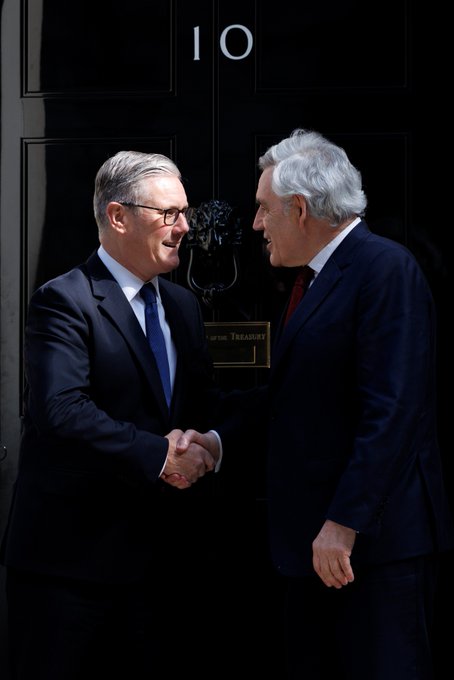
UK PM Keir Starmer with Gordon Brown (Image Starmer on X)
By SAHASRANSHU DASH
Labour setbacks, Reform UK’s rise and territorial fragmentation suggest Britain is no longer operating as a stable two-party system.
Sheffield (UK), May 18, 2026 — The recent local elections in the United Kingdom have revealed something deeper than a difficult electoral cycle for a governing party. They have exposed a broader crisis of political legitimacy in a state whose traditional party system, territorial cohesion and governing narratives are all weakening simultaneously.
The heavy losses suffered by Labour across England, the continuing collapse of Conservative authority, the dramatic rise of Reform UK, and the strengthening of nationalist and Green parties across the devolved nations and metropolitan centres together suggest not merely voter dissatisfaction but systemic transition. Britain increasingly resembles a polity caught between political orders.
The old post-war settlement has visibly broken down, but a new equilibrium has not yet consolidated. Keir Starmer’s predicament is therefore not reducible to personal unpopularity or strategic error alone. Rather, his government has become the focal point of a wider structural problem: the inability of Britain’s political system to generate a stable governing coalition, a coherent national story or a renewed sense of collective purpose in the aftermath of Brexit and prolonged economic stagnation.
The empirical scale of the upheaval is difficult to overstate. Across roughly 5,000 council seats coeir ntested in England, Labour lost well over 1,000 seats, while Reform UK gained more than 1,400 councillors, consolidating itself in areas stretching from Essex to former industrial Labour heartlands in the Midlands and the North. The Conservatives continued their post-Brexit deterioration, losing several hundred additional seats and failing to recover support in southern England. Meanwhile, the Green Party achieved significant breakthroughs in urban centres such as Hackney, Lambeth, Reading and Plymouth, while the Liberal Democrats strengthened their position in suburban and southern localities.
In Wales, Plaid Cymru emerged as the dominant force under the newly proportional Senedd electoral system, ending the aura of inevitable Labour predominance that had defined Welsh politics for decades. In Scotland, the SNP remained the largest party despite some erosion, while Reform UK and the Greens established stronger footholds. Northern Ireland, long governed through its own ethno-national cleavage structure, continued to operate almost entirely outside the logic of British two-party competition.
The cumulative effect is unmistakable. Britain no longer functions as a coherent two-party system in the way it did for most of the twentieth century. Indeed, the combined vote share of Labour and the Conservatives has fallen to historic lows, while multiple parties now compete across different territorial, cultural and ideological dimensions.
Yet the deeper significance of the elections lies not merely in fragmentation itself, but in the fact that fragmentation is occurring across several overlapping axes simultaneously. The old class-based alignment that structured British politics for generations has weakened substantially, while no new dominant cleavage has yet emerged to replace it.
Andy Burnham, Streeting and Rayner in Focus Amid Labour Revolt
Instead, Britain has entered a prolonged period of political “unfreezing” in which multiple rival cleavages, cultural, territorial, educational and generational, compete for dominance without fully stabilising into a new order.
This is where the classic Lipset-Rokkan theory of cleavage politics becomes particularly illuminating. Seymour Martin Lipset and Stein Rokkan argued that European party systems were historically shaped by major social cleavages produced during industrialisation and nation-state formation.
In Britain, the dominant cleavage became class, expressed through the Labour-Conservative duopoly that defined twentieth-century politics. These alignments eventually “froze” into stable electoral systems, producing durable partisan identities and predictable governing coalitions.
But cleavage systems are not immutable. Under conditions of major social transformation, institutional strain or economic dislocation, old alignments can weaken before new ones crystallise.
Britain today appears to be precisely in such an intermediary phase. Class still matters, but it no longer organises political behaviour in a consistent way. Labour now simultaneously loses support among economically left-behind voters in post-industrial towns, socially liberal metropolitan professionals migrating towards the Greens, and nationalist voters in Scotland and Wales.
The Conservatives, meanwhile, have struggled to reconcile affluent market liberals with culturally nationalist and anti-immigration constituencies mobilised by Brexit. Reform UK’s success reflects the emergence of a new cleavage centred on sovereignty, immigration and distrust of institutions that cuts across older class identities.
The Greens, for that matter, increasingly represent a post-materialist and cosmopolitan bloc concentrated among younger and university-educated voters, though their role unlike Reform is less that of a government-in-waiting and more that of spiteful modern left-populist insurgencies whose singular aim is to burn down the governable centre even at the cost of handing over the keys to 10 Downing Street to Enoch Powell’s political progeny.
Territorial politics has also intensified. Scotland, Wales and Northern Ireland now operate through partially autonomous political systems structured around constitutional identity rather than simply left-right economics.
Economic stagnation intensifies these fractures without entirely causing them. Britain’s weak productivity growth, regional inequality, declining public services and long-term fiscal constraints have created an environment in which distributive politics becomes increasingly zero-sum.
Real wages have remained sluggish outside parts of London and the South East, housing affordability has deteriorated for younger generations, and local government finances remain under severe pressure after years of austerity and post-pandemic borrowing. Yet economic malaise alone cannot explain why electoral fragmentation has taken such culturally and territorially differentiated forms.
Rather, economic stagnation amplifies the salience of other cleavages by undermining the material basis on which broad coalitions once rested. In periods of strong growth, political systems can often contain cultural and regional tensions through redistribution and compromise. In periods of stagnation, however, conflicts over immigration, sovereignty, identity and institutional trust become more politically central because the state possesses fewer resources with which to mediate competing demands.
This dynamic has proven fertile terrain for populist movements. Reform UK’s rise is not merely an expression of economic grievance but a broader revolt against what its supporters perceive as a detached political establishment incapable of representing national interests. Populism here functions less as a coherent ideology than as a political logic dividing society between “the people” and an unresponsive elite.
Nigel Farage’s continued salience reflects his ability to articulate a simplified but emotionally resonant narrative of national decline, institutional betrayal and cultural dislocation. Brexit itself succeeded partly because it condensed a wide range of frustrations into a clear story of sovereignty and democratic recovery: “take back control”. By contrast, mainstream British politics since Brexit has often struggled to produce comparably compelling narratives about the country’s future direction.
This absence of narrative coherence is perhaps the most important part of Britain’s present instability. Much contemporary analysis correctly emphasises economics, fragmentation and populism, but it often underestimates the crisis of political meaning underlying them. Modern democratic politics is, alas, not sustained by administration anymore.
It also depends upon legitimacy, collective purpose and what Max Weber would have recognised as the capacity of leadership to generate belief in political authority. Weber distinguished between purely bureaucratic authority and forms of leadership capable of mobilising deeper emotional or ideological commitment. In periods of systemic stability, procedural competence may suffice. But during moments of transition and uncertainty, electorates often demand more than managerial reassurance. They seek direction, identity and historical purpose.
This is precisely where Keir Starmer’s leadership encounters its deepest structural limitations. Starmer has consistently presented himself as a serious, competent and decent administrator after years of Conservative chaos. His appeal has rested on professionalism, proceduralism and institutional restoration.
Yet competence alone is a fragile source of legitimacy in a period when the political system itself appears increasingly incapable of articulating a convincing national project. The recurring praise of Starmer as “decent” from allies and colleagues unintentionally captures the problem. Decency is a moral quality, but not a political narrative.
It does not answer the larger question increasingly animating British politics: what is Britain for after Brexit, austerity, deindustrialisation and the erosion of post-war assumptions about prosperity and national identity?
Since the Brexit referendum, Britain’s governing elites have often appeared hesitant to articulate ambitious collective visions precisely because Brexit itself represented such a destabilising rupture. The political establishment remains, in many ways, psychologically and institutionally shell-shocked by the referendum result.
Subsequent leaders, from Boris Johnson to Rishi Sunak to Starmer, have oscillated between managerialism and improvisational rhetoric without constructing a durable post-Brexit settlement. Johnson temporarily succeeded by offering an emotionally expansive narrative of sovereignty and renewal, but his government lacked administrative coherence.
Sunak represented technocratic retrenchment without popular enthusiasm. Starmer, despite greater seriousness and competence, has similarly struggled to articulate a broader sense of national direction beyond restoring stability itself.
The consequence is a peculiar form of political exhaustion. Britain continues to cycle rapidly through leaders because no prime minister has yet succeeded in reorganising the country’s fragmented cleavages into a durable coalition with a compelling legitimising story.
Since 2016, Britain has had five prime ministers and may soon face a sixth, an extraordinary rate of turnover for a country long associated with a stiff upper lip and institutional continuity. Leadership churn is therefore not merely a symptom of media volatility or parliamentary intrigue.
It reflects declining hegemonic capacity at the centre of the political system. Governments win office but struggle to consolidate authority because the electorate itself no longer shares a common understanding of national purpose.
The 2026 local elections thus reveal more than the weakness of a particular government. They expose a polity undergoing simultaneous economic, territorial and ideological transition without a settled framework capable of containing those tensions.
Britain remains formally governed through institutions designed for a stable two-party state, yet its electorate increasingly behaves as though it inhabits several competing political systems at once. Labour and the Conservatives continue to dominate Westminster numerically, but neither possesses the social coalition, narrative coherence or territorial integration that once underpinned durable governance.
Until a new cleavage structure stabilises, or a political movement succeeds in constructing a broadly legitimate post-Brexit national story, instability is likely to remain the defining feature of British politics rather than a temporary deviation from it.
Liberal democracy requires patience and compromise. British politics since 2016, by contrast, is an extreme case of what happens when one decides to get rid of both at once, hurling self-righteous slogans into the void and shaking fists at wholly imaginary clouds.
(This is an opinion piece. Views expressed are the author’s own.)
Follow The Raisina Hills on WhatsApp, Instagram, YouTube, Facebook, and LinkedIn




About The Author