Yogi in West Bengal: Kamandal Triumphs Over Mandal
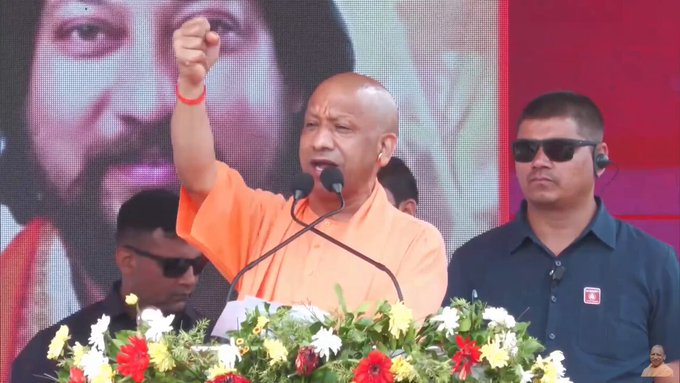
Uttar Pradesh CM Yogi Adityanath campaigns in West Bengal. (Image X.com)
Yogi Adityanath’s success in West Bengal challenges the dominance of caste-based Mandal politics, highlighting the growing influence of Hindutva-driven Kamandal consolidation in India’s evolving electoral landscape.
By SIDHARTH MISHRA
New Delhi, May 6, 2026 — For decades, Bengal was considered resistant terrain for Hindutva politics. The state prided itself on linguistic nationalism, cultural exceptionalism, Left-oriented intellectualism, and regional political identity. Unlike the Hindi heartland, caste politics was never overtly dominant in Bengal’s electoral discourse. Yet beneath this surface lay fragmented social identities and local grievances waiting for a larger political narrative to unify them. The BJP managed to provide precisely that narrative through the politics of Hindu consolidation.
One of the most striking indicators of this transformation has been the role of Yogi Adityanath in Bengal’s electoral campaign. Often portrayed in his home state of Uttar Pradesh as a leader whose political identity is intertwined with his Thakur caste background, Yogi’s extraordinary strike rate in Bengal tells a completely different story. Campaigning in 22 constituencies, he helped the BJP secure victory in 20 of them. This is politically significant because Bengal has a negligible Thakur population. The caste identity associated with Yogi in UP simply does not exist as a meaningful electoral factor in Bengal.
And yet, his appeal translated into electoral success.
This is perhaps the clearest contemporary evidence that identity politics in India is moving beyond caste arithmetic towards religious-cultural consolidation. Yogi Adityanath’s popularity in Bengal did not emerge from caste affinity. It emerged from his image as an uncompromising Hindutva mascot, a defender of Sanatan identity, and a symbol of muscular Hindu assertion. Voters who had no caste connection with him still responded to the larger ideological and civilisational narrative he represented.
This marks a decisive departure from the Mandal era. The politics of Mandal relied on fragmentation: mobilising specific caste blocs, building social coalitions among backward classes, and negotiating representation through caste equations. Kamandal politics operates differently. It seeks aggregation rather than fragmentation. Instead of emphasising internal divisions among Hindus, it foregrounds a collective religious identity that supersedes caste boundaries.
Bengal demonstrates how effective this strategy has become. The BJP’s expansion in the state has not depended on replicating north Indian caste equations. Rather, it has depended on reframing political discourse around questions of cultural identity, demographic anxieties, religious symbolism, and perceptions of Hindu political marginalisation. In such a framework, caste becomes secondary to the larger emotional appeal of Hindu unity.
The significance of Yogi Adityanath’s success in Bengal lies precisely here. It undercuts the long-standing argument that leaders associated with caste identities can only succeed within their own social geography. Bengal proved that when politics is reorganised around Hindutva, caste markers could become politically irrelevant. A leader rooted in the social realities of eastern Uttar Pradesh could emerge as an effective campaigner in Bengal because the connecting thread was no longer caste, but ideology.
This also reflects the BJP’s broader political project under Narendra Modi and Amit Shah. The party has consistently attempted to recast Indian politics away from narrow caste negotiations toward a pan-Hindu political identity. Importantly, this project does not eliminate caste altogether. Instead, it subsumes caste identities within a wider ideological framework. Communities continue to exist socially, but politically they are increasingly encouraged to vote as Hindus first.
Bengal’s electoral evolution reveals the potency of this model. Traditional determinants like Bengali sub-nationalism, regional pride, linguistic identity, and local political charisma have not disappeared, but they are no longer sufficient barriers against Hindutva mobilisation. The BJP’s growth has shown that even states with deeply entrenched regional political cultures are vulnerable to ideological consolidation around religion.
For parties rooted in Mandal-era politics, this presents a serious challenge. Their strategies remain tied to caste arithmetic, welfare calculations, and fragmented coalition building. Nevertheless, Kamandal politics changes the battlefield entirely. Once political discourse shifts from representation to civilisational identity, the old caste formulas lose much of their effectiveness.
The Bengal experience particularly demonstrates that Hindutva’s success no longer depends on upper-caste social dominance. Yogi Adityanath’s campaign victories in a state lacking his caste base symbolise this transition powerfully. His political effectiveness in Bengal was not sociological; it was ideological. Voters were responding not to caste kinship, but to a broader narrative of Hindu assertion and Sanatan consciousness.
That is the real message emerging from Bengal. The debate is no longer merely about which caste coalition is numerically superior. The debate is about whether religious identity has now become the primary organising principle of Indian politics. Bengal suggests that the answer, increasingly, is yes.
Kamandal has not simply defeated Mandal electorally. It has altered the very vocabulary of political mobilisation.
(This is an opinion piece. Views expressed are the author’s own.)
Follow The Raisina Hills on WhatsApp, Instagram, YouTube, Facebook, and LinkedIn




About The Author









An honest analysis without falling into any sociological or political jargons. Yogi did strike at the ethno-religious Hindu entity as a whole and it worked to BJP’s favour.