Trump’s Face on a $250 Bill? Laws Be Damned: Explainer
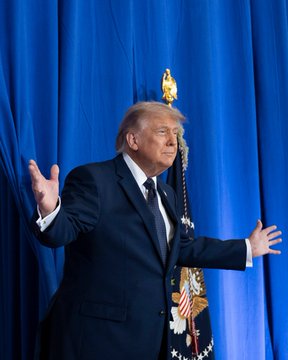
US President Donald Trump speaking during a public appearance as negotiations over a possible Iran deal continue amid tensions over the nuclear programme and Strait of Hormuz. (Image White House)
By TRH World Desk
Trump administration officials are pressing for a $250 bill featuring President Trump’s portrait. Here’s what you need to know.
Washington, May 28, 2026 — Money, as the saying goes, talks. In the Trump era, it may soon do something it has not done in over 150 years — wear a living president’s face.
The Washington Post reported Thursday that Trump administration officials have pressed the Bureau of Engraving and Printing to design a $250 bill featuring President Donald Trump’s portrait, citing four current and former employees familiar with the matter. The revelation cuts to the heart of a question that has dogged the second Trump term: where does presidential ambition end and institutional guardrail begin?
The answer, increasingly, appears to be: wherever the administration decides to draw the line.
According to the WaPo, US Treasurer Brandon Beach and his senior adviser, Mike Brown, “repeatedly urged bureau staff to prepare prototypes of the note.” Beach reportedly went further, delivering mock-up designs directly to bureau employees in August and September 2025. One draft, obtained by the newspaper, placed Trump’s scowling second inaugural portrait at the centre of the $250 note, flanked by the signatures of Trump and Treasury Secretary Scott Bessent, along with the inscription “250 AMERICA.”
The legal problems with this are not subtle. Federal law has prohibited living individuals from appearing on American currency since 1866 — a rule born of hard-won republican principle, intended to keep the republic from sliding into the personality-cult symbolism of monarchy. As Larry R. Felix, a former director of the Bureau of Engraving and Printing, told the Post plainly: “A $250 note is not statutorily authorised” without an act of Congress. “The secretary has to be given authority to do that,” Felix added, referring to Treasury Secretary Bessent.
The denomination itself is an additional complication. Current law limits circulating currency to denominations between $1 and $100. A $250 bill does not legally exist, and creating one would require Congress to act — twice over.
Congress has, in fact, been asked. In February 2025, Rep. Joe Wilson (R-SC) introduced the Donald J. Trump $250 Bill Act, which would direct the Bureau of Engraving and Printing to print a $250 note bearing Trump’s image and carve a one-time exemption into the 19th-century prohibition on living figures. Wilson framed it with characteristic Trumpian flair, writing on X: “Bidenflation has destroyed the economy forcing American families to carry more cash. Most valuable bill for most valuable President!” The bill attracted 15 co-sponsors before stalling in the House Financial Services Committee, where it has sat untouched.
Yet the stall in Congress does not appear to have slowed enthusiasm inside the Treasury. A department spokesperson told the Post that the bureau “is conducting appropriate planning and due diligence,” adding: “Should this legislative mandate be signed into law, the BEP is moving proactively to produce a $250 commemorative note which will appropriately recognize the 250th anniversary of our great nation.”
The 250th anniversary framing is the administration’s most credible political cover. The United States marks its Semiquincentennial in 2026, and commemorative currency tied to the milestone carries genuine public appeal. The State Department has already begun issuing passports featuring Trump’s portrait and signature for the occasion — a move that required no congressional sign-off because passports are executive documents. Bills are not.
British artist Iain Alexander, who produced an early mock-up of the note, told the Post that Trump himself had reviewed the design and offered notes. “He likes to call me his favourite British artist,” Alexander said.
That detail — a sitting president personally engaged in designing his own currency portrait — is the kind of thing that, in a previous American era, would have been disqualifying. Today it barely makes the second paragraph.
The $250 bill may never exist. Congress shows little appetite for the legislation, experts warn of the logistical labyrinth involved in launching any new denomination, and the legal exposure for proceeding without authorisation is real. But the episode is instructive regardless of outcome. It reveals an administration willing to test the boundaries of institutional law not through dramatic executive orders, but through bureaucratic pressure — asking career civil servants to design the future before the law permits it to exist.
In Trump’s Washington, the prototype always comes first. The legislation, if it comes at all, comes later.
Follow The Raisina Hills on WhatsApp, Instagram, YouTube, Facebook, and LinkedIn




About The Author