Russia-China Challenge Western-Led System in Joint Declaration
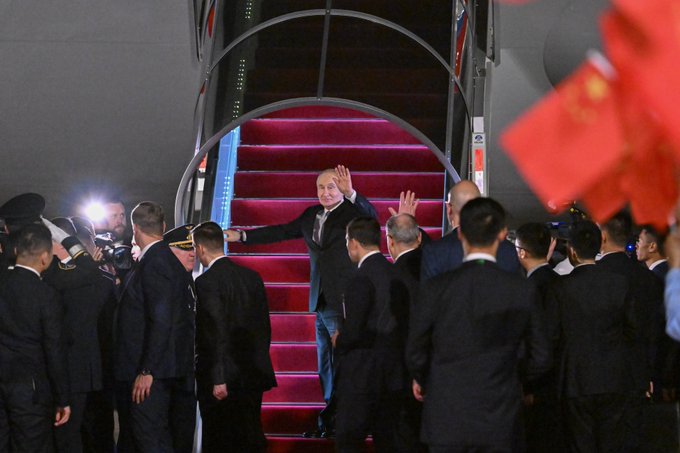
Russian President Vladimir Putin departs after concluding his visit to China. (Image China MFA)
TRH World Desk
Russia and China Unveil New Multipolar Vision, Call for Overhaul of Global Order
New Delhi, May 20, 2026 — In a significant geopolitical signal aimed at reshaping global power structures, the Russia and China on Wednesday issued a sweeping joint declaration advocating the construction of a “multipolar world” and a “new type of international relations,” positioning themselves as central pillars of an emerging post-Western global order.
The declaration, released on May 20, frames Moscow and Beijing not merely as strategic partners but as “important centers of power” tasked with preserving global balance and reforming international governance systems.
The document revives themes that have increasingly defined Russia-China diplomacy over the last decade: opposition to Western dominance, criticism of unilateralism, rejection of military blocs, and demands for greater influence for developing nations in global institutions.
Direct Challenge to Unipolarity
At the core of the declaration is an argument that the post-Cold War international system has entered irreversible transition. Russia and China argue that decolonisation, the rise of Asia, Africa and Latin America, and the growth of regional organisations have fundamentally altered the distribution of global power. According to the statement, attempts by a small number of states to dominate international affairs and impose their interests globally have failed.
Without explicitly naming the West or the United States, the declaration criticises “hegemonism,” “bloc confrontation,” sanctions politics, and what it calls neo-colonial tendencies in international affairs.
The two powers contend that the world is moving toward “polycentricity” — a system with multiple centres of influence rather than a single dominant power.
Security Architecture Without Alliances
One of the most consequential sections concerns security. Russia and China jointly reject military bloc expansion, proxy wars, hybrid conflicts, and zero-sum geopolitical competition. The declaration argues that security cannot be achieved “at the expense of another state,” reflecting long-standing opposition by Moscow to NATO expansion and Beijing’s criticism of alliance-based Indo-Pacific strategies.
The statement also emphasises neutrality rights and rejects coercion forcing countries into geopolitical camps.
This formulation mirrors broader efforts by both countries to present alternatives to Western security frameworks while appealing to the Global South.
Reforming Global Governance
The declaration strongly advocates reform of multilateral institutions, especially the United Nations system. Russia and China argue that global governance structures should provide larger representation and stronger voices for developing countries. The document insists that no state or bloc should monopolise decision-making or development opportunities.
Importantly, both nations defend multilateralism while simultaneously arguing existing institutions have become ineffective and require structural redesign.
Civilisational Politics and Value Systems
The declaration also advances an ideological dimension. It rejects hierarchies between civilizations and argues that no culture, political model, or value system should be considered superior. The statement opposes the use of human rights narratives as instruments for intervention in sovereign affairs.
This language aligns with Beijing’s “Global Civilization Initiative” and Moscow’s longstanding critique of liberal interventionism.
Strategic Message to the Global South
Analysts are likely to view the declaration as aimed not only at Western capitals but also at Asia, Africa and Latin America. By emphasising sovereignty, development rights, anti-colonial narratives and institutional reform, Moscow and Beijing appear to be positioning themselves as champions of a more distributed international system — particularly at a time when forums such as BRICS are expanding and geopolitical competition is intensifying.
The declaration suggests the Russia-China partnership is evolving beyond tactical cooperation into a broader attempt to shape the ideological architecture of a future world order.
Follow The Raisina Hills on WhatsApp, Instagram, YouTube, Facebook, and LinkedIn




About The Author



China and Russia are directly challenging the West’s so called rules-based order, and they should. Now we need to create a new paradigm centered on development of the Global South..