₹100 to a Dollar: Is India Preparing for a Weaker Rupee?

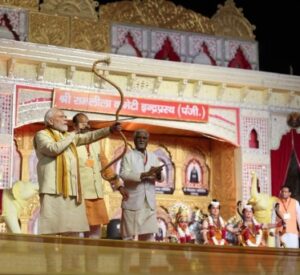
PM Narendra Modi Met a delegation of the 16th Finance Commission members led by Dr Arvind Panagariya, the Chairman of the Commission. (Image Modi on X)
By S. JHA
Former NITI Aayog vice-chairman argues RBI should not fear the psychological barrier of ₹100 per dollar. Yet the debate raises uncomfortable questions about India’s economic resilience, oil dependence and the costs ordinary citizens may bear.
Mumbai, May 21, 2026 — As the Indian rupee inches closer to the psychologically loaded ₹100-per-dollar mark, former NITI Aayog vice-chairman Arvind Panagariya has offered a blunt message to the RBI: stop treating ₹100 as a sacred line.
In a detailed thread on X, Panagariya argued that the Reserve Bank of India should allow the rupee to depreciate naturally rather than burn reserves trying to defend an arbitrary number. “100 is just a number, like 99 and 101,” he wrote, framing rupee depreciation as the economically rational response to an oil-driven external shock.
The intervention is significant not merely because of the economics, but because it may also signal a shift in elite policy thinking: preparing India psychologically for a weaker rupee.
For years, a strong rupee carried symbolic value. It projected stability, confidence and macroeconomic management. Crossing ₹100 to a dollar would therefore be more than an exchange-rate event; it would be politically and psychologically consequential.
Panagariya’s argument rests on two scenarios.
If the oil shock is temporary — lasting three months to a year — depreciation now would eventually reverse once oil prices stabilise and foreign investors return seeking undervalued Indian assets.
If the shock proves prolonged, he argues that defending the rupee through reserve depletion, dollar bonds or high-interest NRI deposits would merely postpone the inevitable. India would eventually cross the ₹100 threshold anyway.
Economically, the argument has merit. Exchange rates are not fixed monuments. Countries often allow currencies to adjust to external shocks. But the question is not whether depreciation is theoretically sound. The question is who pays the bill.
A weaker rupee immediately raises import costs. For a country deeply dependent on imported crude oil, that means higher fuel costs cascading through transport, logistics and consumer prices. Inflation may not be in double digits as it was in 2013, but households already grappling with stagnant wages, expensive food and uneven job creation may experience even modest imported inflation differently from economists.
Panagariya argues India today is not 2013 because inflation remains under control due to prudent monetary management. Yet the political economy of 2026 is arguably more fragile.
Growth concerns, youth unemployment anxieties and widening inequality have already entered public discourse. In such an environment, even technically sound macroeconomic adjustments can become politically combustible.
His criticism of dollar bonds and high-yield NRI deposits is also notable. According to Panagariya, these instruments are expensive stopgaps that effectively transfer wealth to affluent overseas Indians while imposing costs on the domestic economy. He describes them as little more than “band-aids”.
That criticism implicitly challenges a familiar policy reflex: using diaspora capital to bridge external vulnerabilities instead of confronting structural weaknesses.
The larger issue remains India’s persistent oil dependence. Every external energy shock revives the same dilemma — defend the currency, deplete reserves, attract costly foreign capital, or absorb depreciation.
Panagariya’s intervention may therefore be less about exchange rates and more about realism. But realism has political consequences.
For ordinary Indians, ₹100 to a dollar is not merely a statistic on currency markets. It risks becoming another symbol — of imported inflation, rising costs and an economy increasingly vulnerable to global disruptions.
The RBI may ignore the psychological barrier. The public probably will not.
Follow The Raisina Hills on WhatsApp, Instagram, YouTube, Facebook, and LinkedIn




About The Author