Iran War: India Bet on America. America Just Lost. Now What?
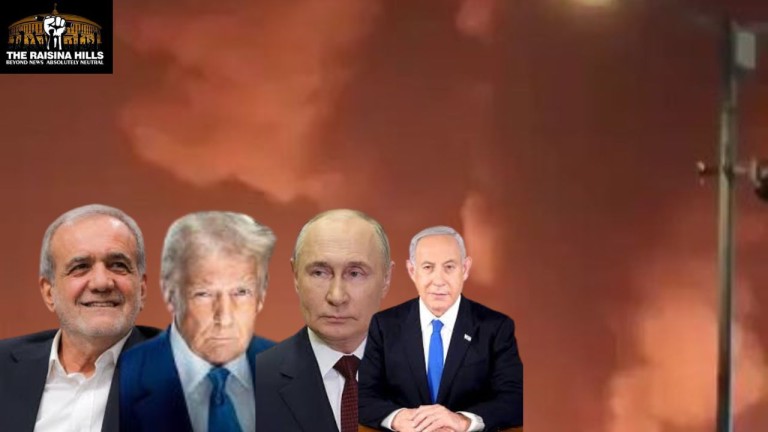
US-Iran-Israel Conflict (Image TRH)
With Germany, UK, Japan and Australia all refusing to join the Hormuz war, and China’s global power surging, geopolitics analyst Manish Anand argues India’s pro-America, pro-Israel image has become a strategic liability it can no longer afford.
By TRH World Desk
New Delhi, March 16, 2026 — One by one, America’s closest allies said no.
Germany’s Chancellor Friedrich Merz stated plainly that this was not NATO’s war. Japan’s Prime Minister — personally an admirer of Donald Trump — ruled out sending warships. Australia, a Five Eyes partner, refused. Britain’s Keir Starmer issued a video statement drawing a clear line: opening the Strait of Hormuz by military force was America’s question, not England’s. France followed. Belgium went further, proposing that the European Union begin repairing relations with Russia.
The picture that has emerged, according to Manish Anand, geopolitics analyst speaking on The Raisina Hills, is of an America that started a war and then found itself strategically alone — and an India that aligned itself too closely to that America at precisely the wrong moment.
“A question mark has appeared over India’s diplomacy,” Anand said, adding: “At a time when America itself is feeling isolated, India’s pro-America and pro-Israel image has been compromised. India will have to very quickly develop a vision and make adjustments.”
Iran held. The world noticed.
At the heart of the emerging new order, Anand argues, is the military reality of what Iran actually achieved in this conflict. Despite facing the combined power of the United States and Israel, Iran neither collapsed nor submitted to regime change. In Iranian political language, Anand notes, the message was directed at what Tehran calls the “Great Satan” — America — and the “Little Satan” — Israel: that Iran could absorb their combined military pressure and keep fighting.
“Trump is desperate for Iran to agree to talks so a ceasefire can be announced,” Anand observed, adding: “He wanted a George W. Bush moment — the Iraq war that rallied public opinion and won him a second term. That has not happened. Public anger inside America against Trump is running far higher than any wartime rally effect.”
American media, Anand points out, has published documents and video footage suggesting the US military position is considerably weaker than Trump’s public declarations imply.
India’s quiet pivot has already begun
Even as the conflict continues, Anand sees early signals that New Delhi is reading the moment correctly. India’s diplomatic engagement with Iranian leadership helped secure passage for Indian tankers through the Strait — vessels that have now safely reached Indian shores. “Iran also wants good relations with India,” Anand said, adding: “There are centuries-old civilisational ties. The full possibility exists for India-Iran relations to normalise very quickly.”
He points to a further signal: India’s recent Cabinet decision to relax restrictions on Foreign Direct Investment from countries sharing land borders — a move widely understood as an opening toward Chinese investment. “India has begun its preparation for the post-Iran world order,” Anand said, adding: “India and China will work together considerably more.”
The broader framework Anand envisions is a resurgent multilateralism — BRICS nations including Brazil, South Africa, Russia, China and India collectively shaping a post-war world order that reduces dependence on American hegemony and dismantles the architecture of unilateral US sanctions that have long constrained global trade.
The question New Delhi cannot delay
“New Delhi does not need to listen to America anymore,” Anand said, echoing a view he describes as increasingly mainstream among global geopolitics commentators. “This is quite logical given what has happened,” he added.
The more immediate question for India, he argues, is whether to resume oil purchases from Iran — which India had curtailed under US pressure. With the External Affairs Ministry having already stated publicly that India decides its own energy sourcing, the political cover exists. “India could increase its options for oil requirements. Beyond Russia, purchases can be made from Iran as well,” Anand noted.
As Trump’s domestic political stakes sharpen ahead of the November midterms and the post-Iran world order takes shape, Anand’s conclusion is pointed: the realignment is not optional for India — it is already underway. The only question is whether New Delhi leads it deliberately or stumbles into it by default.
‘I Stand Here, Ashamed’: Najeeb Jung Questions Silence on Iran
Follow The Raisina Hills on WhatsApp, Instagram, YouTube, Facebook, and LinkedIn




About The Author





Too simplistic an analysis of a complex situation
Have Adanis’ legal difficulties & Epstein’s tangles nothing to do with the stranglehold of the USA?