‘I Stand Here, Ashamed’: Najeeb Jung Questions Silence on Iran
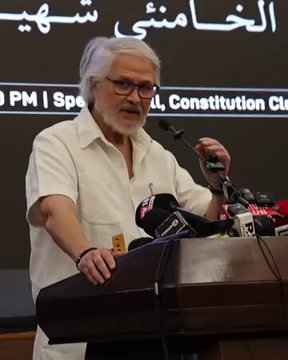
Former Delhi Lt. Governor Najeeb Jung (Image video grab)
In a rare, unguarded public speech, the former administrator turned to English mid-address so embassy officials in the room could hear him directly — then held nothing back
By TRH World Desk
New Delhi, March 15, 2026 — He began in Urdu. Then he stopped himself. “With your permission, I’d like to speak in English,” said Najeeb Jung, former Lieutenant Governor of Delhi, addressing a gathering at the Constitution Club of New Delhi this week, “in the hope that some of the embassies get to hear our voice.”
What followed was one of the most unsparing public speeches delivered by a former Indian official in recent memory — a sustained moral indictment of the world’s silence on the American strikes on Iran, the complicity of Arab nations, the failure of global media, and India’s own hesitation to speak.
“I stand here today,” Jung said, pausing deliberately, “with my head bowed. Ashamed.”
‘There Is Nothing Called the Islamic World’
Jung did not spare anyone — beginning with the nations geographically and religiously closest to Iran.
“There is nothing known as the Islamic world,” he said bluntly. He further stated that “our Arab friends have proven that the concept of pan-Islamism does not exist.”
“It is the Arab world. It is not the Islamic world. They have driven the deepest shaft in our hands for a few dollars that they get,” Jung added.
He questioned what security America could possibly guarantee these nations — and at what cost. “At the cost of humanity? At the cost of lives of children who are dying,” he asked.
Jung invoked Palestine as context for what Iran now faces. “There was a Karbala every day in Palestine for two years,” he said, adding: “And this world kept quiet. And there will be a Karbala repeated in Iran every day of the next few months or years that this war lasts.”
Alexander, Darius and the Civilisation America Is Trying to Destroy
In the most historically resonant passage of his address, Jung reached back seven millennia to make his point about what is at stake in Iran.
“When Alexander the Great came to Persia — and Persia was the greatest empire of the world in those days — he was so impressed by the culture that he decided to stay back,” Jung said. He added that “the Queen Mother, the mother of Darius, treated him like a son. Alexander wished that the great Greek culture could be even a seminal part of the great Persian culture.”
He let the silence do its work before asking: “You want to destroy that? And the world sits quiet.”
The argument was precise and pointed — that what America and Israel are attacking is not merely a military adversary or a nuclear programme, but a 7,000-year-old civilisation with a cultural depth that has outlasted every empire that attempted to erase it. “The Iranians have known the force of pain,” Jung said, adding: “The mistake that has been made by America and Israel is that they forget the concept of sacrifice, the concept of bearing pain that the Iranians have.”
A Personal Memory: The Paris Blast and India’s Condolence Books
Jung drew a sharp and uncomfortable contrast from his own time in office. “I remember — I was still in office in those days — when there was a blast in France, in Paris. I, in office, and several ministers of the Indian government, went to the French embassy to sign the condolence message.”
He paused. “There was just one blast there. There is a blast every minute of the day in Iran, if not every second. There are bombs in thousands. You cannot imagine how a child can sleep in Tehran or Isfahan,” Jung said.
And yet, he noted, India has not found the same institutional impulse to express solidarity with Iran that it found, reflexively, for Paris. The implication was left unstated but unmistakable.
‘The Less We Speak of Indian Media, the Better’
Jung reserved particular contempt for the media ecosystem that has, in his view, rendered the Iranian civilian experience invisible.
“The less we speak of the Indian media, the better,” he said, adding: “And the less we speak of the CNNs and the BBCs and the Al Jazeeras who have sold their conscience for 30 pieces of silver. There is no voice to speak of the Iranians.”
He offered one exception: “I think we are all proud of what the YouTubers do” — a pointed contrast that captured, in a single sentence, where he believes authentic journalism has migrated.
‘Where Is Our Gandhi? Where Is Our Mandela?’
The speech built toward a question that landed with quiet devastation. Jung said: “I stand ashamed today that the world doesn’t have a Gandhi. I stand ashamed today that there is no Mandela to speak for anyone. I stand ashamed that there is no Martin Luther King to speak. Who will speak for these people?”
He was equally clear-eyed about the geopolitical landscape. “It is not India. The Chinese are playing their own games. Perhaps Russia at some point of time,” he added. The absence of a credible, morally authoritative global voice — one willing to speak for the bombed and the besieged without calculating its strategic interest first — was, for Jung, the deepest failure of the present moment.
His call to action was direct: politicians, parliamentarians, civil society leaders, members of every faith community — Sikhs, Muslims, Hindus — needed to “come out in the streets and protest,” write with courage, hold conferences, and “raise the conscience of Americans.”
“Will thousands of our young people and old people and politicians and members of parliament not come out in the streets and protest?” he asked. “Is it not time?”
Follow The Raisina Hills on WhatsApp, Instagram, YouTube, Facebook, and LinkedIn




About The Author