Bengal Gets Poll Dates. But Has Mamata Just Trapped Herself?
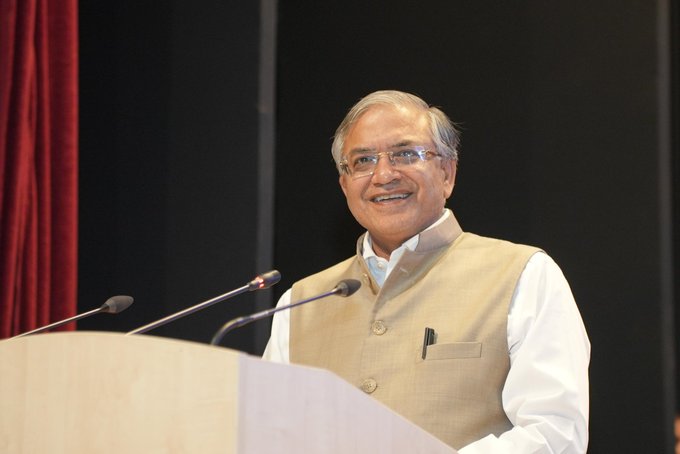
CEC Gyanesh Kumar addressed officer trainees of the Indian Revenue Service (IRS) (Image X.com)
The Election Commission sets West Bengal voting for April 23 and 29 — but with 6.44 crore voters and an incomplete electoral roll, a senior CPI-M leader warns the entire exercise may be constitutionally vulnerable
By NIRENDRA DEV
New Delhi, March 15, 2026 — The mega suspense is over. There will be no President’s Rule in West Bengal.
Chief Election Commissioner Gyanesh Kumar announced Sunday afternoon that the “festival of elections” will be held across four states and one Union Territory — West Bengal, Assam, Kerala, Tamil Nadu and Puducherry — with counting for all on May 4, 2026.
The Full Election Schedule
| State/UT | Polling Date(s) | Counting |
| Assam | April 9 | May 4 |
| Kerala | April 9 | May 4 |
| Puducherry | April 9 | May 4 |
| Tamil Nadu** | April 23 | May 4 |
| West Bengal | April 23 (Phase 1), April 29 (Phase 2) | May 4 |
The term of the current 17th West Bengal Legislative Assembly — a 294-member House — expires on May 7, 2026, making the timeline constitutionally tight but workable.
“About 17.4 crore electors roughly comprise the combined populations of Australia, France, South Africa, Germany and Canada,” Kumar noted, adding that electoral commission representatives from more than 20 countries would observe the process.
The Questions That Survive the Announcement
The suspension of President’s Rule speculation does not resolve the deeper constitutional and political questions that have been building for weeks. The central question: is holding elections in West Bengal without completing the Special Intensive Revision of electoral rolls constitutionally sound?
CPI-M leader and Senior Advocate Bikash Ranjan Bhattacharya says it is not.
“Any attempt at a declaration without completing the enrolment list would be unconstitutional,” Bhattacharya said, adding: “The Election Commission would unnecessarily be inviting much more litigation.”
He further stated that “this is not the way a constitutional authority should function. It’s their failure that they could not yet complete the upgradation of the voter list — and this failure will create disparity.”
The Election Commission’s own response to this was notably careful. CEC Kumar acknowledged that West Bengal’s final electoral list as of February 28 stands at 6.44 crore voters — but added a significant qualifier: “The learned judges, after their adjudication, whatever supplementary list comes, they shall be added.”
In other words, the voter list is not final. The elections will proceed anyway. And the legal exposure that creates is real.
Has TMC Walked Into a Trap?
Here is the political paradox. The Trinamool Congress spent weeks aggressively contesting the SIR process — framing it as a BJP conspiracy to delete minority voters, engineering street protests against the Election Commission delegation, greeting CEC Kumar’s team with black flags and go-back slogans, and mounting legal challenges that drew Supreme Court intervention.
The strategy was aimed at delegitimising the electoral roll revision and, many analysts believed, creating grounds for either postponement or a sympathetic legal stay.
Instead, the Supreme Court directed full logistical support for the SIR process. The Election Commission announced dates anyway. And now the TMC finds itself contesting an election on a voter list it has spent months publicly attacking as flawed and incomplete — while that very incompleteness may, perversely, provide BJP and its legal teams with grounds to challenge results in constituencies where the supplementary list additions prove decisive.
The Broader Electoral Landscape
Beyond Bengal, the election landscape tells its own story.
In Assam, the NDA bloc led by BJP currently holds 86 of 126 assembly seats. The Congress, sitting at just 22, faces an almost vertical climb to the 64-seat majority mark. The BJP is defending from a position of significant strength.
In Kerala, the 140-member assembly will see Chief Minister Pinarayi Vijayan’s CPI-M-led Left Democratic Front face a two-front contest against both the BJP and the Congress-led United Democratic Front — a triangular battle that has defined Kerala politics for decades. The assembly’s term expires before May 23.
In Tamil Nadu, the assembly term ends May 10. The April 23 polling date keeps the constitutional timeline intact — but only just.
Puducherry, the sole Union Territory in the mix, votes April 9 alongside Assam and Kerala.
What CEC Gyanesh Kumar Said
Kumar’s press conference framing was notably elevated — pitched beyond administration into something approaching democratic philosophy.
“These five states and UTs represent distinct geographical and cultural landscapes of India,” he said. “These elections represent not only a democratic exercise, but also the cultural richness of India and truly reflect the unity and diversity of our nation,” he added.
Follow The Raisina Hills on WhatsApp, Instagram, YouTube, Facebook, and LinkedIn




About The Author