Harsh Malhotra Elevation Reveals BJP’s Electoral Calculus in Delhi
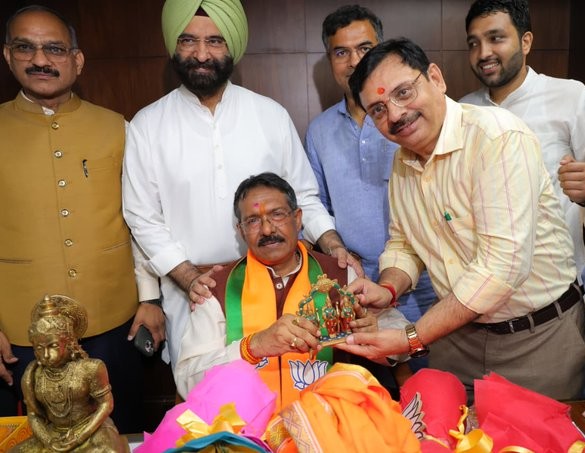
Delhi BJP leader Harsh Malhotra (Image BJP on X)
By SIDHARTH MISHRA
Harsh Malhotra’s appointment as Delhi BJP chief is more than an organisational change. It reflects the BJP’s larger strategy to preserve the Punjabi-Baniya social coalition that powered its return to power in Delhi.
New Delhi, May 28, 2026 — The BJP’s decision to appoint Harsh Malhotra as the new chief of its Delhi unit is not merely an organisational reshuffle. It is a calibrated political signal aimed at preserving the delicate social coalition that brought the saffron party back to power in the national Capital after 27 years.
By replacing Virendra Sachdeva, another Punjabi face, with Malhotra, the party has made it clear that Delhi’s politics continues to revolve around social balancing among its traditional support groups — especially Punjabis and Baniyas.
The move assumes greater significance because the BJP has already installed Rekha Gupta, who belongs to the Baniya community, as the chief minister. In Delhi’s political arithmetic, symbolic representation matters immensely.
The BJP understands that its revival in the assembly elections of 2025 was possible because it succeeded in reconnecting with the very communities that had gradually drifted towards the Aam Aadmi Party during the 2015 and 2020 assembly polls.
For years, a simplistic narrative dominated Delhi’s political discourse: that Purvanchali migrants, Dalits and minorities consolidating behind the AAP caused the BJP’s repeated defeats in assembly elections. While there is partial truth in this argument, electoral data from the past decade presents a far more nuanced picture.
The BJP’s real crisis was not merely its inability to attract new voters; it was the erosion of support among its own traditional urban base — Punjabis, Baniyas and Sikhs — during assembly elections.
This contradiction was visible in the stark difference between Lok Sabha and Vidhan Sabha voting patterns. In parliamentary elections, the BJP consistently swept Delhi, winning all seven Lok Sabha seats in 2014, 2019 and 2024. These victories were powered significantly by overwhelming support from Punjabi-Baniya dominated constituencies. Yet, the same voters appeared to shift allegiance in assembly polls, enabling the AAP to dominate Delhi politics.
There are around 34 assembly constituencies in Delhi where Punjabis and Baniyas hold decisive influence. During Lok Sabha elections, these constituencies generate huge leads for the BJP. However, in the 2015 and 2020 assembly elections, the BJP performed disastrously in these very seats.
In 2020, the party managed to win only one such constituency — Rohini. The remaining BJP victories came largely from constituencies with a substantial Purvanchali and Dalit presence.
This reality completely overturns the conventional wisdom that Purvanchali and Dalit voters alone were responsible for BJP’s defeats. In fact, even during the peak of the AAP wave, several constituencies with strong Purvanchali populations — such as Karawal Nagar, Ghonda, Rohtash Nagar, Laxmi Nagar, Gandhi Nagar, Vishwas Nagar and Badarpur — stayed with the BJP. The bigger political question, therefore, was why Punjabi and Baniya voters, historically regarded as the BJP’s natural constituency, were abandoning the party in assembly elections while continuing to support it in parliamentary polls.
The answer lies partly in the nature of Delhi politics. Parliamentary elections in the Capital are often driven by national considerations and the popularity of leaders like Narendra Modi. Assembly elections, however, revolve around local governance, civic delivery, neighbourhood networks and candidate accessibility. The AAP successfully positioned itself as a party focused on everyday urban governance while simultaneously cultivating deep penetration within trader colonies, refugee settlements and middle-class Punjabi neighbourhoods that once formed the BJP’s ideological backbone.
The BJP’s recent organisational decisions suggest that the party has carefully studied this trend. By ensuring that a Punjabi leader heads the Delhi unit while a Baniya leader occupies the chief minister’s office, the party is attempting to reassure both communities that their political importance within the organisation remains intact. This balancing act is especially important because Delhi’s urban Hindu middle class is not a monolithic voting bloc. Identity, representation and social familiarity continue to influence electoral behaviour.
RSS and Pakistan: Why Hosabale’s Talk Pitch Is Not a Departure
The symbolism of Malhotra’s appointment also extends beyond caste arithmetic. Punjabi refugees who settled in Delhi after Partition have historically played a crucial role in shaping the BJP and the broader Sangh ecosystem in the Capital. Several trader associations, market bodies and residential welfare networks linked to Punjabi communities have traditionally served as informal organisational pillars for the saffron party. The BJP cannot afford alienation within this segment, particularly after rediscovering its electoral relevance in Delhi.
The importance of this voter base becomes even more evident when one examines constituencies under the Chandni Chowk parliamentary segment. Out of ten assembly seats there, Punjabi and Baniya voters heavily dominate eight. The area also houses a dense network of Rashtriya Swayamsevak Sangh shakhas and affiliated organisations. Yet, despite such ideological presence, the BJP failed to win any of these eight seats in the 2020 assembly polls. The defeats exposed a disconnect between ideological influence and booth-level electoral mobilisation.
This explains why the BJP has increasingly focused on strengthening organisational machinery rather than merely depending on the Modi factor. Programmes such as “Mera Booth Sabse Majboot” were designed precisely to energise booth workers and rebuild direct contact with core voters. The BJP’s leadership realised that unless its traditional supporters turned out enthusiastically in assembly elections, returning to power in Delhi would remain difficult.
The 2025 victory appears to have emerged from that learning process. Unlike previous elections, the BJP succeeded in reviving enthusiasm among sections of Punjabi and Baniya voters who had previously voted differently in assembly and parliamentary contests. The party’s strategy was not based solely on expanding its social coalition but on reclaiming its original one.
Malhotra’s elevation must therefore be viewed within this broader framework. It is both a reward to the Punjabi leadership for its role in the BJP’s return to power and a message that the community’s influence within Delhi BJP remains secure despite the rise of new social groups in the city’s politics.
At another level, the move reflects the BJP’s larger political method across India — combining governance with social representation. The party has repeatedly demonstrated that electoral success is sustained not merely through ideological messaging but also through careful accommodation of influential caste and community groups within organisational structures.
Delhi remains a uniquely complex political landscape where national and local voting behaviours differ sharply. The BJP’s challenge will be to ensure that the social coalition that delivered victory in 2025 does not fragment again in future civic or assembly contests. By appointing Harsh Malhotra as Delhi BJP chief, the party has attempted to send a stabilising message to its traditional urban base: that the Punjabi-Baniya axis, which historically formed the core of Delhi’s saffron politics, remains central to its political strategy even today.
From Memes to Mandates? The Limits of Cockroach Janata Party
Follow The Raisina Hills on WhatsApp, Instagram, YouTube, Facebook, and LinkedIn




About The Author