From Memes to Mandates? The Limits of Cockroach Janata Party
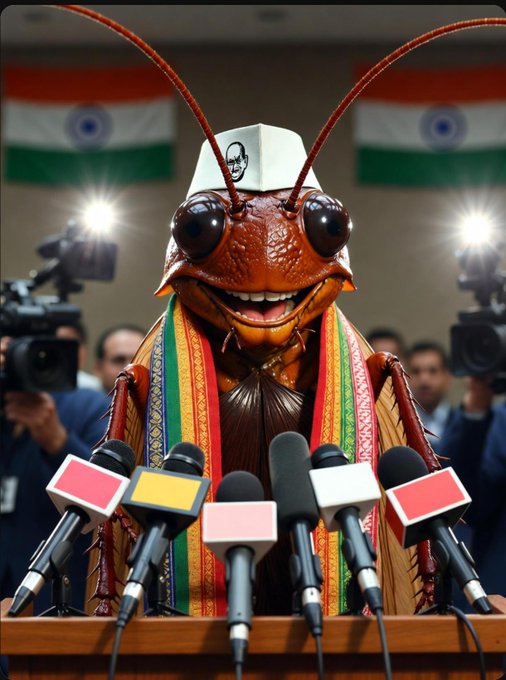
Cockroach Janata Party mascot (Image X.com CJP)
By SIDHARTH MISHRA
The Cockroach Janata Party may be a meme-driven movement today, but its rapid rise reveals deeper anxieties among India’s youth over jobs, exams, and political representation. But India’s political system may resist meme-driven upheaval.
The sudden rise of the so-called “Cockroach Janata Party” (CJP) on social media has revealed something far deeper than a passing meme trend. Despite the extraordinary traction it has gained online, there is little reason to believe that the movement can easily transform itself into a serious political force in real-world electoral politics.
India’s democratic structure, political culture, and institutional resilience are vastly different from those of countries such as Bangladesh, Nepal, or Sri Lanka, where youth-driven upheavals have recently reshaped governments. The emergence of the CJP began after remarks attributed to the Chief Justice during a court hearing triggered a storm on social media.
Even though the clarification followed quickly, the phrase had already touched a nerve among millions of young Indians. Within days, memes, hashtags, videos, and digital campaigns around the “cockroach” metaphor flooded Instagram and X. The symbolism worked because it resonated with a section of youth that increasingly feels invisible within the system.
The choice of the cockroach as a political metaphor is itself revealing. Cockroaches are generally associated with disgust and neglect, yet they are also known for resilience and survival. Young supporters of the campaign argue that they are identifying with a creature that refuses to die despite hostile conditions.
However, the online popularity of the movement should not be mistaken for an imminent political revolution. India’s political landscape has repeatedly shown that social media energy does not automatically translate into durable electoral success. The biggest example remains the India Against Corruption (IAC) movement led by Anna Hazare more than a decade ago. That movement, too, had mobilised unprecedented urban middle-class and youth participation. It channelled anger against corruption into a nationwide agitation and eventually gave birth to the Aam Aadmi Party (AAP).
But the trajectory of that experiment also explains why many Indians remain sceptical of new anti-establishment political movements. A large section of those who had enthusiastically joined the anti-corruption movement eventually felt betrayed by the transition from activism to conventional politics.
Idealistic promises gave way to political compromises, internal conflicts, personality-driven leadership battles, and accusations that the movement itself had become part of the same political culture it once opposed. For many Indians, that experience has created deep cynicism toward any political mobilisation claiming to represent “pure change.”
This historical memory is one of the biggest obstacles before the CJP. While millions may follow its Instagram page or share its memes, translating digital discontent into booth-level political organisation is an entirely different challenge.
Elections in India are not won by viral content alone. They require cadre networks, sustained local engagement, ideological clarity, financial resources, and credible leadership. The CJP currently appears more like a spontaneous digital outburst than a structured political alternative.
At the same time, dismissing the phenomenon entirely would be a serious mistake. The scale and intensity of the response indicate that a significant section of Indian youth feels unheard. India is one of the world’s youngest countries, with an average age of around 27 years. Yet policymaking and political representation continue to be dominated by older generations.
According to various analyses, most legislators and ministers are well above 50 years of age. Young people increasingly consume politics through social media, where they expect immediacy, accountability, humour, and direct engagement. Traditional political communication often appears distant and scripted to them.
The frustration also has concrete economic roots. Unemployment, competitive examinations paper leaks, rising educational costs, stagnant wages, and inflation have created anxiety among large sections of students and first-time job seekers. The controversy surrounding examinations such as NEET has further deepened the perception that even merit-based pathways are becoming unreliable.
For many young Indians, the fear is not simply economic hardship but the belief that the system itself may not reward honesty or hard work fairly. This is why the government cannot afford to treat the CJP merely as an internet joke or dismiss it as foreign propaganda or an opposition conspiracy.
Doing so would only widen the disconnect between institutions and youth sentiment. The central and state governments need to seriously examine why such a campaign found immediate resonance among millions. The answers may lie not in the movement’s rhetoric but in the insecurities that fueled its growth.
At the same time, opposition parties too must introspect. Much of the youth anger visible online is not automatically translating into support for conventional opposition politics either. Many young users mocking the establishment are equally distrustful of opposition parties, whom they often view as ineffective, opportunistic, or disconnected from ground realities. This vacuum of trust is precisely what allows unconventional digital movements to gain traction so quickly.
India possesses stronger democratic institutions, a more stable constitutional structure, and a far more complex social and political fabric. Sudden regime changes driven solely by social media mobilisation are therefore unlikely. Indian democracy also has a long history of absorbing dissent and adapting gradually rather than collapsing abruptly. But democratic resilience should not be confused with public satisfaction.
(This is an opinion piece. Views expressed are the author’s own.)
Follow The Raisina Hills on WhatsApp, Instagram, YouTube, Facebook, and LinkedIn




About The Author