Why Kerala’s Budget Numbers Are Raising Difficult Questions
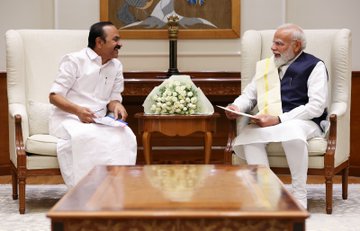
Kerala Chief Minister V. D. Satheesan on Tuesday called on PM Narendra Modi. (Image Satheesan on X.)
By P. SESH KUMAR
Kerala’s fiscal challenge is not welfare alone but the collision of debt, ageing, rigid spending and the end of revenue-deficit grants.
The finances confronting Kerala’s new government are neither the stuff of sensationalist bankruptcy talk nor the manageable discomfort of a welfare state briefly squeezed by New Delhi. They are more serious, and more interesting, than either caricature. Kerala still carries the social prestige of an advanced state: high life expectancy, very low infant mortality, near-universal access to basic public services, and a political culture that treats pensions, healthcare, education, and social protection as core state obligations rather than charitable extras. But the numbers now show that this social compact is being financed with a fiscal machine that has become rigid, debt-heavy, and increasingly dependent on accounting maneuvers, optimistic projections, and shrinking external cushions.
The collapse of post-devolution revenue-deficit grants exposed the gap mercilessly. CAG’s latest audit for Kerala shows grants-in-aid from the Union falling by 55.92 per cent in 2023-24, while the State’s revenue deficit climbed to Rs18,140 crore; the 2026-27 Annual Financial Statement now budgets a revenue deficit of Rs 34,587 crore.
NITI Aayog’s recent work complicates the lazy story that Kerala simply does not raise enough money: strangely, the State scores relatively well on revenue mobilisation, but badly on expenditure quality, debt burden, and fiscal prudence. The real verdict, then, is harsher and more precise. Kerala’s fiscal problem is not welfare alone, not federal discrimination alone, and not tax weakness alone. It is the collision of a demanding welfare architecture, ageing and pension pressures, modest capital formation, off-budget liabilities, and a transfer regime that no longer hides the strain.
Where the grant illusion broke
The first fact the new government must stare down is brutally simple: it has inherited not just a budget, but the end of an illusion. For years, Kerala’s books were cushioned by post-devolution revenue-deficit grants. Those grants did not solve Kerala’s structural imbalance; they anaesthetised it. The official Finance Commission-backed Kerala study shows that post-devolution revenue-deficit grants were still Rs 19,891 crore in 2021-22, Rs 13,174 crore in 2022-23, and Rs 4,749 crore in 2023-24, before dropping out thereafter. The 2025-26 Kerala budget documents themselves show the same cliff edge: Rs 13,174 crore, then Rs 4,749 crore, then zero. Kerala did not suddenly become fiscally weak when the grants disappeared; the grants merely stopped disguising a weakness that was already there.
Once that support ebbed, the accounts immediately looked rawer. According to the CAG’s 2025 State Finances Audit Report for Kerala, revenue receipts fell by 6.21 per cent in 2023-24, from Rs 1,32,724.65 crore to Rs 1,24,486.15 crore, even though the State’s own tax revenue rose by 3.28 per cent and its share in Union taxes and duties rose by 19.07 per cent.
The reason was the collapse in grants-in-aid from the Union, which slumped from Rs 27,377.86 crore to Rs 12,068.26 crore in a single year, a drop of 55.92 per cent. The result was predictable and ugly: revenue deficit rose to Rs 18,140.19 crore, or 1.58 per cent of GSDP, and fiscal deficit rose to Rs 34,258.05 crore, or 2.99 per cent of GSDP. That is the real drama. The state did not lose its revenues across the board; it lost the cushion that had been covering the hole.
Why the problem is deeper than a lazy tax story
Yet it would be a mistake to reduce Kerala’s fiscal story to the lazy cliché of a spendthrift welfare state that never bothered to tax. NITI Aayog’s ‘Macro and Fiscal Landscape of the State of Kerala’ makes that easy simplification impossible. In 2022-23, Kerala’s own tax revenue and own non-tax revenue, at 6.9 per cent and 1.5 per cent of GSDP respectively, were both marginally above those of a median large state.
NITI’s ‘Fiscal Health Index 2026’ goes further: Kerala ranks seventh among major states on revenue mobilisation, with a score of 47.8, putting it in the “Front Runner” category on that specific dimension. This is a crucial complication. Kerala’s problem is not that it raises no money. It is that the money it raises is not large or elastic enough to keep pace with the structure of commitments it has built into the state. That difference matters, because it changes the diagnosis from laziness to mismatch.
And those commitments have yielded real public value. Kerala’s social model is expensive, but it is not fictitious. NITI’s Kerala profile notes life expectancy at 75 years in 2020, infant mortality at 6 per 1,000 live births, household access to sanitation at 98.5 per cent, electricity at 99.5 per cent, and drinking water at 95.9 per cent. These are not decorative indicators. They mean the state has historically used public money to buy social capability, not merely political applause.
That is why any call for “fiscal discipline” that translates into mindless compression of health, education, or old-age support would be both politically naive and economically foolish. Kerala is not paying for nothing. It is paying for a high social floor. The trouble is that the old fiscal plumbing cannot now sustain that floor without strain.
The real choke point lies in expenditure rigidity. CAG reports that committed expenditure on salaries, pensions, and interest payments reached Rs 92,728.15 crore in 2023-24, accounting for 65.01 per cent of revenue expenditure. Add other inflexible heads and the ratio becomes 74.83 per cent of revenue expenditure. That leaves the government with surprisingly little discretionary space even before it begins to talk about development.
“Subsidies” are not the main villain if the word is used in the narrow budgetary sense. CAG notes direct subsidies at Rs 1,723.83 crore in 2023-24, only 1.21 per cent of revenue expenditure. Kerala’s binding fiscal rivals are not classic subsidy bills alone; they are pensions, salaries, interest, and the support channelled through state entities and welfare vehicles. In that sense, the phrase “welfare state commitments” is accurate, but the phrase “subsidy burden” is too blunt to capture the anatomy of the problem.
There is a further irony. Kerala’s economy is famously buffered by migration and remittances, and the Sixteenth Finance Commission’s Kerala study notes that remittances amounted to more than 10 per cent of GSDP in normal years, except during the pandemic shock. But remittances are a comfort blanket for private households, not a magic wand for public finance.
They boost consumption, real estate demand, and services, but the state can only catch the fiscal spillover through indirect taxes, stamp duties, vehicle taxes, excise, fees, and a non-tax system in which lotteries remain disproportionately important. Recent West Asian crisis would have made a dent in the remittances.
NITI’s Fiscal Health Index observes that lotteries accounted for between 66 and 81 per cent of Kerala’s non-tax revenue during 2019-20 to 2023-24. Meanwhile, GST and sales-related taxes dominate the own-tax basket. That is not a robust sovereign tax architecture; it is a narrow, consumption-heavy revenue frame trying to finance a very broad social state.
Borrowing on a treadmill
If the revenue side explains why Kerala is squeezed, the borrowing side explains why the squeeze now feels dangerous. The CAG’s most damning table is not the debt ratio table, but the table on utilisation of borrowed funds. In 2023-24, 88.45 per cent of total borrowings went to repayment of earlier borrowings. Only 5.18 per cent went to net capital expenditure, 0.99 per cent to net loans and advances, and 5.38 per cent to financing revenue expenditure. CAG’s own language is unusually blunt: borrowed funds, it says, were being used mainly for current consumption and repayment of earlier borrowings rather than capital creation and development. This is the point at which Kerala’s fiscal debate must stop pretending that “borrowing for development” is a sufficient defence. A state can survive with high debt if debt is visibly building future capacity. It cannot indefinitely defend debt that mostly refinances yesterday.
That is why Kerala’s capital story looks so anaemic against its rhetoric. CAG records capital expenditure at Rs 13,584.45 crore in 2023-24, down from Rs 14,191.73 crore in 2021-22, and notes that capital expenditure was only 7.39 to 9.28 per cent of total expenditure over the five-year period from 2019-20 to 2023-24.
NITI’s Fiscal Health Index is harsher still. Kerala ranks last among major states in quality of expenditure, with a score of 4.1. NITI’s Kerala state chapter says capital expenditure over the previous five years ranged between just 1.04 and 1.67 per cent of GSDP. That is a startlingly weak transformation ratio for a state that has repeatedly argued that its borrowing model is future-oriented. The state is borrowing a lot; it is building less than its debt narrative suggests.
This treadmill has also begun to show up in cash management. In 2023-24, Kerala had to resort to Ways and Means Advances, Special Drawing Facility, and overdrafts amounting in aggregate to Rs 53,306.52 crore, with overdrafts used on 67 days, according to CAG. No, this does not mean imminent insolvency.
But it does mean liquidity is being managed under stress, not ease. A state that still has to tap such short-term mechanisms so heavily while also carrying a large structural revenue deficit is not in free fall; it is in a constant fight with the calendar. That sort of fiscal life can continue for some time. It is also the kind of life in which one external shock, one court award, one pay revision, or one central tightening can suddenly make the ordinary look alarming.
The shadow ledger and federal squeeze
Kerala’s official budget, moreover, is not the whole budget. The shadow ledger matters. CAG reports off-budget borrowing of Rs 10,632.46 crore in 2023-24 through Kerala Infrastructure Investment Fund Board (KIIFB) and Kerala Social Security Pension Ltd., (KSSPL) taking the outstanding stock of off-budget borrowing to Rs 32,942.14 crore by March 2024.
CAG says that, once these are counted, outstanding liabilities rise to 37.84 per cent of GSDP, against the Kerala Fiscal Responsibility target of 33.70 per cent. This is not merely a technical accounting dispute. Borrowing through KIIFB can at least be argued to create long-lived public assets. Borrowing through KSSPL is fiscally much more uncomfortable because it effectively finances current welfare commitments through debt. A road financed today may still serve the taxpayer who repays it tomorrow. A pension financed off-budget is a far more naked transfer of present politics into future debt service.
The broader public sector compounds the risk. CAG’s press brief notes that the return on the State’s investment in PSUs rose to 2.22 per cent in 2023-24, still far below the 6.74 to 7.58 per cent interest paid by the government on its borrowings. The Sixteenth Finance Commission’s Kerala study then adds a more disturbing institutional detail: KSRTC, Kerala Water Authority, Kerala State Social Security and Pension Ltd., and KSEB Ltd. together accounted for 86 per cent of the total net loss of Kerala’s public enterprises in 2022-23, while public utilities contributed 80.2 per cent of all such losses. In plain English, Kerala is not just carrying debt; it is carrying weak delivery institutions on whose behalf the budget is repeatedly asked to bleed. Even when direct subsidies look manageable, quasi-fiscal burdens keep reappearing through these state entities.
Still, any fair account must admit that Kerala’s complaint about the federal squeeze is not theatrical self-pity. NITI records that Kerala’s share in taxes from the Centre fell from 2.5 per cent under the Fourteenth Finance Commission to 1.9 per cent under the Fifteenth, with some compensation coming through increased revenue-deficit grants. The outgoing government’s 2026 budget speech complained explicitly that tax devolution and borrowing limits had been curtailed while expenditure commitments kept increasing.
And the Sixteenth Finance Commission’s final report does impose a harder environment than many states would have liked: no revenue-deficit grants at all, no sector-specific or state-specific grants, and a firm recommendation that states remain capped at a fiscal deficit of 3 per cent of GSDP. Kerala does get one bit of relief: its ‘inter se’ share in horizontal devolution has been fixed at 2.382 per cent for 2026-31. But that is not a bailout. It is a slightly kinder formula inside a much stricter regime.
The deeper truth, then, is uncomfortable for both sides of the political argument. Kerala can legitimately say Delhi has tightened the screws. But Kerala must also admit that its own fiscal machine had become too rigid even before the screws tightened. The Sixteenth Finance Commission’s Kerala study says exactly that in more polite language: revenue growth has lagged GSDP growth in recent years for reasons partly exogenous, yet the State must still mobilise more revenue resources and rationalise expenditure.
The same study estimates that, even after recent improvement, around 60 per cent of borrowed resources would continue to be used to fill the revenue deficit gap till 2026-27. So yes, federal rules have made Kerala’s life harder. But a harder life is not the same thing as an innocent balance sheet.
The projections now facing the new government
If this were only a story about past audits, the new government could console itself that things were already improving. The problem is that Kerala’s own projections have become less comforting, not more. The 2025-26 Medium Term Fiscal Policy statement had placed the 2026-27 revenue deficit and fiscal deficit at 2.29 per cent and 3.51 per cent of GSDP respectively and pegged the debt-GSDP ratio at 33.15 per cent. But by the time the 2026-27 Medium Term Fiscal Policy statement was issued, those numbers had worsened.
The new MTFP put the revenue deficit and fiscal deficit for 2026-27 at 2.58 per cent and 3.78 per cent of GSDP respectively and indicated a debt-GSDP path of roughly 34.4 per cent for 2026-27, easing only to 33.36 per cent in 2027-28 and 33.29 per cent in 2028-29. In one year, then, the state’s own forward arithmetic shifted against itself. That is often the surest sign that optimism is running out and realism is beginning to bite.
The Annual Financial Statement for 2026-27 makes the hole visible in rupee terms. Revenue receipts are budgeted at Rs1,82,972.10 crore and revenue expenditure at Rs 2,17,558.76 crore, leaving a revenue deficit of Rs 34,586.66 crore. If we compare that with the audited revenue deficit of Rs 18,140.19 crore in 2023-24, the scale of deterioration becomes impossible to prettify.
To be sure, budget estimates are not audited outcomes. But they tell us what the State itself believes it must plan for. And what Kerala is planning for in 2026-27 is not a narrow shortfall, but a gaping revenue account wound. The grant illusion is no longer merely over; it has been replaced by a budgeted admission that the ordinary revenue stream cannot carry the ordinary obligations.
The hard road back to fiscal credibility
What, then, should the new government actually do? Not what the slogan-merchants of austerity think. Kerala cannot simply slash its way back to health without harming the very social assets that distinguish it. But neither can it emote its way out through endless complaint about the Centre. The first correction must be intellectual.
Kerala’s fiscal problem is not solvable by one heroic tax move. Since it already performs better than the median state on own-revenue effort, the gains from additional mobilisation will be meaningful but incremental, not miraculous. The right revenue strategy is therefore technical and unspectacular: stronger compliance, better valuation, more leakage control, sharper user-charge rationalisation, and less dependence on lottery cash as a crutch.
The Sixteenth Finance Commission’s Kerala study points directly to improving tax compliance and rate revision, and even flags undervaluation in stamp-duty administration as a live area of revenue leakage. That is the road: boring reforms with recurring yield, not theatrical announcements with one-off optics.
The second task is harder, because it is political rather than merely administrative. Pension and payroll reform can no longer be deferred into philosophical abstraction. CAG’s audit and NITI’s work both show that salaries, pensions and interest are choking fiscal flexibility.
At the same time, Kerala’s social indicators prove that the answer cannot be a crude hacking away at health, schooling and social care. The state must learn to distinguish between core social obligations that produce durable social returns and peripheral or badly targeted expenditures that survive mainly because they are politically sticky.
That means tighter targeting of transfers, cleaner beneficiary databases, firmer control over support routed through state entities, and an end to the habit of financing current welfare through debt-like devices outside the main budget. If a borrowed rupee is not creating an asset or a durable productivity gain, the burden of proof should now fall on the politician who wants to spend it.
The third task is honesty. Kerala needs a government willing to present a believable path rather than a beautiful one. Off-budget borrowing, over-friendly medium-term projections, weak capital conversion, low PSU returns, and the casual normalisation of refinancing are all forms of fiscal camouflage.
The new government should begin with an explicit opening balance-sheet statement that recognises the full burden of KIIFB, KSSPL, guarantees, and contingent support to utilities. It should then publish a three-year consolidation path that the market, the Assembly, and the public can actually trust.
The Sixteenth Finance Commission has already made clear that the era of revenue-deficit grants is over and the era of a hard 3 per cent fiscal-deficit ceiling is here. Kerala can rage against that, and some of that rage is justified. But the state will not regain fiscal credibility until it does something more difficult than protest: it must prove that it can fund a first-rate social contract with first-rate fiscal craftsmanship. Otherwise, every change of government will merely change the cast, while the same old cash crunch returns for an encore.
(This is an opinion piece. Views expressed are the author’s own.)
V.S. Achuthanandan: Kerala’s Revolutionary Communist Bows Out
Follow The Raisina Hills on WhatsApp, Instagram, YouTube, Facebook, and LinkedIn




About The Author