RSS and Pakistan: Why Hosabale’s Talk Pitch Is Not a Departure
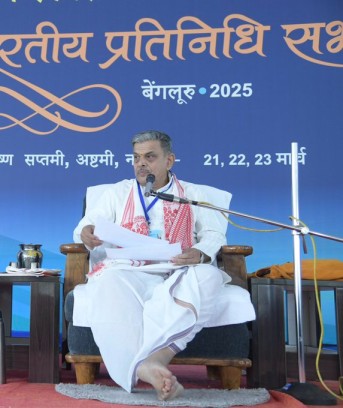
RSS general secretary Dattatreya Hosbole in Bengaluru on Sunday (Image credit Rajesh Padmar)
By SIDHARTH MISHRA
Dattatreya Hosabale’s remarks on dialogue with Pakistan reflect the RSS’s layered position combining national security concerns with cultural engagement.
The Rashtriya Swayamsevak Sangh (RSS) has always held a layered and nuanced view on Pakistan. On one hand, the organisation has consistently condemned Pakistan-sponsored terrorism, the politics of partition, and religious extremism. On the other hand, several of its senior leaders have, from time to time, emphasized the importance of dialogue, cultural ties, and people-to-people engagement. Recent remarks by RSS general secretary Dattatreya Hosabale have once again brought this debate into focus, whether the RSS is changing its approach towards Pakistan, or whether this is simply an extension of its long-standing ideological position in a more balanced form.
Hosabale recently stated that “a channel for dialogue should always remain open” and that ordinary citizens and civil society groups in Pakistan should take initiatives for peace and engagement. He also referred to the shared cultural links and common history between the two countries. The statement came at a time when India-Pakistan relations continue to be strained due to terrorism, border tensions, and deep political distrust.
Predictably, the remarks drew varied political reactions. Some interpreted them as a sign of moderation within the RSS, while critics accused the organisation of displaying “softness” towards Pakistan. Any discussions around Pakistan in India often become highly emotional and politically charged. Any attempt at peace outreach is frequently viewed with suspicion. In that context, Hosabale’s remarks are significant because they attempt to strike a balance between nationalism and dialogue.
When viewed in the context of the RSS’s broader ideological history, Hosabale’s statement does not appear sudden or inconsistent. The RSS’s worldview is rooted in the idea of cultural nationalism. The organisation has long spoken of “Akhand Bharat” (Undivided India), regarding Partition as a historical mistake. RSS chief Mohan Bhagwat has repeatedly argued that India and Pakistan were once part of the same civilizational and cultural space. He once described Pakistan as “a room of the same house.” Yet this idea is generally articulated not as an immediate political or military objective, but more as a civilizational and cultural aspiration.
This explains why two parallel strands can be seen in the RSS’s approach towards Pakistan. The first strand is centered on national security and strategic interests. The RSS has passed several resolutions condemning Pakistan-backed terrorism. Its stance on Kashmir, cross-border terrorism, and religious radicalism has remained uncompromising. The organisation and its affiliates have consistently maintained that there can be no compromise on India’s sovereignty and security. From this perspective, Pakistan’s military establishment and extremist elements are viewed as the primary obstacles to peace.
The second strand relates to cultural and social engagement. Hosabale’s statement reflects this dimension. The RSS does not necessarily see the people of Pakistan as enemies. Shared languages, cuisine, music, traditions, and historical experiences continue to connect the societies of the two nations. This is why some RSS leaders have periodically spoken in favour of “people-to-people contact” and sustained dialogue. In many ways, this aligns with India’s broader diplomatic tradition, which sees war as the last resort.
Importantly, the ideas of “Akhand Bharat” and “dialogue” are not necessarily contradictory within the RSS framework. For the organisation, Akhand Bharat is not only about political reunification; it also signifies cultural proximity and civilizational continuity. Therefore, when Hosabale advocates dialogue, he is not stepping outside the RSS’s ideological framework, but rather presenting it in a pragmatic and humane manner.
It is equally important to recognize the harsh realities that define India-Pakistan relations. Cross-border terrorism, a history of wars, and deep-rooted mistrust cannot be resolved merely through emotional appeals. Even within the RSS, calls for engagement are not made at the cost of national security concerns. The broader approach may therefore be described as one of “peace with vigilance.” Even within the RSS’s nationalist rhetoric, there appears to be an understanding that lasting peace cannot be achieved solely through military strength, but also through social and cultural engagement.
Ultimately, the RSS’s view on Pakistan is less contradictory than it is multi-dimensional. The organisation strongly criticizes Pakistan’s power structures and support for terrorism, while simultaneously acknowledging the shared cultural heritage and the importance of keeping channels of dialogue open. Dattatreya Hosabale’s recent statement can therefore be seen as reflecting this complex but balanced perspective, one where national interest remains paramount, but the possibility of peace and engagement is not entirely abandoned.
(This is an opinion piece. Views expressed are the author’s own.)
Follow The Raisina Hills on WhatsApp, Instagram, YouTube, Facebook, and LinkedIn




About The Author