Thirst Before Coins: Childhood Under Delhi’s Blazing Sun
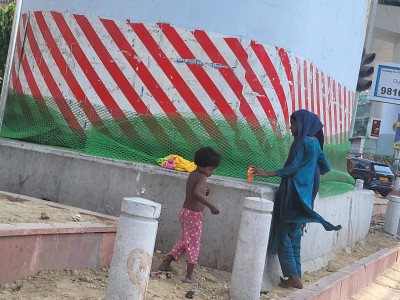
At Delhi Signals, Children Begging for Water Reveal a Deeper Crisis (Image Bhawna Malik)
By BHAWNA MALIK
As Delhi’s temperatures cross 44°C, child beggars at traffic signals are increasingly asking for water instead of money. The heatwave is exposing an invisible humanitarian crisis among street children.
New Delhi, May 19, 2026 — As temperatures soar beyond 44°C, child beggars at Delhi’s traffic signals are no longer asking for money first — they are asking for water. Yet amid policy announcements and urban indifference, their suffering remains largely invisible.
At a bustling red light near Hotel Siddhartha Jaypee in Patel Nagar, six-year-old Chandu (name changed) wipes sweat from his face as vehicles idle under the scorching Delhi sun. Barefoot and shirtless, he moves from one car window to another, stretching out a tiny hand not for toys or schoolbooks, but for survival.
When he pauses to ask for water instead of money, he is slapped by his mother.
“Sirf paise lene hain, khana peena nahi” (“Only accept money, not food or water”), Chandu’s mother shouts.
For Chandu and thousands of children like him, Delhi’s brutal summer is not merely uncomfortable — it is life-threatening. While children his age spend vacations indoors or attend school, Chandu spends nearly every waking hour inhaling toxic fumes at traffic intersections.
His three-year-old sister, Jhumki (name changed), has already learned the harsh rules of survival.
“Only money, no water, no biscuits,” older beggars warn her. Even hunger must wait.
Across Delhi’s traffic signals, a disturbing shift is visible this summer. Children who once begged primarily for coins are now murmuring a single desperate word: “Paani.”
Ironically, near the same roundabout where Chandu stands, residents and feeders regularly leave water and grain for pigeons and stray animals. Yet no public drinking water source exists for the children begging nearby.
“Mandir se paani laate hain, par baar baar nahi,” Chandu says softly. (We get water from the nearby temple, but not regularly.)
The Nomad Who Left Silicon Valley for Goats, Art and Conscience
A Summer of Survival
India’s intensifying heatwaves are exposing the country’s poorest children to unbearable conditions. With temperatures repeatedly crossing 44°C in Delhi, street children face constant risks of dehydration, heatstroke, exhaustion, and illness.
Delhi Chief Minister Rekha Gupta recently announced precautionary measures for gig workers, labourers and security guards during the heatwave. Yet child beggars — among the most vulnerable groups on city streets — found no mention.
“I used to ask for money,” says 10-year-old Raju (name changed), who spends his days at another busy crossing. “Now I feel dizzy. I just want water. Money can’t stop the heat.”
According to UNICEF, millions of Indian children continue to live without adequate shelter, nutrition or hydration, making them especially vulnerable to extreme weather events worsened by climate change.
“These children are the invisible victims of urban life,” says social worker Meena Sharma. “People notice them but rarely truly see them. Sometimes, a single bottle of water can prevent a child from collapsing.”
Childhood Lost to Poverty
Behind the traffic signals lies a deeper crisis rooted in migration, debt, unemployment and social neglect. Many children begging on the streets belong to families trapped in intergenerational poverty or informal begging networks.
India has over 3.72 lakh child beggars below the age of 14, according to Census 2011 data. West Bengal records the highest number, followed by Uttar Pradesh and Madhya Pradesh.
Delhi’s challenge is equally stark. An estimated 60,000 beggars live in the city, with nearly one-third believed to be children, according to the Delhi Commission for Protection of Child Rights (DCPCR). Separate surveys estimate that over 70,000 children live on Delhi’s streets.
Beyond Sympathy
Experts warn that organised begging rackets continue to exploit vulnerable children, while girls face heightened risks of abuse, trafficking and exploitation.
Activists argue that rescue drives alone are insufficient. Families need stable livelihoods, shelter, healthcare and access to education.
What Delhi urgently requires is not seasonal sympathy but sustained policy action — drinking water access at major intersections, heat shelters, child protection teams, rehabilitation programmes and stricter enforcement against organised exploitation.
Because when a six-year-old child standing barefoot on a burning road asks not for money but for water, the crisis is no longer about poverty alone.
It is about humanity.
Follow The Raisina Hills on WhatsApp, Instagram, YouTube, Facebook, and LinkedIn




About The Author