Why Progressive Politics Failed in the 21st Century
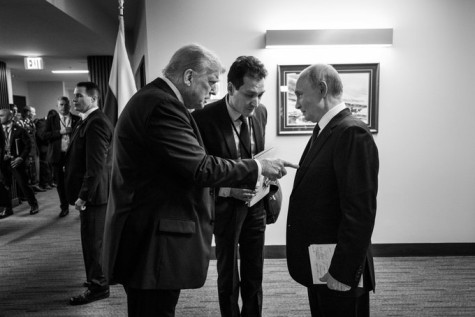
US President Donald Trump speaking to Russia's President Vladimir Putin! (Image The White House)
From Obama and Merkel to Modi and Milei — a rigorous political analysis of how redistributive and pluralist movements collapsed across the US, Europe, India and the Global South between 2000 and 2026.
By SAHASRANSHU DASH
Sheffield (the UK), March 29, 2026 — The story of the early twenty-first century was, for a time, a story of movement. It seemed as if history itself had resumed a progressive direction. Across continents, subordinate classes and marginalised groups entered the political centre. Redistribution, recognition and democratic deepening appeared not merely as demands but as governing logics. It was possible to believe at last that the long arc of struggle had begun to bend toward justice.
That belief has since collapsed.
America’s Historic Moment
In the United States, the election of the erudite and inspiring Barack Obama, whose rich baritone and lyrical oratory carried the cadence and confidence of history itself, was not simply an instance of ideological alignment between superstructure and a shifting social base. It was a historically dense rupture shaped by multiple converging forces. The symbolism of the first Black president in a republic built on slavery and segregation carried real weight, not as abstraction but as lived historical reversal. His speeches, infused with a sense of historical inevitability, felt at the time as if the past had finally caught up with the aspirations of the present.
His oratory, disciplined and expansive, helped reconstitute political imagination at a moment of deep crisis. The collapse of Lehman Brothers. Widespread disillusionment with the Iraq War. “Yes We Can.” It condensed anti-war sentiment, economic anxiety and the aspirations of a multiracial electorate into a language of possibility that felt materially grounded rather than merely rhetorical. For a brief moment, it seemed plausible that crisis could be converted into reform and that representation could align with redistribution within the existing state form.
The 2016 insurgent wave around Bernie Sanders attempted to push beyond symbolic inclusion toward material redistribution. That arc has not merely stalled, it has inverted. The same political system now produces the return of Donald Trump, accompanied by the expansion and normalisation of coercive state apparatuses. The moral economy that underwrote liberal optimism has broken down, and nowhere is this breakdown more violently visible than in Gaza, where the scale of genocidal devastation exposed the hollowness of extant liberal universalism.
Europe’s Lost Confidence
A comparable arc unfolded in Europe. The continent that, under Angela Merkel, articulated the moral confidence of “Wir schaffen das” during the refugee crisis appeared, for a moment, capable of integrating humanitarian commitment with political stability. That confidence has since eroded into a far more volatile formation. Across the continent, anti-immigrant sentiment has hardened into a structuring political force, expressed through the rise of formations such as the Rassemblement National in France and Reform UK in Britain. What was framed as a challenge of integration has been recoded as civilisational threat, with echoes of Blut und Boden reappearing not at the margins but within mainstream discourse. The European project now exhibits the same contraction and defensive nationalism visible elsewhere.
India’s Fragile Pluralism
India in 2010 was a republic that increasingly appeared to embody a stable pluralist hegemony. A Sikh prime minister, a Muslim president and an Italian-born Roman Catholic at the apex of political power without controversy in a country four fifths Hindu. A country whose mass culture could produce PK, a satire of the majority religion, and celebrate it in the mainstream. Yet this conjuncture was more fragile than it appeared.
The 2008 Mumbai attacks restructured the national security imagination, normalising a language of permanent threat and sharpening suspicion toward Muslim citizens even as the violence itself came from across the border. The perceived inability of the state to respond decisively, whether to 26/11 or to subsequent cross-border attacks, further fed a growing sense that the existing order was both morally compromised and strategically weak. At the same time, the corruption scandals that engulfed the United Progressive Alliance eroded the moral legitimacy of the very formation that had come to symbolise pluralist governance.
Running parallel to this was the collapse of the mid-2000s Indo-Pak peace process under Manmohan Singh and Pervez Musharraf, following on from the end of the Vajpayee years, which had suggested that internal pluralism and external reconciliation could stabilise one another, and that the subcontinent’s wounds were finally beginning to heal. Its failure foreclosed that possibility, allowing hostility to harden both geopolitically and domestically, even as this period also saw substantial material advances through rights-based welfare legislation.
The Mahatma Gandhi National Rural Employment Guarantee Act, the National Food Security Act, the Forest Rights Act and social security measures for unorganised workers expanded the state’s redistributive and protective functions in unprecedented ways. Yet the political dividends of these initiatives were undercut by the simultaneous erosion of legitimacy and authority.
Redistribution without a convincing narrative of sovereignty and order proved insufficient to sustain hegemony, and the ideological terrain has since shifted from pluralist confidence to majoritarian anxiety, with extreme anti-Muslim bigotry hardening into national common sense. This new hegemonic bloc fuses ethnonationalism, disciplining oligarchic capital and cultural grievance, with even moments of apparent vulnerability, such as the near setback in June 2024, being absorbed and reversed into renewed momentum.
Trump’s Pakistan Tilt Explained: Taliban Hostility and Geopolitics
Patterns Across the Global South
Across the global South, the pattern repeats in distinct forms. In Bolivia, the rise of Evo Morales represented a historic rupture, a moment in which indigenous majorities captured the state and redirected surplus through redistributive policies enabled by a commodity boom. Yet the underlying mode of accumulation remained extractivist. When external conditions shifted and internal factionalism intensified, the project fragmented and collapsed.
In Nepal, the Maoist revolution that abolished monarchy and produced a republican constitution failed to consolidate a durable post-insurgent order. Fragmentation, economic stagnation and political churn eroded legitimacy until the system dissolved into paralysis. In Argentina, the long crisis of Peronism culminated in hyperinflation that delegitimised the entire tradition, enabling the rise of Javier Milei.
In Venezuela, the Bolivarian experiment reached its most dramatic rupture. Built on oil rents and redistribution, it proved unable to reproduce itself under conditions of economic collapse and geopolitical pressure. The capture of Nicolás Maduro symbolises not merely regime change but the breakdown of a model that could not stabilise its material base.
Cuba now stands as perhaps the most important unresolved case. The revolutionary state that emerged after the overthrow of Fulgencio Batista has long justified its structure through that foundational rupture. But relitigating Batista’s brutality adds little analytical value today. The more urgent question is whether the Cuban model, confronted with economic stagnation, sanctions and generational change, should have undertaken a structural transformation similar to Đổi Mới in Vietnam.
Vietnam retained one-party rule but restructured its economy, integrating into global capitalism while maintaining political control. Cuba’s refusal or inability to pursue a comparable path has left it exposed to intensifying crisis, now sharpened by the escalation of blockade policies under figures such as Marco Rubio and their alignment with a more aggressive American posture.
Even where movements took explicitly revolutionary form, the outcome is similar. In the forested regions of central and eastern India, the Maoist insurgency has receded sharply. The killing of figures such as Madvi Hidma marks the exhaustion of a strategy that substituted protracted militarisation for mass political organisation. The retreat of the guerrilla has not resolved the contradictions of land dispossession and extraction. It has exposed them under conditions of intensified state control.
The Collapse of Belief
Yet what gives the present its distinctive character is not just failure but the collapse of the belief that these trajectories were irreversible.
For a period, the expansion of queer rights appeared cumulative, almost linear. That illusion has broken, replaced by the normalisation of anti-trans discourse across political and cultural spaces. The trajectory of J. K. Rowling is emblematic of a broader ideological shift. Similarly, the apparent ascendancy of secular and atheist thought has given way to the resurgence of religious conservatism as a structuring force.
Alongside this, the rise of political Islam across multiple regions has reshaped the ideological field in ways the earlier progressive wave did not adequately theorise. Movements rooted in religious identity mobilised real grievances against imperialism, inequality and state violence, but often articulated them through frameworks that were themselves exclusionary, patriarchal or authoritarian.
The emergence of formations such as ISIS, along with the global wave of terror attacks that followed, altered the terrain decisively. Incidents such as the 2008 Mumbai attacks, the Charlie Hebdo shooting, the murder of Samuel Paty and the Manchester Arena bombing became flashpoints through which fear, securitisation and civilisational rhetoric were normalised across Europe, India and beyond.
What followed was not a simple clash between progressive and reactionary forces, but a feedback loop between different forms of reaction. Islamist violence fed into the rise of openly anti-Muslim politics in the West and in India, where it was absorbed into existing majoritarian narratives and redeployed to justify surveillance, exclusion and communal polarisation.
This was accompanied by the increasing ghettoisation of Muslim minorities, both materially through segregated urban geographies and symbolically through their construction as permanent outsiders within the nation. In turn, these conditions of marginalisation and suspicion reinforced the sense of siege and grievance that reactionary Islamist movements draw upon.
The result was a profound global misalignment. Even during a period that appeared, on the surface, to be one of linear progress in rights and recognition, mutually reinforcing reactionary ideologies were consolidating beneath that surface, shaping a political field in which anti-imperialist rhetoric could coexist with deeply illiberal social projects, and in which the left struggled to maintain a consistent universalism without collapsing into either apologetics or abstraction.
Geopolitics Is Repeating History: AI Feels More 1906 Than Sci-Fi
China: The Quiet Contradiction
In addition, the greatest success story of the era, paradoxically, was the rise of China under the Chinese Communist Party. Its model combined authoritarian governance with deep integration into global capitalism, producing rapid accumulation while suppressing dissent and minority rights. It unfolded alongside—and in a sense, in quiet contradiction to—the apparent global advance of progressive values, almost as if mocking the optimism of the era.
As liberal and democratic socialist societies celebrated the expansion of rights, representation and individual freedoms, the most consequential economic transformation of the period was being driven by a system that explicitly rejected those premises. China’s rise functioned, in effect, as a structural counterpoint to the optimism of the era. Its success demonstrated that high growth, technological advancement and global influence could be achieved without political liberalisation, without free speech in any meaningful sense, and without the expansion of minority or queer rights. The mass detention of Uyghur populations and the tightly circumscribed space for civil society are not aberrations but expressions of a model in which control is constitutive of accumulation.
Labour discipline, surveillance and political centralisation are not temporary measures but embedded features of the mode of production. This created a fundamental contradiction at the level of the global system. The material base of contemporary capitalism—including supply chains, manufacturing capacity and increasingly digital infrastructure—has been shaped in significant part by this model.
Yet the ideological superstructure of the same system continued, for a time, to project a narrative of inevitable liberal progress. The coexistence of these two trajectories produced a kind of dissonance: it allowed progressive forces to imagine that history was moving in their direction even as the underlying dynamics of accumulation were consolidating elsewhere, on very different terms.
In that sense, China’s rise did not merely coexist with the progressive wave. It exposed its limits. It suggested that the expansion of rights in certain regions was contingent, not universal, and that the global balance of power could shift decisively toward a formation that treated those rights as secondary or even dispensable. What now appears as reversal was, in part, prefigured in this divergence. The apparent linearity of progress was always shadowed by a counter-trajectory, one that is now impossible to ignore.
Crisis as Clarifier
During periods of expansion, this contradiction could be obscured. Under conditions of crisis, it becomes decisive. Inflation, stagnation and ecological breakdown expose the limits of a system that cannot reconcile accumulation with justice. The climate crisis intensifies this contradiction further. The accelerating destruction of ecological systems imposes constraints that neither neoliberalism nor its reformist critics have adequately addressed. The failure to construct a global political project capable of responding to climate change represents perhaps the most profound failure of the progressive era.
The intellectual response to these converging crises has often been marked by a collapse of seriousness. Faced with systemic breakdown, sections of the left retreat into campism, selectively suspending universal principles. The case of Iran is illustrative. The Islamic Republic, shaped by figures such as Ali Khamenei, has long fused clerical authority with coercive power. Its repression of dissent and economic failures have generated repeated waves of protest. The recent decapitation of leadership under external assault did not resolve these contradictions; it intensified them.
Yet analysis frequently degenerates into indulgence, extending solidarity to ‘Resistance’ figures such as Ali Larijani or Vladimir Putin or—even, if you are Sammy Obaid—Kim Jong Un. This degeneration is even more stark in the circulation of absurd rumours, including repeated hoaxes about the death of Benjamin Netanyahu. That Netanyahu should face justice before institutions such as the International Criminal Court is a serious political demand. To replace that demand with fantasy is to abandon material analysis for affective spectacle. It reflects a deeper crisis in which political discourse is detached from organisational practice and empirical reality.
Trump’s US-Venezuela Energy Deal: Oil, Power and Geopolitics
AI and the Intensification of Contradictions
What is striking is how artificial intelligence enters this already fractured conjuncture, not as a neutral technological advance but as an intensifier of existing contradictions. In classical Marxist terms, it represents a dramatic development of the productive forces, but one that is unfolding within unchanged relations of production. The result is not emancipation but displacement, precarity and new forms of control.
Platform capitalism already fragmented labour into atomised gig workforces with weakened bargaining power. AI extends this logic further by threatening not only manual labour but also cognitive and creative work once seen as relatively secure. At the same time, the ownership of these systems remains concentrated within a handful of corporations and states, deepening the centralisation of capital on a global scale. There is also an ideological dimension: AI systems trained on vast datasets reproduce the biases, hierarchies and exclusions embedded in existing social relations, while presenting their outputs as neutral or objective. This creates a new layer of mystification, where algorithmic authority obscures the human decisions and power structures that shape it.
In political terms, AI enables more sophisticated surveillance, information control and behavioural manipulation, strengthening both authoritarian states and corporate power. It is not incidental that some of the most advanced deployments occur in contexts of high social control, reinforcing rather than challenging illiberal governance. At the level of consciousness, AI contributes to the same drift toward spectacle and unseriousness noted earlier.
The circulation of misinformation, synthetic media and low-effort content erodes the distinction between reality and fabrication, making it easier for political discourse to detach from material conditions. The hoaxes, the memes, the endless churn of content are not separate from the political crisis but part of its infrastructure. In this sense, AI does not simply arrive in a world already in turmoil. It becomes one of the mechanisms through which that turmoil is organised, experienced, and, increasingly, normalised.
The Persistence of Contradiction
What we are witnessing, then, is not simply backlash but the unfolding of contradictions that were always present. Projects that sought to humanise capitalism without transforming its underlying logic encountered structural limits. Movements that expanded recognition underestimated the persistence of reaction embedded within the social base. Intellectual frameworks that assumed linear progress failed to account for uneven development, geopolitical conflict and ecological constraint.
The symmetry remains. The forces currently ascendant—whether Javier Milei in Argentina, Narendra Modi in India, or Donald Trump in the United States—will confront the same constraints of inflation, institutional friction and global interdependence. Their dominance is conjunctural, not absolute.
What has been lost is not merely power but direction, the sense that history possessed a progressive vector. Rebuilding that sense requires abandoning illusions, confronting material conditions, and reconstructing politics on the basis of organisation rather than rhetoric. It requires taking seriously questions of climate, labour, migration, gender and speech not as moral positions but as terrains of struggle rooted in the structure of the global economy.
A Harder Road Ahead
The early twenty-first century demonstrated that transformation was possible under specific conditions. The present demonstrates that without restructuring those conditions, such transformation remains fragile and reversible. We are not at the end of struggle, of course, but we are most definitely at the end of a phase in which our victories appeared easier than they were.
What follows will be harder, more constrained and far less forgiving. But faithless is he that says farewell when the road darkens.
(This is an opinion piece. Views expressed are author’s own.)
Modi’s Tianjin Gamble: India-China Ties Amid Geopolitical Shifts
Follow The Raisina Hills on WhatsApp, Instagram, YouTube, Facebook, and LinkedIn




About The Author