‘Start Preparing for 2024 Polls’: What Modi Told a Manipur Student in 2014
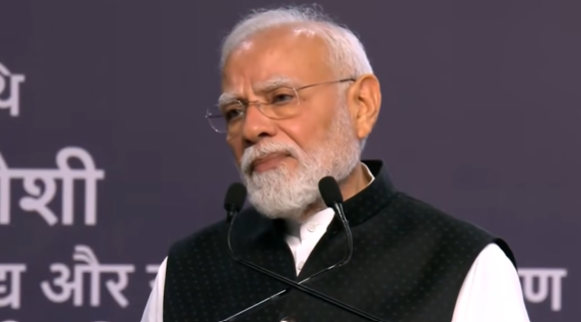
Prime Minister Narendra Modi at SRCC College spoke of Naraz Fufa. (Image video grab BJP on X)
By NIRENDRA DEV
A 2014 exchange between Narendra Modi and a Manipur student who dreamed of becoming Prime Minister offers a striking lens to examine Modi’s political journey, India’s economy and the challenges ahead of 2027.
New Delhi, September 6, 2026 — September 5, 2014, was Narendra Modi’s first Teachers’ Day as Prime Minister. On that occasion, during a televised interaction with students, a young student from Manipur asked Modi what she should do if she wanted to become the Prime Minister of India.
Modi’s response was revealing — and, with the benefit of hindsight, rather interesting. “Start preparing for the 2024 polls,” Modi told her, adding that this meant he had no immediate threat to his position.
He also told the student, in the presence of his first Human Resource Development Minister, Smriti Irani: “In a democracy anyone who wins the confidence of public can become PM. My wishes are with you.”
Twelve years later, both Manipur and Narendra Modi have remained firmly in the headlines.
Manipur is heading towards another crucial electoral contest, while Modi has already crossed the 2024 electoral hurdle and continues to dominate national politics. His next major political challenge will come not in Manipur but in Uttar Pradesh, where the electoral battle in 2027 will carry enormous significance.
The larger question is: how much has Modi changed in these 12 years, and how much has Modi changed India during his tenure as Prime Minister?
One can, of course, ask Rahul Gandhi and the broader anti-Modi ecosystem. Their answer would predictably be that the Indian economy is either dead or heading towards disaster.
Some television anchors, too, seem to have difficulty accepting the political reality that Modi has been Prime Minister since 2014.
So, let us move beyond the familiar political rhetoric.
From Gujarat to Delhi: Modi’s political journey
There is another interesting episode from September 2013.
On September 5, 2013, when Modi was still Gujarat chief minister, he had said: “I never see such dreams (of becoming Prime Minister), nor am I going to see such dreams. People of Gujarat have given me the mandate to serve them till 2017 and I have to do this with full strength.”
Many interpreted the statement as a temporary withdrawal from the race — or at least as a political gesture.
There was also an obvious element of political calculation. Modi could maintain a “win-win” position.
A week later, on September 13, 2013, the BJP formally named Modi as its prime ministerial candidate, with party president Rajnath Singh making the announcement.
Had he not been named, Modi could perhaps have continued saying that he had never been particularly keen on becoming Prime Minister.
History, however, took a different course.
“Politics is not a profession, it is a service”
Returning to the Teachers’ Day programme of September 5, 2014, Modi spoke extensively about public life, ambition and service.
“If I had to gain things, I would not come (join politics),” he said, stressing that everything could not be reduced to labh, or personal profit.
“Work without any ‘labh’ and the joy is different,” Modi said.
He urged students to read biographies of great people and extraordinary achievers.
He also spoke about the scale of the responsibility he carried as Prime Minister, saying that the country’s 125 crore people were his family and therefore he did not feel stressed.
His broader message was equally clear: “Politics is not a profession, it is a service.”
Twelve years later, those statements invite a natural question: how has that philosophy translated into governance?
India’s 7.8% GDP Growth: Government’s Case, Garg’s Argument and the Numbers Explained
From diplomacy to the India-China-US triangle
India’s foreign policy offers another lens through which Modi’s tenure can be examined.
In 2025, The Guardian published an editorial arguing that the geopolitical centre of gravity appeared to be shifting towards China-led forums, particularly the Shanghai Cooperation Organisation.
The editorial observed that “it is in Tianjin, not Washington, where it looks as if the hinge of history is moving.”
The argument was significant because the SCO itself remains a complicated grouping. India and Pakistan remain adversaries, while India and China continue to face a heavily militarised Himalayan frontier.
Yet India has increasingly sought to protect its strategic space rather than align itself completely with any one power centre.
The recent SCO diplomacy has again highlighted this balancing act, with Modi engaging with Chinese President Xi Jinping even as India-US relations have faced their own strains.
For Washington, this has not always been comfortable.
For New Delhi, however, the calculation appears straightforward: India’s strategic autonomy comes before the comfort of any external power.
The economic question: Is growth reaching ordinary Indians?
The debate now moves to the economy.
The World Economic Forum has pointed to a structural shift in India’s middle-class consumption story. One important projection is that 93% of urban consumer growth could come from outside the country’s five largest metropolitan centres — Mumbai, Bengaluru, New Delhi, Kolkata and Chennai.
Nearly 500 “consumer cities” could emerge.
If that projection materialises, it would represent a major structural change in India’s consumption economy, with rising incomes, expanding aspirations and a broader middle-class consumer base beyond the traditional metropolitan centres.
This is where the government’s economic policy approach needs to be examined more carefully.
India’s growth story cannot be judged only by headline GDP numbers. Nor can it be dismissed simply through political rhetoric.
The real question is whether the growth is translating into jobs, incomes, opportunities and improved living standards for ordinary Indians.
Mecca Pact vs IMEC: Is America Building a New Front to Counter China?
Oil shock and the politics of economic management
Consider another sensitive issue: crude oil.
When international crude benchmarks surged above $100 and, at times, towards $113 per barrel amid disruptions around the Strait of Hormuz, India faced the familiar problem of an external oil shock.
Yet the entire shock did not immediately translate into an equivalent rise at the neighbourhood petrol pump.
That was not accidental.
India had built several buffers and policy mechanisms to contain the impact.
These included a rapid diversification of crude suppliers, changes in fuel taxation, absorption of part of the higher costs by oil marketing companies and restrictions or adjustments affecting fuel exports.
In other words, this was economic management.
Whether one agrees with every component of the strategy is another matter. But simply pretending that the government had no role in cushioning consumers from a global oil shock would also amount to an incomplete reading of the situation.
This is where much of the political debate becomes unnecessarily simplistic.
The unfinished economic questions
Yet there is an equally important counterpoint.
Even as India continues to grow despite global headwinds, are Indians actually feeling that growth?
That question cannot be dismissed.
Issues such as unemployment, quality of employment, opportunities for young people, the condition of the unorganised sector and the widening differences between organised and informal economic activity require closer examination.
The economic challenges of 2026 also deserve a serious assessment. How effectively have policymakers managed external shocks? How sustainable is the current growth trajectory? And, most importantly, how widely is the benefit of growth being distributed?
These are legitimate questions — and they should not automatically be dismissed as anti-government arguments.
India is a classic country where we often specialise in comparing apples with oranges.
GDP growth is not the same thing as household prosperity.
Stock-market performance is not the same thing as job creation.
Urban consumption is not the same thing as rural purchasing power.
And political popularity is not necessarily a substitute for economic satisfaction.
From that Manipur student to 2027
Perhaps that is what makes the September 5, 2014 interaction worth revisiting.
A young student from Manipur asked Narendra Modi how she could become Prime Minister.
He told her to prepare for the 2024 elections.
The joke, the political message and the confidence were all packed into that response.
Twelve years later, 2024 has come and gone. Modi remains Prime Minister. The student’s question has acquired a different meaning. And India is moving towards another round of crucial state elections, including Manipur and Uttar Pradesh.
The real test now is not merely whether Modi can continue winning elections.
It is whether the political confidence displayed in 2014 can continue to be matched by economic delivery, strategic autonomy and an India-wide sense that growth is improving the lives of ordinary citizens.
That, ultimately, may prove to be the more consequential question of Modi’s third-term era.
PM Modi at SRCC: From 2013 ‘Half-Full Glass’ to India’s Growth Story
Follow The Raisina Hills on WhatsApp, Instagram, YouTube, Facebook, and LinkedIn




About The Author