India’s 7.8% GDP Growth: Government’s Case, Garg’s Argument and the Numbers Explained
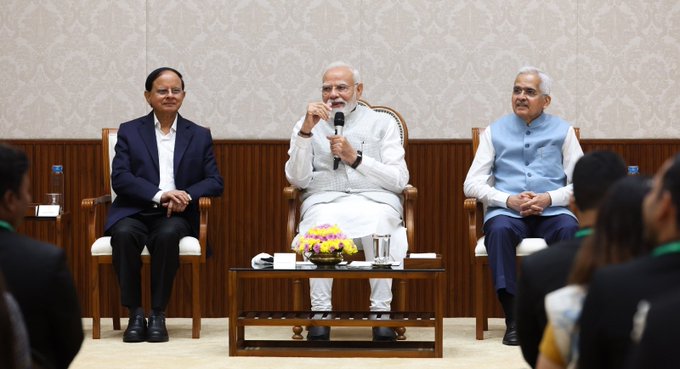
Prime Minister Narendra Modi with principal secretary in the PMO PK Mishra (Image Modi on X)
By R. NARAYANAN
The debate over India’s latest GDP data is not simply about 7.8% growth. It centres on the shift from the 2011-12 to 2022-23 base year, the sharp revision in comparable nominal GDP and the need for greater transparency over methodology.
New Delhi, September 5, 2026 — Recently, Ministry of statistics and program implementation has released the country’s economic output data for first quarter covering April, May, and June of current financial year, i.e. Financial Year 2027. Official data for first quarter showed that out real GDP is 7.8% and nominal GDP is 10.3%. Real GDP is the nominal GDP adjusted to inflation.
In the meanwhile, in February 2027, the base year was revised from 2011-12 to 2022-23. Normally, base year would be revised every five years but this time, the base year was revised to 2022-23 after an undue delay which invited lot of criticism from economists.
For making a meaningful analysis of both the growth data, we should have the data of first quarter GDP under new series of Financial Year 2026 and financial year 2027 for both nominal and real GDP. Similarly we should also have first quarter GDP data in old series for financial year 2026 and 2027 in both nominal and real GDP.
Nevertheless, the very crucial point is that there is no old 2011-12 series data for first quarter of financial year 2027 GDP since the old 2011-12 series was superseded when the base year was changed to 2022-23.
Therefore, what we have is for first quarter for financial year 26 in both series but first quarter of financial year 27 is available only for new series.
Now, let us see the data of first quarter of financial year 2026, i.e, April, May and June of 2025 in old series (11-12) and new series (22-23).
| Sr.No. | GDP | Old Series (11-12) | New Series (22-23) |
| 1. | Real GDP | 47.89 Lakh Crores | 75.46 lakh crore |
| 2. | Nominal | 86.05 Lakh Crores | 80 Lakh Crores. |
Therefore, under latest 22-23 series, the first quarter of FY26 was 75.46 Lakh Crore Real GDP and 80 Lakh Crores Nominal GDP.
It may be seen that nominal GDP for Q1 of FY26 was revised downward from 86.05 Lakh Crore in old series to 80 Lakh crore, by New series. The reduction was roughly around 7%. How this retrospective reduction to the extent of 6.05 Lakh crore happened.
It also implies that the country’s economic performance during FY26 was not as good as it was projected.
Now, let us see the data of Q1 of FY27 in New series, i.e April, May and June 2026.
New series (22-23)
Real GDP – 81.36 Lakh Crore
Nominal GDP – 88.27 Lakh Crore
So, real GDP grew from 75.46 Lakh Crore to 81.36 Lakh Crore, i.e. that is 7.8%. At the same time, nominal GDP grew from 80 Lakh Crore to 88.27, i.e. 10.3%.
The bone of contention is that the government had earlier said that FY26, nominal GDP was 86.05 Crore and now on the basis of base year 22-23 New series, the nominal GDP was 88.27 lakh Crore and the actual growth was only 2.6 percent and not 10.3%. In fact, if nominal GDP growth of 2.6% percent is adjusted to inflation, the real GDP would further go down to negative territory.
Now, what is the takeaway? The government tried to show underperformance in last year’s economic parameters to project a better economic performance in the current FY. This is the views of the former finance secretary Mr. Garg. He is not completely wrong nor completely right.
Firstly, we cannot take 86.05 Lac Crore from the old series and compare with 88.27 Lac Crore from the New series since both are two different statistical parameters.
Once we changed the measuring methodology, we had to recalculate the previous year data and accordingly, we recalculated the previous year data as 80 L Crore. The result is 88.27 Lac Crore minus 80 Lac Crore = 8.27 Lac Crore, that is 8.27÷80×100 = 10.3% which is the nominal GDP. This is the argument of the government.
In other words, former finance secretary is right about the arithmetic which he put forward, because previous year GDP is 86.05 Lac Crore and current GDP is 88.27 Lac Crore and the growth is only 2.6%.
The basic principle that we should not calculate the growth rate by mixing two different GDP series. So, the right method is that new series of Q1 of FY26 is equal to 80L Crore. The new series of Q1 of FY27 is equal to 88.27L Crore.
So the growth rate is 10.3%, as the government of India claimed.
https://theraisinahills.com/india-economy-growth-2026-7-8-percent-exports-investment/
Even if the government is right and Mr. Garg is wrong, the Government cannot escape from clarifying why did comparable previous year nominal GDP came down from 86.05 L Crore to 80L crore – whether the methodological changes had any implication in calculation. Instead of generalizing the causes, can the government not say the precise changes made in the methodology, new data sources, addition of informal economic growth, new PPI, double deflector at both production and consumer point etc.
Normally any increase in the GDP should result in reduction of unemployment ratio but this has not happened in the country. Similarly there is no impact on the private sector investment or household expenditure. To sum up, Mr. Garg has identified a real and important issue, i.e., the downward revision of previous year nominal GDP is substantial.
However, this 2.6% growth cannot be described as the actual GDP growth rate. This is because it resulted from combining the old series and new series numbers.
At the same time, the Govt. cannot close the issue by simply saying that it is because of different series. It has to explain convincingly why the previous year number was moved from 86.05L Crore to 80L Crore and how and why the new deflator/methodology produced the reported real growth rate of 7.8% and nominal growth rate of 10.3%.
Base Year is not being revised for the first time. After independence, this is the ninth time it is revised. Base year 1948 – 1949 was introduced in 1956, 1960-61 was introduced in 1967, 1970-71 was introduced in 1978, 1980-81, introduced in 1988, 1993-94 introduced in 1999, 1999-2000 introduced in 2006, 2004-05 was introduced in 2010, 2011-12 was introduced in 2015 and 2022-23 has been introduced in Feb 2026. So this is nothing new to the country. Then why this much controversy and criticism against the basic revision which is a normal practice in economy, not only in India but also in the world?
The main reason is that there is a widening mistrust between the Govt. and the opposition parties. Whatever the government does, it is seen with suspicion. Like efficient functioning of the parliament is the responsibility of the government, similarly it is the responsibility of the government of the day to take all the opposition together with them, at every stage. Both the opposition and the government should understand that every move of the government and parties is watched by the entire world, through electronic media.
https://theraisinahills.com/india-7-8-gdp-growth-jobs-income-consumption/
Follow The Raisina Hills on WhatsApp, Instagram, YouTube, Facebook, and LinkedIn




About The Author