‘Miracle’ in Nepal: 2 Workers Rescued Alive After 10 Days Inside Flood-Hit Tunnel
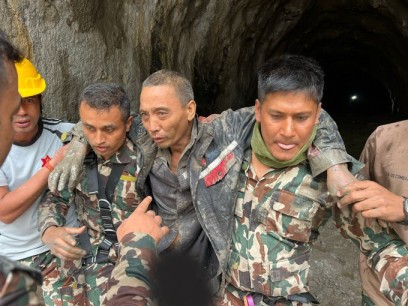
Nepal Army rescues a foreign national from a tunnel (Image Nepal Army on X)
By TRH News Desk
Two workers have been rescued alive from a hydropower project tunnel in Nepal after being trapped underground for around 10 days following the devastating flash floods along the Nepal-Tibet border, in what rescuers and relatives have described as a miracle.
New Delhi, September 5, 2026 — Two workers trapped inside a tunnel at the Trishuli hydropower project in Nepal have been rescued alive, offering a rare moment of hope after the deadly flash flooding that struck the Nepal-Tibet border region on August 26.
The dramatic rescue was described as a “miracle” by rescuers and relatives, according to Anil Giri, chief sub-editor of The Kathmandu Post, who spoke to Al Arabiya English about the latest developments.
Giri said the two workers were found alive after spending about 10 days inside the tunnel and have since been taken to a local hospital operated by the Nepal Army.
According to Giri, doctors have said the two rescued workers are in a relatively stable condition despite the prolonged period underground.
One of the workers was reported to be in good condition, while the other was suffering from hypothermia and possible effects associated with prolonged oxygen deprivation.
Despite the difficult circumstances, doctors said their vital signs were stable and their condition was being monitored.
The rescue has brought immense relief to the families of the workers, who were able to meet their relatives after days of uncertainty.
For relatives waiting outside the tunnel, the sight of the two men being brought out alive was an extraordinary moment after days of fearing the worst.
The rescue, however, has not brought the operation to an end.
Nepal Floods Were Bigger Than First Thought: Avalanche Estimate Revised to 150 Billion Litres
Giri said rescue teams, including the Nepal Army, were continuing efforts to locate and rescue other workers believed to remain trapped in hydropower project tunnels affected by the flooding.
Earlier reports had indicated that several dozen workers could still be trapped in the affected tunnel.
The scale of the disaster has complicated rescue operations, with debris, damaged infrastructure and difficult Himalayan terrain making access extremely challenging.
Giri also highlighted the potentially enormous scale of the problem.
According to his account, around 900 people were working across different hydropower projects in the affected areas when the flash floods struck.
The Nepal-Tibet border region contains a number of hydropower projects and other infrastructure sites, many located in difficult mountainous terrain.
The sudden flooding therefore created a major emergency not only for local communities but also for workers inside tunnels and construction sites.
The rescue of the two workers has raised hopes that others may also have survived inside underground sections of the affected projects.
For rescue teams, every hour remains critical.
Workers trapped underground face multiple threats, including cold temperatures, limited oxygen, lack of food and water, flooding and the possibility of further landslides or structural collapse.
The successful rescue of the two men demonstrates that survival underground remains possible even after many days—but it also underlines the urgency of continuing the search.
The Nepal Army and other rescue personnel are therefore facing a race against time as they attempt to reach those who may still be alive.
The August 26 flash floods have already caused deaths and widespread destruction along the Nepal-Tibet border. The disaster has also exposed the vulnerability of major infrastructure projects operating in one of the world’s most difficult terrains.
For the families still waiting outside the tunnels, however, the rescue of the two workers has provided something that had been in desperately short supply: hope.
As Giri put it, their survival after around 10 days underground is being viewed as nothing short of a miracle.
And in the shadow of one of Nepal’s deadliest recent flash-flood disasters, that miracle could become the reason rescuers continue digging.
Nepal Floods: Langtang Lirung Avalanche Was Far Bigger Than First Estimated, Says Geographer
Follow The Raisina Hills on WhatsApp, Instagram, YouTube, Facebook, and LinkedIn




About The Author