Amit Shah’s Uttar Pradesh Task: Tackling Modi Anti-incumbency
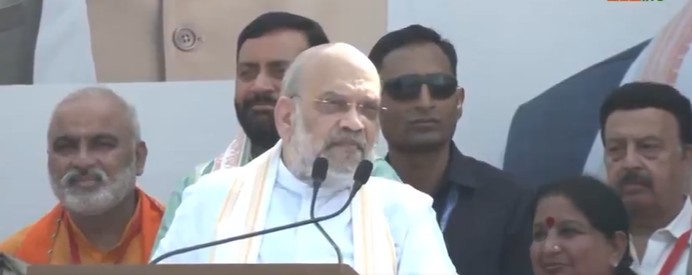
Union Minister for Home Affairs Amit Shah has begun poll preparations in UP (image BJP on X)
By MANISH ANAND
Amit Shah takes command of BJP’s UP challenge amid ground reports suggesting sharpening of anti-incumbency against Modi
New Delhi, November 10, 2026 — Union Minister for Home Affairs Amit Shah has taken guard on India’s electorally most swinging pitch, with Uttar Pradesh’s 2027 Assembly polls promising to shape national politics in definitive terms. UP Chief Minister Yogi Adityanath now is the confirmed face of the Bharatiya Janata Party (BJP) by all internal accounts. His rivalry with Shah has been widely speculated for possible succession plan in the BJP, but the plot has receded now to the backburner as party leaders admit that UP polls will not just decide the ruler of Lucknow but also New Delhi after 2029 general elections.
UP in 2014, 2019, and 2025 Lok Sabha elections presented clear political signals: a tidal wave for Modi, a welfarism model peak, and eventually a sharp voters’ rejections for collapse of the promised aspirational politics by the Prime Minister.
As 2026 walks into its winters, Shah finds a changed UP: core vote base in rupture, organisational strength stretched, and the growing anti-incumbency against Modi across the state.
“The people still are not excessively negative about Yogi. He has an advantage due to the law-and-order plank. But anti-incumbency against Modi is sweeping through UP,” said a BJP functionary in Moradabad.
The law-and-order plank had given former UP chief minister Mayawati a tag of an “Iron Lady.” But that tag also had failed to stop the Samajwadi Party from wresting power in Lucknow in 2012. Her defeat at the hands of a resurgent Akhilesh Yadav, his father Mulayam Singh Yadav still held the helm of the party then, had come on the back of agrarian distress, social base rupture, a perception of a bureaucratic governance, and the youth unrest due to unemployment.
Yogi incidentally is approaching the 2027 elections with the same set of factors which had sent Mayawati down the hills in her political career. In addition, Yogi faces an acute challenge, which also mirrors 2012 polls: a bipolar politics.
In 2012, the BJP’s supporters, as was the case in the 2007 elections, had concluded that their party has no hope of forming a government in Lucknow. So, they chose Mayawati in 2007 and a significant chunk rallied behind Akhilesh. For 2027, Mayawati’s support base is in a similar position. Unlike last two elections in the state when Mayawati’s support base tactically in substantial numbers voted for the BJP, the poll plot for 2027 suggests they are sanguine with Akhilesh, dropping the perceived social chasm of Yadav versus Jatav.
Shah’s poll micro-management banks on closing the organisational ranks, shuffling caste permutation and combinations, dropping incumbent legislators, carpet-bombing at local levels with extraordinary poll managers, and grabbing the narrative pivot.
But Shah, per BJP leaders, is also aware that all his skills have been seen in UP, and the drift away from the party of the voters is threatening to acquire the force of a tidal wave. Why: the saffron narrative has peaked and Ram Temple donation row has already turned even core supporters critical; the 2024 anger of the locals against the outside contractors (loosely called Gujaratis by locals) has gained more strength; Brahmins, the king makers in UP’s electoral politics, are miffed at Modi’s UGC social equity push and their marginalisation in the leadership roles; sweeping agrarian distress; and the youth recalling Akhilesh’s 2012 slogan of “berozgaar baap” (unemployed youth who have a family to feed).
To make Shah’s challenge more cumbersome, Modi seems to have already fired all his narrative missiles without them hitting targets. Muslims by staying tactically silent are also frustrating BJP’s polarisation pivot, as party leaders say that the pitch to invoke Ghazni and Ghori in UP aren’t resonating.
Why Modi and Shah Are Rushing Back to Their Core Political Turfs
Follow The Raisina Hills on WhatsApp, Instagram, YouTube, Facebook, and LinkedIn




About The Author