Mecca Pact vs IMEC: Is America Building a New Front to Counter China?
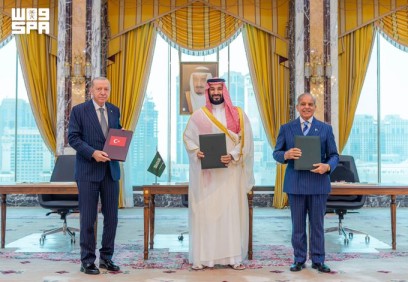
Pakistan-Saudi-Turkey Defence Pact (Image Saudi Arabia MFA)
By TRH Op-Ed Desk
Geopolitics analyst Manish Anand argues that the Pakistan-Saudi Arabia-Türkiye security pact and the India-Middle East-Europe Economic Corridor could be viewed together as part of a wider US strategy to counter China’s growing Eurasian influence.
NEW DELHI, September 5, 2026 — The recently signed Mecca Pact between Pakistan, Saudi Arabia and Türkiye could have implications extending far beyond the Islamic world, with its significance potentially becoming clearer when viewed alongside the India-Middle East-Europe Economic Corridor (IMEC), according to geopolitics analyst Manish Anand.
In a monologue for The Raisina Hills, Anand drew parallels with the dramatic US-China diplomatic opening of the early 1970s and argued that seemingly separate geopolitical developments can sometimes acquire greater significance when viewed through the lens of strategic competition.
Recalling former US Secretary of State Henry Kissinger’s secret 1971 journey to Beijing from Pakistan, Anand said the episode was followed by then-US President Richard Nixon’s historic visit to China in 1972, fundamentally changing the trajectory of US-China relations. He quoted an article published by the US-based think tank Hudson Institute, authored by Ken Moriyasu and Hamza Azhar Salam, to spotlight the American strategic goals in promoting both Mecca pact and IMEC.
Anand used the episode to underline the importance of looking beyond the immediate headlines surrounding the Mecca Pact.
The pact brings together Pakistan, Saudi Arabia and Türkiye, while IMEC links India, Israel, the UAE, Saudi Arabia, Cyprus and Greece in a proposed connectivity and economic framework.
According to Anand, examining the two arrangements together offers a different perspective on the emerging geopolitical competition between the United States and China.
“The Mecca Pact and IMEC, if seen together, can potentially be viewed as a counterbalance to China’s growing military and geopolitical capabilities,” Anand said.
Kirill Dmitriev Links Up Russia & US with Aid from Saudi Arabia
Pakistan’s strategic geography
Anand argued that Pakistan’s geographical position gives it particular importance in the Eurasian strategic equation.
Pakistan provides China with an important route towards the Arabian Sea through Gwadar, developed under the China-Pakistan Economic Corridor (CPEC), per the article.
He said China’s broader connectivity ambitions face strategic vulnerabilities because important maritime chokepoints, including the Strait of Hormuz and Strait of Malacca, remain outside Beijing’s direct control.
The Strait of Malacca is particularly important for China’s maritime trade and energy flows, while access towards the Arabian Sea gives Pakistan added significance in China’s continental-maritime connectivity strategy, Anand argued.
At the same time, he pointed to India’s growing strategic footprint in Central Asia and its expanding defence and economic relationships in the region.
Türkiye adds another layer
Türkiye’s membership of NATO, according to Anand, gives Washington another potential strategic lever in the wider Eurasian landscape.
He argued that Saudi Arabia’s relationship with Pakistan, Türkiye’s NATO membership and India’s position in IMEC create an unusually complex network of relationships in which countries with competing interests can simultaneously participate in arrangements supported or welcomed by the United States.
US President Donald Trump has welcomed and supported the Mecca Pact, Anand noted, arguing that Washington’s engagement with both India and Pakistan makes the emerging configuration particularly significant.
The result, he suggested, is not necessarily a formal anti-China alliance but a potential geopolitical balancing architecture.
India’s role in the emerging equation
Anand said India’s importance in this strategic framework stems from its expanding economic, military and diplomatic footprint.
He pointed to India’s participation in IMEC as particularly significant. The corridor, announced on the sidelines of the G20 Summit in New Delhi, envisages greater connectivity between India, the Middle East and Europe.
The inclusion of Saudi Arabia in both the Mecca Pact and IMEC, Anand argued, demonstrates how the same country can simultaneously participate in arrangements involving different strategic partners.
Similarly, Türkiye’s participation in the Mecca Pact and its NATO membership gives the country a unique position between Western and non-Western geopolitical groupings.
Anand said these overlapping relationships illustrate the increasingly complicated nature of contemporary geopolitics, where countries pursue multiple partnerships rather than aligning exclusively with one major power.
The China factor
At the centre of Anand’s analysis is the question of China’s growing influence across Eurasia and the Middle East.
He argued that Washington has a strategic interest in preventing Eurasia and the Middle East from becoming overwhelmingly dependent on Beijing.
China’s relationship with Pakistan remains central to this equation, particularly because of CPEC and Gwadar’s location on the Arabian Sea.
At the same time, China’s influence extends across Central Asia, including countries such as Kazakhstan and Azerbaijan, while Türkiye maintains its own regional influence.
India, Anand said, is also expanding its footprint in Central Asia and strengthening its strategic relationships.
“The US strategic goal is that Eurasia and the Middle East should not, at any level, be left to China,” Anand said.
In his assessment, the Mecca Pact and IMEC could therefore provide Washington with additional geopolitical leverage as it seeks to manage China’s expanding influence.
The emerging picture is consequently less about two neatly defined camps and more about overlapping strategic partnerships, economic corridors, defence arrangements and geographical chokepoints.
Anand cautioned that the significance of these developments will depend on how the participating countries translate their agreements into sustained strategic and economic cooperation.
For India, the evolving configuration presents both opportunities and challenges. Its participation in IMEC places it within an emerging connectivity architecture linking the Indian Ocean to the Middle East and Europe, while its strategic relationships with the United States, Gulf states and other regional powers give New Delhi greater room for manoeuvre.
The larger question, Anand said, is whether these overlapping arrangements ultimately become part of a wider effort to balance China’s Eurasian ambitions.
Follow The Raisina Hills on WhatsApp, Instagram, YouTube, Facebook, and LinkedIn




About The Author