Iran-Israel-US War Could Spiral Into South Asian Conflict
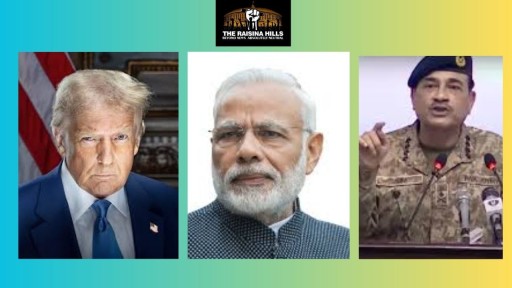
US President Donald Trump, PM Narendra Modi, Pakistani Army Chief General Asim Munir (Image credit X.com)
Geopolitics analyst Manish Anand warns of a multi-vector war scenario in South Asia as Iran strikes Saudi Arabia, Pakistan allows US use of its airbases, and the Taliban-Pakistan conflict escalates simultaneously
By TRH Op-Ed Desk
New Delhi, February 28, 2026 — As missiles rain down on Tehran and American fighter jets sustain their assault on Iranian targets, a leading Indian geopolitics analyst is sounding an alarm that has received insufficient attention in the coverage of the US-Israel war on Iran: the conflict may be moving inexorably toward India’s borders.
Manish Anand, geopolitics analyst and commentator for The Raisina Hills, has laid out a detailed and sobering scenario in which the current war transforms from a US-Israel versus Iran confrontation into a broader Shia-Sunni regional conflict — one in which Pakistan becomes a front-line actor, and South Asia is drawn into the vortex.
Iran Strikes Saudi Arabia — and Saudi Arabia Threatens to Hit Back
The trigger for Anand’s concern is Iran’s missile strikes on American military bases in Bahrain, the United Arab Emirates, Saudi Arabia, and Qatar. Crucially, he notes, Iran has also struck targets on Saudi territory.
“Saudi Arabia has threatened retaliatory action,” Anand said in his analysis for The Raisina Hills. “Saudi Arabia is a very strategic alliance partner of the United States, and Trump shares a very close personal bond with Mohammed bin Salman. Saudi Arabia’s entry into this war could transform the entire character of Middle Eastern involvement in this conflict.”
He pointed to the Abraham Accords — Trump’s first-term initiative to normalise relations between Israel and Sunni Arab nations — as an arrangement that now appears to be taking on a sharply militarised shape. The war, in his assessment, risks hardening into a Shia versus Sunni confrontation across the region.
Pakistan’s Double Exposure
At the heart of Anand’s South Asia warning lies Pakistan’s peculiar and dangerous position. Reports have indicated that American fighter jets attacking Iran have used Pakistani airbases for operations — making Pakistan, at minimum, an indirect participant in the strikes on a neighbouring country.
Pakistan is a Sunni Muslim-majority state, and crucially, it has a formal strategic defence partnership with Saudi Arabia under which an attack on Saudi Arabia is treated as an attack on Pakistan, obligating Islamabad to join Riyadh’s defence.
“Iran has struck Saudi Arabia. If Saudi Arabia enters the war on the American side, Pakistan will be compelled to participate as well,” Anand explained. “And because Pakistan’s airbases and air force installations are already being used by the United States, Pakistan automatically becomes a target for Iran.”
Iran’s missile arsenal, he stressed, is formidable. “Iran is a missile power in its own right — there is no question about this,” he said. “They have long-range missiles. They have hypersonic missiles that successfully struck the major American base in Bahrain. Pakistan’s air defence system is not strong enough. Its weaknesses have already been exposed in earlier operations.”
Pakistan Already Fighting on One Front — Now Potentially Three
What makes this scenario particularly alarming, Anand argued, is that Pakistan is not entering this potential conflict from a position of stability. It is already engaged in active hostilities with Taliban-controlled Afghanistan.
“Pakistan has carried out airforce strikes on Kabul, Kandahar, and several other areas in Afghanistan,” he said. “The Taliban, in response, has already overrun more than 75 Pakistani military posts along the border. Pakistan and Afghanistan are already in a state of war.”
A conflict with Iran would therefore open a second front — creating what Anand describes as a “multi-vector war” situation for Pakistan simultaneously facing threats from the west through Iran, from the northwest through Afghanistan and the Taliban, and from internal pressure in Balochistan, where Taliban-linked organisations are active.
“Balochistan and Pakistan-occupied Kashmir — in the coming period we could see wild and unpredictable episodes across all of these areas,” he warned. “Iran could take swift and severe retaliatory action against Pakistan.”
Trump’s Real Objective: Regime Change in Tehran
On the question of what Washington is actually seeking to achieve, Anand was unambiguous. The ongoing nuclear talks between Iran and the United States, mediated through Oman, were, in his assessment, a deliberate smokescreen.
“Geopolitical experts are saying that the negotiations with Iran were basically a smokescreen. The intention was always clear — regime change in Iran,” he said. “Just as America succeeded in engineering a regime change in Venezuela, emboldened by that success, Trump is attempting the same in Iran. The aim is to install a US-backed leadership in Tehran.”
He also connected the war to Trump’s domestic political pressures — the Supreme Court’s ruling declaring his tariffs illegal, declining approval ratings, anti-immigration controversies, and the approaching midterm elections. “Some commentators are saying that Trump has welcomed this war as a distraction,” Anand noted.
India Must Prepare
For India, Anand’s conclusion is pointed and urgent. “There is a very real concern that war could come to South Asia,” he said. “Our western border could face certain disturbances. India needs to be prepared. A very significant conflict is now visibly taking shape near India’s borders.”
How Trump’s Supreme Court Defeat Made War on Iran Inevitable
Follow The Raisina Hills on WhatsApp, Instagram, YouTube, Facebook, and LinkedIn




About The Author