PM Modi at SRCC: From 2013 ‘Half-Full Glass’ to India’s Growth Story
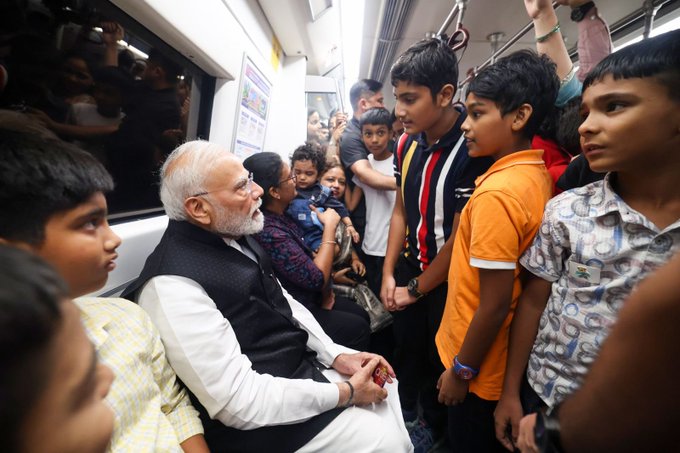
PM Modi Returns to SRCC After 13 Years: ‘Half-Full Glass’ Remark, 7.8% Growth and India’s Big Ambitions (Image Modi on X)
By TRH Political Desk
Prime Minister Narendra Modi returned to Delhi’s Shri Ram College of Commerce, recalling his 2013 address and highlighting India’s economic growth, financial inclusion, manufacturing, defence production and ambitions for a developed India.
New Delhi, September 5, 2026 — Prime Minister Narendra Modi, addressing students at Shri Ram College of Commerce (SRCC) in Delhi, looked back at his much-discussed 2013 speech at the institution and used the occasion to present what he described as India’s transformation over the past 12 years.
Modi recalled that when he addressed SRCC in 2013, he had spoken about looking at a glass as “half full” rather than “half empty”. He said that even though he was then a chief minister and a member of the principal Opposition party, he had chosen to present a positive vision rather than use the platform primarily to attack the then Central government.
Referring to the economic and political environment of 2013, Modi listed headlines of that period, including concerns over GDP growth, a high current account deficit, inflation, industrial slowdown, corruption allegations and terrorism. He contrasted that period with what he described as India’s stronger economic and security position today.
Modi highlights economic achievements
A major part of the speech focused on India’s recent economic performance. Modi pointed to 7.8% quarterly GDP growth, saying the figure demonstrated the resilience of the Indian economy despite geopolitical tensions, trade-related difficulties and the conflict in West Asia.
He also cited increases in electricity generation, vehicle sales and steel and cement consumption as indicators of consumer demand, construction, infrastructure and industrial activity. According to Modi, these trends showed that India was not only growing but also creating new employment opportunities.
Modi also highlighted financial inclusion as one of the major changes since 2014. Recalling the launch of the Pradhan Mantri Jan Dhan Yojana, he said around 60 crore new bank accounts had been opened over the past 12 years.
He described financial inclusion as a foundation for India’s fintech revolution and argued that connecting poorer households, women, migrant workers and students to formal banking had changed access to financial services.
The Prime Minister also revisited his 2013 call for “Made in India”, saying the idea had since evolved into a significant manufacturing ecosystem.
He pointed to India’s growing mobile-phone exports and defence production as examples. Modi said India, which once depended heavily on imports for mobile phones, now exports more than ₹2.5 lakh crore worth of mobile phones. He also said defence production had reached around ₹2 lakh crore, while defence exports had risen to nearly ₹40,000 crore.
‘Developed India’ as the next ambition
Looking ahead, Modi told students that India could become a global manufacturing, research and innovation hub and an agricultural export powerhouse. He also spoke of ambitions including an Indian space station and hosting an Olympics that would attract global attention.
He urged young Indians to think beyond conventional career ambitions, arguing that Indian consulting, accounting, legal and financial firms should aspire to become global leaders.
“I have trust in the country, trust in the capability of the country, and I trust you, the youth,” Modi said while outlining his vision of a developed and self-reliant India.
The speech ultimately returned to the theme of his 2013 SRCC address: Modi argued that India’s future would depend on its ability to maintain ambition, embrace innovation and pursue large national goals.
India’s 7.8% GDP Growth: Government’s Case, Garg’s Argument and the Numbers Explained
Follow The Raisina Hills on WhatsApp, Instagram, YouTube, Facebook, and LinkedIn




About The Author