Nepal Floods Were Bigger Than First Thought: Avalanche Estimate Revised to 150 Billion Litres
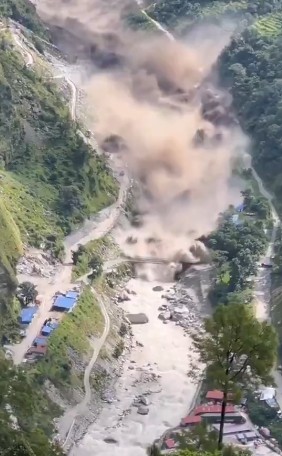
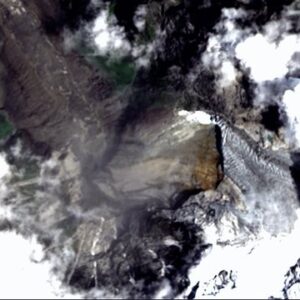
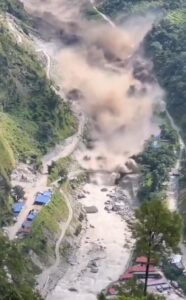
Nepal Floods: Glacier Collapse May Have Triggered Lhende-Bhotekoshi-Trishuli Debris Floods, says an expert. (Image video grab)
By TRH News Desk
Geographer Dr Vaibhav Kaul says the initial ice-rock avalanche may have been 50-60 billion litres, while the resulting debris avalanche could have exceeded 150 billion litres.
New Delhi, September 1, 2026 — The scale of the massive ice-rock avalanche that is believed to have triggered the devastating Nepal floods may have been significantly greater than initially estimated, according to the latest assessment by geographer Dr Vaibhav Kaul.
Kaul, who had earlier assessed that a shrinking and unstable glacier on the northwestern face of the Langtang Lirung massif could have supplied the ice avalanche that transformed into a devastating debris flow along the Lhende-Bhotekoshi-Trishuli river system, has now revised his estimate substantially upward.
In his latest assessment, Kaul says the avalanche did not consist only of glacial ice. It also included considerably thick masses of bedrock from underneath the collapsed chunk of glacial ice, as well as large sections of bedrock from near the glacier.
According to Kaul, the bedrock involved was high-grade metamorphic rock and appears to have been intensely fractured during the M7.8 April 2015 earthquake.
“This high-grade metamorphic bedrock must have been fractured quite intensely 11 years ago, during the M 7.8 April 2015 earthquake,” Kaul said, while sharing his latest assessment.
The observation adds an important geological dimension to the understanding of the avalanche. The material released from the mountain was not simply a mass of ice. Large quantities of fractured bedrock were also incorporated into the initial collapse, increasing its overall volume and destructive potential.
Initial Avalanche Estimate Revised Sharply Upward
Kaul has also revised his assessment of the average thickness of the collapsed ice mass.
“The average thickness of the collapsed ice mass also seems to be greater than what I had initially estimated, although I had a good idea of the thickness of the patches of dead ice downstream of the terminus of the glacier,” he said.
In his earlier assessment, Kaul had estimated that the mass of ice that collapsed from the terminal section of the glacier, together with nearby dead ice, could have been around 5 billion litres.
He had also explained that the rapidly descending ice could have entrained large quantities of rock debris and water-saturated morainic sediments, transforming the initial avalanche into a much larger and highly destructive debris flow.
The latest assessment now puts the initial ice-rock avalanche at an order of magnitude greater than his earlier estimate.
“Consequently, a more realistic estimate of the initial volume of the ice-rock avalanche would be an order of magnitude larger, say 50-60 billion litres,” Kaul said.
That estimate includes the substantially thicker collapsed ice mass as well as the considerable quantity of bedrock that was incorporated into the avalanche.
Debris Avalanche Could Have Exceeded 150 Billion Litres
But Kaul’s revised estimate of 50-60 billion litres represents only the initial ice-rock avalanche.
As the avalanche hurtled down from an altitude of about 5,000 metres towards the valley floor of the Lhende River at around 3,000 metres, it would have incorporated additional material.
Kaul says the calculation would therefore need to include the volume of sediments, water and other material added to the debris avalanche during its descent.
“The estimated total volume of the debris avalanche would then easily be more than 150 billion litres,” Kaul said.
The distinction between the initial avalanche and the final debris avalanche is critical to understanding the scale of the disaster.
The initial ice-rock avalanche is now estimated at approximately 50-60 billion litres, while the total debris avalanche, after additional material was incorporated during the descent, could have exceeded 150 billion litres.
A Wall of Water, a Wall of Silence: Inside China’s Handling of the Tibet Flood Disaster
From Glacier Collapse to Massive Debris Flow
Kaul’s latest assessment builds on his earlier reconstruction of the event.
In that assessment, he had said that a shrinking and unstable glacier, with a substantial detached terminal mass, on the northwestern face of the Langtang Lirung massif appeared to have supplied the ice avalanche that generated the devastating debris floods along the Lhende-Bhotekoshi-Trishuli river system.
He had initially estimated the ice involved at around 5 billion litres but stressed that the descending avalanche could have entrained a much larger volume of rock debris and water-saturated morainic sediments.
The latest assessment significantly expands that picture.
The collapse involved not only a larger-than-previously-estimated volume of ice but also thick masses of fractured bedrock from underneath and around the glacier. As this combined ice-rock mass descended thousands of metres, additional sediments and water were incorporated into the flow.
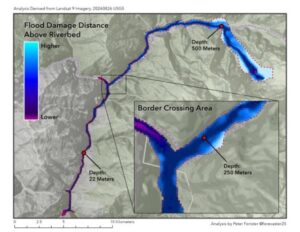
Kaul says the resulting debris avalanche ultimately transformed into a 200-metre-tall flow as it moved towards the valley floor.
The latest estimate therefore presents the August 26 disaster as a cascading process: an initial ice-rock collapse high on the mountain, followed by the incorporation of additional material during the descent and the transformation of the avalanche into an enormous debris flow.
The revised assessment also highlights the possible significance of geological damage sustained during the 2015 earthquake. According to Kaul, the high-grade metamorphic bedrock involved in the latest collapse must have been intensely fractured during that earthquake 11 years ago.
The combination of a substantially larger collapsed ice mass, fractured bedrock and the subsequent addition of water and sediments now points to a far greater initial and final volume than Kaul had estimated in his preliminary assessment.
The latest estimate is therefore clear: the initial Langtang Lirung ice-rock avalanche may have contained 50-60 billion litres of material, while the resulting debris avalanche could have exceeded 150 billion litres.
Nepal Flood Horror: 1,500-Ft Surge? New Terrain Analysis Reveals Shocking Scale
Follow The Raisina Hills on WhatsApp, Instagram, YouTube, Facebook, and LinkedIn




About The Author